

Manufacturing
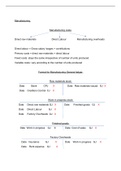
Manufacturing costs
Direct raw materials Direct Labour Manufacturing overheads
Direct labour = Gross salary /wages + contributions
Primary costs = direct raw materials + direct labour
Fixed costs: stays the same irrespective of number of units produced
Variable costs: vary according to the number of units produced
Format for Manufacturing General ledger
Raw materials stock
Date Bank CPJ X Date Raw materials issued GJ X
Date Creditors Control CJ X
Work in progress stock
Date Direct raw materials GJ X Date Finished goods GJ X
Date Direct Labour GJ X
Date Factory Overheads GJ X
Finished goods
Date Work in progress GJ X Date Cost of sales GJ X
Factory Overheads
Date Insurance GJ X Date Work in progress GJ X
Date Rent expense GJ X
, Formulas
Markup % = Gross profit ÷ cost of sales x 100
Cost of sales = 100 ÷ (100 +markup %) x sales
Sales = Markup % x cost of sales + cost of sales
GAAP and IFRS principles
GAAP= Generally accepted accounting principles
IFRS= International financial reporting standard
1. Business entity rule~ shareholders & business = separate entities
2. Historical cost~ value assets at original cost price
3. Prudence~ most conservative method of calculating profit
4. No offsetting~ no hiding
5. Going concern~ statements show no intention of liquidating business
6. Matching~ incomes and expenses must be matched in the same period
7. Materiality~ is the transaction worth recording e.g. Cents ignored
8. Consistency~ handle similar transactions in the same way
9. Accruals basis~ transactions recorded when they occur rather than when
received
10. Fair representation~ Statement portrays entity in a fair view
Ethics principles
1. Ethics~ acceptable conduct in society
2. Values
3. Morals~ rules on which society is based
4. Integrity~ be honest & sincere
5. Character
6. Laws~ regulations to express peoples needs
Good corporate governance characteristics
1. Discipline
2. Transparency
3. Independence
4. Accountability
5. Responsibility
6. Fairness
7. Social Responsibility
Manufacturing costs
Direct raw materials Direct Labour Manufacturing overheads
Direct labour = Gross salary /wages + contributions
Primary costs = direct raw materials + direct labour
Fixed costs: stays the same irrespective of number of units produced
Variable costs: vary according to the number of units produced
Format for Manufacturing General ledger
Raw materials stock
Date Bank CPJ X Date Raw materials issued GJ X
Date Creditors Control CJ X
Work in progress stock
Date Direct raw materials GJ X Date Finished goods GJ X
Date Direct Labour GJ X
Date Factory Overheads GJ X
Finished goods
Date Work in progress GJ X Date Cost of sales GJ X
Factory Overheads
Date Insurance GJ X Date Work in progress GJ X
Date Rent expense GJ X
, Formulas
Markup % = Gross profit ÷ cost of sales x 100
Cost of sales = 100 ÷ (100 +markup %) x sales
Sales = Markup % x cost of sales + cost of sales
GAAP and IFRS principles
GAAP= Generally accepted accounting principles
IFRS= International financial reporting standard
1. Business entity rule~ shareholders & business = separate entities
2. Historical cost~ value assets at original cost price
3. Prudence~ most conservative method of calculating profit
4. No offsetting~ no hiding
5. Going concern~ statements show no intention of liquidating business
6. Matching~ incomes and expenses must be matched in the same period
7. Materiality~ is the transaction worth recording e.g. Cents ignored
8. Consistency~ handle similar transactions in the same way
9. Accruals basis~ transactions recorded when they occur rather than when
received
10. Fair representation~ Statement portrays entity in a fair view
Ethics principles
1. Ethics~ acceptable conduct in society
2. Values
3. Morals~ rules on which society is based
4. Integrity~ be honest & sincere
5. Character
6. Laws~ regulations to express peoples needs
Good corporate governance characteristics
1. Discipline
2. Transparency
3. Independence
4. Accountability
5. Responsibility
6. Fairness
7. Social Responsibility


