
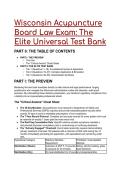
Wisconsin Acupuncture
Board Law Exam: The
Elite Universal Test Bank
PART 0: THE TABLE OF CONTENTS
● PART I: THE PREVIEW
○ The Intro
○ The "Critical Axioms" Cheat Sheet
● PART II: THE ELITE TEST BANK
○ Tier 1 (Questions 1–18): Foundational Syntax & Application
○ Tier 2 (Questions 19–37): Complex Application & Simulation
○ Tier 3 (Questions 38–55): Grandmaster Synthesis
PART I: THE PREVIEW
Mastering this test bank translates directly to elite clinical and legal performance, forging
practitioners who navigate the Wisconsin administrative codes with absolute, audit-proof
precision. By internalizing these statutory parameters, you transform regulatory compliance from
a liability into an impenetrable professional shield.
The "Critical Axioms" Cheat Sheet
● The 30-Day Mandate: All practitioners must respond to Department of Safety and
Professional Services (DSPS) inquiries and provide translated patient records within
exactly 30 days to avoid a rebuttable presumption of non-compliance.
● The 7-Year Record Protocol: Complete and accurate records for every patient visit must
be retained for exactly 7 years past the most recent visit.
● The Red Flag Consultation Rule: Specific extreme somatic symptoms mandate a
documented physician consultation prior to commencing or continuing treatment.
● The "Actively Engaged" Threshold: Out-of-state reciprocity requires demonstrating
primary treatment of at least 100 patients with a minimum of 500 visits during the 12
months immediately preceding the application, with specialized care remaining under
30%.
Operational Category Statutory Mandate / Prohibited / Unacceptable
Requirement Methods
Sterilization (Steam) Autoclave at 250º F, 15 pounds Boiling, alcohol soaking, glass
of pressure for 30 minutes. bead sterilizers.
Sterilization (Dry) Dry heat sterilization for 2 hours Any temperature/time
,Operational Category Statutory Mandate / Prohibited / Unacceptable
Requirement Methods
at 338º F. combination below 338º F / 2
hours.
Max Financial Penalty Forfeiture of $100 to $1,000 per Exceeding $1,000 per standard
violation. Ch. 451 violation.
Hand Hygiene Scrub thoroughly for ≥ 10 Rinsing without soap, scrubbing
seconds with < 10 seconds.
soap/antimicrobial.
PART II: THE ELITE TEST BANK
Tier 1 (Questions 1–18) - Foundational Syntax & Application
Q1: An applicant submits documents to the Wisconsin Department of Safety and Professional
Services (DSPS) to establish an acupuncture clinic. Based on the principles of Wisconsin
Statute 451.04, which action is the FIRST requirement before a person may use the title
"acupuncturist"? A) Registering the clinic name with the local municipal board of health. B)
Completing a supervised physical therapy residency in dry needling. C) Being formally certified
as an acupuncturist by the department. D) Passing a practical examination administered by the
county health inspector.
● Answer: C (Being formally certified as an acupuncturist by the department.)
● Distractor Analysis:
○ A is incorrect: Local municipal business registration does not grant the legal right to
use the state-protected professional title.
○ B is incorrect: A physical therapy residency does not confer Chapter 451
acupuncture certification.
○ D is incorrect: State DSPS certification, not local county health inspection, dictates
professional title use.
The Mentor's Analysis: Title protection is the bedrock of professional regulation. When facing
questions regarding professional identity, the immediate priority is securing state-level DSPS
certification. By utilizing the exact statutory language of Ch. 451.04, you bypass the common
trap of confusing local business requirements with state credentialing. Professional Intuition:
State certification via DSPS supersedes all local or tangential credentialing for title use.
Q2: A practitioner utilizes heat produced by burning dried moxa wool near the patient's skin to
restore health. Based on the principles of SPS 70.02, which conclusion is the MOST
APPROPRIATE definition of this therapy? A) Thermal stimulation B) Laserpuncture C)
Moxibustion D) Acupressure
● Answer: C (Moxibustion)
● Distractor Analysis:
○ A is incorrect: Thermal stimulation is a generic term, whereas the statute
specifically defines burning moxa wool as Moxibustion.
○ B is incorrect: Laserpuncture strictly involves the use of lasers to stimulate points.
○ D is incorrect: Acupressure is defined as the manual stimulation of points, not the
application of heat.
The Mentor's Analysis: Statutory definitions eliminate clinical ambiguity. When facing questions
on therapeutic modalities, the immediate priority is matching the intervention to its exact legal
definition. By utilizing the SPS 70.02 definitions, you bypass the common trap of using colloquial
, or generalized terminology. Professional Intuition: Moxibustion legally requires the burning
of dried moxa wool; alternative heat sources do not qualify under this specific definition.
Q3: A certified acupuncturist establishes a new clinic in a busy commercial district. Based on the
principles of Wis. Stat. 451.04(3), which action is the MANDATORY protocol regarding the
physical certificate? A) Keeping it securely filed in a locked, fireproof cabinet. B) Presenting it
only upon direct request by a DSPS investigator. C) Posting the certificate in a conspicuous
place in the place of business. D) Uploading a digital copy to the clinic's public website in lieu of
physical posting.
● Answer: C (Posting the certificate in a conspicuous place in the place of business.)
● Distractor Analysis:
○ A is incorrect: Filing the certificate violates the strict public display requirement.
○ B is incorrect: The statute requires constant, unprompted public visibility, not
conditional presentation.
○ D is incorrect: While digital display is good practice, the statute mandates posting
the physical certificate in the business location.
The Mentor's Analysis: Public trust relies on visible verification of credentials. When facing clinic
setup requirements, the immediate priority is public display of certification. By utilizing Wis. Stat.
451.04(3), you bypass the common trap of treating the certificate merely as a protected private
record. Professional Intuition: Certificates must be immediately visible to the public in the
physical workspace without request.
Q4: An applicant seeks to qualify for an initial acupuncturist certificate. Based on the principles
of SPS 71.01, which action is an ABSOLUTE prerequisite regarding national examinations? A)
Passing the Wisconsin State Board Clinical Exam. B) Passing a practical exam administered by
the local health department. C) Evidence of successful completion of the NCCAOM examination
in acupuncture. D) Submitting a portfolio of 50 successfully treated case studies.
● Answer: C (Evidence of successful completion of the NCCAOM examination in
acupuncture.)
● Distractor Analysis:
○ A is incorrect: Wisconsin utilizes the NCCAOM exam rather than an independent
state clinical exam.
○ B is incorrect: Local health departments do not administer acupuncture competency
exams.
○ D is incorrect: Case study portfolios are not a statutory substitute for the
standardized NCCAOM examination.
The Mentor's Analysis: Standardization of competency relies on national benchmarks. When
facing initial certification requirements, the immediate priority is satisfying NCCAOM standards.
By utilizing SPS 71.01 mandates, you bypass the common trap of assuming localized or
portfolio-based competency evaluations are legally sufficient. Professional Intuition: NCCAOM
certification is the non-negotiable gateway to Wisconsin DSPS certification.
Q5: A clinic updates its sterilization protocols and acquires new equipment. Based on the
principles of SPS 72.02, which conclusion is the ONLY acceptable parameter for dry heat
sterilization? A) 250º F for 30 minutes. B) 300º F for 1 hour. C) 338º F for 2 hours. D) Boiling at
212º F for 2 hours.
● Answer: C (338º F for 2 hours.)
● Distractor Analysis:
○ A is incorrect: This parameter applies exclusively to steam autoclave sterilization,
not dry heat.
○ B is incorrect: 300º F for 1 hour fails to meet the legal temperature and time
Board Law Exam: The
Elite Universal Test Bank
PART 0: THE TABLE OF CONTENTS
● PART I: THE PREVIEW
○ The Intro
○ The "Critical Axioms" Cheat Sheet
● PART II: THE ELITE TEST BANK
○ Tier 1 (Questions 1–18): Foundational Syntax & Application
○ Tier 2 (Questions 19–37): Complex Application & Simulation
○ Tier 3 (Questions 38–55): Grandmaster Synthesis
PART I: THE PREVIEW
Mastering this test bank translates directly to elite clinical and legal performance, forging
practitioners who navigate the Wisconsin administrative codes with absolute, audit-proof
precision. By internalizing these statutory parameters, you transform regulatory compliance from
a liability into an impenetrable professional shield.
The "Critical Axioms" Cheat Sheet
● The 30-Day Mandate: All practitioners must respond to Department of Safety and
Professional Services (DSPS) inquiries and provide translated patient records within
exactly 30 days to avoid a rebuttable presumption of non-compliance.
● The 7-Year Record Protocol: Complete and accurate records for every patient visit must
be retained for exactly 7 years past the most recent visit.
● The Red Flag Consultation Rule: Specific extreme somatic symptoms mandate a
documented physician consultation prior to commencing or continuing treatment.
● The "Actively Engaged" Threshold: Out-of-state reciprocity requires demonstrating
primary treatment of at least 100 patients with a minimum of 500 visits during the 12
months immediately preceding the application, with specialized care remaining under
30%.
Operational Category Statutory Mandate / Prohibited / Unacceptable
Requirement Methods
Sterilization (Steam) Autoclave at 250º F, 15 pounds Boiling, alcohol soaking, glass
of pressure for 30 minutes. bead sterilizers.
Sterilization (Dry) Dry heat sterilization for 2 hours Any temperature/time
,Operational Category Statutory Mandate / Prohibited / Unacceptable
Requirement Methods
at 338º F. combination below 338º F / 2
hours.
Max Financial Penalty Forfeiture of $100 to $1,000 per Exceeding $1,000 per standard
violation. Ch. 451 violation.
Hand Hygiene Scrub thoroughly for ≥ 10 Rinsing without soap, scrubbing
seconds with < 10 seconds.
soap/antimicrobial.
PART II: THE ELITE TEST BANK
Tier 1 (Questions 1–18) - Foundational Syntax & Application
Q1: An applicant submits documents to the Wisconsin Department of Safety and Professional
Services (DSPS) to establish an acupuncture clinic. Based on the principles of Wisconsin
Statute 451.04, which action is the FIRST requirement before a person may use the title
"acupuncturist"? A) Registering the clinic name with the local municipal board of health. B)
Completing a supervised physical therapy residency in dry needling. C) Being formally certified
as an acupuncturist by the department. D) Passing a practical examination administered by the
county health inspector.
● Answer: C (Being formally certified as an acupuncturist by the department.)
● Distractor Analysis:
○ A is incorrect: Local municipal business registration does not grant the legal right to
use the state-protected professional title.
○ B is incorrect: A physical therapy residency does not confer Chapter 451
acupuncture certification.
○ D is incorrect: State DSPS certification, not local county health inspection, dictates
professional title use.
The Mentor's Analysis: Title protection is the bedrock of professional regulation. When facing
questions regarding professional identity, the immediate priority is securing state-level DSPS
certification. By utilizing the exact statutory language of Ch. 451.04, you bypass the common
trap of confusing local business requirements with state credentialing. Professional Intuition:
State certification via DSPS supersedes all local or tangential credentialing for title use.
Q2: A practitioner utilizes heat produced by burning dried moxa wool near the patient's skin to
restore health. Based on the principles of SPS 70.02, which conclusion is the MOST
APPROPRIATE definition of this therapy? A) Thermal stimulation B) Laserpuncture C)
Moxibustion D) Acupressure
● Answer: C (Moxibustion)
● Distractor Analysis:
○ A is incorrect: Thermal stimulation is a generic term, whereas the statute
specifically defines burning moxa wool as Moxibustion.
○ B is incorrect: Laserpuncture strictly involves the use of lasers to stimulate points.
○ D is incorrect: Acupressure is defined as the manual stimulation of points, not the
application of heat.
The Mentor's Analysis: Statutory definitions eliminate clinical ambiguity. When facing questions
on therapeutic modalities, the immediate priority is matching the intervention to its exact legal
definition. By utilizing the SPS 70.02 definitions, you bypass the common trap of using colloquial
, or generalized terminology. Professional Intuition: Moxibustion legally requires the burning
of dried moxa wool; alternative heat sources do not qualify under this specific definition.
Q3: A certified acupuncturist establishes a new clinic in a busy commercial district. Based on the
principles of Wis. Stat. 451.04(3), which action is the MANDATORY protocol regarding the
physical certificate? A) Keeping it securely filed in a locked, fireproof cabinet. B) Presenting it
only upon direct request by a DSPS investigator. C) Posting the certificate in a conspicuous
place in the place of business. D) Uploading a digital copy to the clinic's public website in lieu of
physical posting.
● Answer: C (Posting the certificate in a conspicuous place in the place of business.)
● Distractor Analysis:
○ A is incorrect: Filing the certificate violates the strict public display requirement.
○ B is incorrect: The statute requires constant, unprompted public visibility, not
conditional presentation.
○ D is incorrect: While digital display is good practice, the statute mandates posting
the physical certificate in the business location.
The Mentor's Analysis: Public trust relies on visible verification of credentials. When facing clinic
setup requirements, the immediate priority is public display of certification. By utilizing Wis. Stat.
451.04(3), you bypass the common trap of treating the certificate merely as a protected private
record. Professional Intuition: Certificates must be immediately visible to the public in the
physical workspace without request.
Q4: An applicant seeks to qualify for an initial acupuncturist certificate. Based on the principles
of SPS 71.01, which action is an ABSOLUTE prerequisite regarding national examinations? A)
Passing the Wisconsin State Board Clinical Exam. B) Passing a practical exam administered by
the local health department. C) Evidence of successful completion of the NCCAOM examination
in acupuncture. D) Submitting a portfolio of 50 successfully treated case studies.
● Answer: C (Evidence of successful completion of the NCCAOM examination in
acupuncture.)
● Distractor Analysis:
○ A is incorrect: Wisconsin utilizes the NCCAOM exam rather than an independent
state clinical exam.
○ B is incorrect: Local health departments do not administer acupuncture competency
exams.
○ D is incorrect: Case study portfolios are not a statutory substitute for the
standardized NCCAOM examination.
The Mentor's Analysis: Standardization of competency relies on national benchmarks. When
facing initial certification requirements, the immediate priority is satisfying NCCAOM standards.
By utilizing SPS 71.01 mandates, you bypass the common trap of assuming localized or
portfolio-based competency evaluations are legally sufficient. Professional Intuition: NCCAOM
certification is the non-negotiable gateway to Wisconsin DSPS certification.
Q5: A clinic updates its sterilization protocols and acquires new equipment. Based on the
principles of SPS 72.02, which conclusion is the ONLY acceptable parameter for dry heat
sterilization? A) 250º F for 30 minutes. B) 300º F for 1 hour. C) 338º F for 2 hours. D) Boiling at
212º F for 2 hours.
● Answer: C (338º F for 2 hours.)
● Distractor Analysis:
○ A is incorrect: This parameter applies exclusively to steam autoclave sterilization,
not dry heat.
○ B is incorrect: 300º F for 1 hour fails to meet the legal temperature and time


