
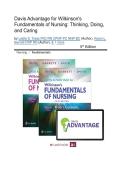
Davis Advantage for Wilkinson's
Fundamentals of Nursing: Thinking, Doing,
and Caring
by Leslie S. Treas PhD RN CPNP-PC NNP-BC (Author), Karen L.
Barnett DNP RN (Author), & 1 more
5th Edition
,TABLE OF CONTENTS
Unit 1: How Nurses Think
1. Evolution of Nursing Thought & Action
2. Clinical Judgment
3. The Steps of the Nursing Process
4. Evidence-Based Practice: Theory and Research
5. Ethics & Values
Unit 2: Factors Affecting Health
6. Life Span: Infancy Through Middle Adulthood
7. Life Span: Older Adults
8. Promoting Wellness: Health & Illness
9. Stress & Adaptation
10. Psychosocial Health & Illness
11. Promoting Family Health
12. Caring in Multicultural Healthcare Environments
13. Spirituality
14. Experiencing Loss
Unit 3: Essential Nursing Interventions
15. Communicating & Therapeutic Relationships
16. Patient Education
17. Interprofessional Partnerships: Documenting & Reporting
18. Measuring Vital Signs
19. Health Assessment
20. Promoting Asepsis & Preventing Infection
21. Promoting Safety
22. Facilitating Hygiene
23. Administering Medications
Unit 4: Supporting Physiological Function
24. Nutrition
25. Urinary Elimination
26. Bowel Elimination
27. Sensation, Perception, & Response
28. Pain
29. Physical Activity & Immobility
30. Sexual Health
31. Sleep & Rest
32. Skin Integrity & Wound Healing
33. Oxygenation
34. Circulation & Perfusion
35. Hydration & Homeostasis
36. Care of the Surgical Patient
Unit 5: Nursing Functions
37. Community & Home Health Nursing
,38. Nursing Informatics
39. Legal Accountability
40. Leading & Managing
, TEST BANK
Wilkinson's Fundamentals of Nursing, 5th Edition (Treas, 2024)
Chapters 1–40 Multiple Choice Questions
UNIT 1: HOW NURSES THINK
CHAPTER 1: Evolution of Nursing Thought & Action
1. Florence Nightingale is most recognized for which contribution to nursing?
A) Developing the first nursing theory based on psychosocial needs
B) Establishing nursing education and emphasizing sanitary conditions
C) Creating the first nurse practice act in the United States
D) Founding the American Nurses Association
Answer: B
Rationale: Florence Nightingale is credited with establishing formal nursing education at St. Thomas'
Hospital in London and emphasizing the importance of sanitation, hygiene, and environmental factors in
patient recovery. Her work during the Crimean War demonstrated that improved sanitary conditions
dramatically reduced mortality. Option A is incorrect because Nightingale's focus was on environmental
theory, not psychosocial needs. Option C is incorrect because nurse practice acts were legislative
developments not attributed to Nightingale. Option D is incorrect because the ANA was founded by a
group of nurses in 1896.
Cognitive Level: Remembering
Client Need: Safe and Effective Care Environment
Nursing Process: N/A
QSEN Competency: Evidence-Based Practice
2. Which historical development most directly led to the establishment of professional standards for
nursing practice?
A) The creation of diploma nursing programs in hospitals
B) The development and adoption of nurse practice acts by states
C) Florence Nightingale's environmental theory
D) The establishment of the Cadet Nurse Corps during World War II
Fundamentals of Nursing: Thinking, Doing,
and Caring
by Leslie S. Treas PhD RN CPNP-PC NNP-BC (Author), Karen L.
Barnett DNP RN (Author), & 1 more
5th Edition
,TABLE OF CONTENTS
Unit 1: How Nurses Think
1. Evolution of Nursing Thought & Action
2. Clinical Judgment
3. The Steps of the Nursing Process
4. Evidence-Based Practice: Theory and Research
5. Ethics & Values
Unit 2: Factors Affecting Health
6. Life Span: Infancy Through Middle Adulthood
7. Life Span: Older Adults
8. Promoting Wellness: Health & Illness
9. Stress & Adaptation
10. Psychosocial Health & Illness
11. Promoting Family Health
12. Caring in Multicultural Healthcare Environments
13. Spirituality
14. Experiencing Loss
Unit 3: Essential Nursing Interventions
15. Communicating & Therapeutic Relationships
16. Patient Education
17. Interprofessional Partnerships: Documenting & Reporting
18. Measuring Vital Signs
19. Health Assessment
20. Promoting Asepsis & Preventing Infection
21. Promoting Safety
22. Facilitating Hygiene
23. Administering Medications
Unit 4: Supporting Physiological Function
24. Nutrition
25. Urinary Elimination
26. Bowel Elimination
27. Sensation, Perception, & Response
28. Pain
29. Physical Activity & Immobility
30. Sexual Health
31. Sleep & Rest
32. Skin Integrity & Wound Healing
33. Oxygenation
34. Circulation & Perfusion
35. Hydration & Homeostasis
36. Care of the Surgical Patient
Unit 5: Nursing Functions
37. Community & Home Health Nursing
,38. Nursing Informatics
39. Legal Accountability
40. Leading & Managing
, TEST BANK
Wilkinson's Fundamentals of Nursing, 5th Edition (Treas, 2024)
Chapters 1–40 Multiple Choice Questions
UNIT 1: HOW NURSES THINK
CHAPTER 1: Evolution of Nursing Thought & Action
1. Florence Nightingale is most recognized for which contribution to nursing?
A) Developing the first nursing theory based on psychosocial needs
B) Establishing nursing education and emphasizing sanitary conditions
C) Creating the first nurse practice act in the United States
D) Founding the American Nurses Association
Answer: B
Rationale: Florence Nightingale is credited with establishing formal nursing education at St. Thomas'
Hospital in London and emphasizing the importance of sanitation, hygiene, and environmental factors in
patient recovery. Her work during the Crimean War demonstrated that improved sanitary conditions
dramatically reduced mortality. Option A is incorrect because Nightingale's focus was on environmental
theory, not psychosocial needs. Option C is incorrect because nurse practice acts were legislative
developments not attributed to Nightingale. Option D is incorrect because the ANA was founded by a
group of nurses in 1896.
Cognitive Level: Remembering
Client Need: Safe and Effective Care Environment
Nursing Process: N/A
QSEN Competency: Evidence-Based Practice
2. Which historical development most directly led to the establishment of professional standards for
nursing practice?
A) The creation of diploma nursing programs in hospitals
B) The development and adoption of nurse practice acts by states
C) Florence Nightingale's environmental theory
D) The establishment of the Cadet Nurse Corps during World War II


