SANJANA VINOD
THE CONGO
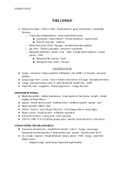
● History in Congo - 1960 to 1966 - characterised - great uncertainty + instability
because:
○ 5 days after independence - army mutinied because:
■ Lumumba - white officers - in their positions - experienced.
■ Did not raise pay - soldiers.
○ Week later (july 1960) - Katanga - seceded from the republic
○ Jan 1961 - Patrice Lumumba - tortured + murdered
○ Repeated rebellions - north + east - until - Joseph Desire Mobutu - seized
power - 1965.
■ Renamed the country - Zaire
■ During his rule - Zaire - corrupt
COLONISATION
● Congo - colonised - King Leopold II of Belgium - late 1800s + it became - personal
fiefdom.
● Long Congo river - access - ivory + rubber rich interior of Congo - desirable territory.
● Congo - personal colony of KL II - after the Berlin Conference - 1884.
● Under his rule - Congolese - brutal oppression - “Congo Horrors”.
GENOCIDE IN CONGO:
● Maximise profits - rubber plantations - trade agents in the colony - sought - steady
supply of cheap labour .
● Agents - forced men to work - holding wives + children captive - quotas - met.
● Many resisted - killed - spot.
● Others - beaten - cruel whips (chicotte) - dried hippo hide w sharp edges.
● Major revolts - brutal system - ruthlessly squashed.
● Extensive violence + repression - after uprising.
● 1895 to 1908 - 8 to 10 million people died - murder, mistreatement + starvation.
CONGO UNDER THE BELGIAN RULE:
● European missionaries - established schools + clinics - Congo - encourage
humanitarian development + objected the way - people - abused under KL II.
● As a result - exposes - brutal methods - king’s admin - 1908 - Congo - under the
Belgian state.
○ Belgian Congo - governance improved significantly.
, SANJANA VINOD
CONGO AND INDEPENDENCE
INDEPENDENCE STRUGGLES:
● 1950s - pro-independence political parties - established.
○ Got support - one particular ethnic group/region.
● Alliance des Bakongo (ABAKO) - support - Bakongo people.
● Federation Kasaienne - support - Kasai region
● The Confederation of Tribal Associations of Katanga (CONAKAT) - support - Luba
people.
● MNC - tried - transcend ethnic + regional divisions - nationwide movement.
● 1959 - political riots in Leopoldville + Stanleyville - crowds gathered - immediate
independence.
● Lumumba - arrested + imprisoned.
● Belgium - attempts to continue oppression - expensive + cost-effective - Belgian
companies - business - independent Congo.
● Jan 1960 - Lumumba - released + attended - Brussels Conference - future -
discussed.
HOW CONGO ATTAINED INDEPENDENCE:
● Belgium - little intention - granting independence to Congolese - after WW2.
○ Secretly - planning period of transition - implemented over 10 years.
● Early 1959 - caught off guard - incidents of unrest broke out - different parts -
country.
○ Not a single group/org - responsible - outbreaks
○ Congolese - venting out frustrations @ being exploited
○ Belgians responded - free elections - farce - congolese - boycotted them.
● The uprisings - led - Belgian colonists - negotiate with representatives.
○ Round table conference - Jan 1960 in Brussels - Lumumba, Joseph Kasavubu
+ Moise Tshombe - invited.
○ Historic - first time in congolese history - belgian authorities - consulted with
the Congolese - events - country.
○ Decision - new elections - held + independence - follow.
● Independence granted - 30 June 1960 - after free multi-party elections in May.
○ Lumumba - head of largest party - National Congolese Movement (MNC) - PM
in a coalition gov.
○ Rival - Kasavubu - president.
● Belgium - independence - without doing anything to prepare the Congolese - change.
● @ independence day celebrations - King Badouin of Belgium - opening address -
insulted the Congolese - response - PL - angry - ‘show what black people can do with
freedom + Congo - shining example for the whole of africa.
THE CONGO
● History in Congo - 1960 to 1966 - characterised - great uncertainty + instability
because:
○ 5 days after independence - army mutinied because:
■ Lumumba - white officers - in their positions - experienced.
■ Did not raise pay - soldiers.
○ Week later (july 1960) - Katanga - seceded from the republic
○ Jan 1961 - Patrice Lumumba - tortured + murdered
○ Repeated rebellions - north + east - until - Joseph Desire Mobutu - seized
power - 1965.
■ Renamed the country - Zaire
■ During his rule - Zaire - corrupt
COLONISATION
● Congo - colonised - King Leopold II of Belgium - late 1800s + it became - personal
fiefdom.
● Long Congo river - access - ivory + rubber rich interior of Congo - desirable territory.
● Congo - personal colony of KL II - after the Berlin Conference - 1884.
● Under his rule - Congolese - brutal oppression - “Congo Horrors”.
GENOCIDE IN CONGO:
● Maximise profits - rubber plantations - trade agents in the colony - sought - steady
supply of cheap labour .
● Agents - forced men to work - holding wives + children captive - quotas - met.
● Many resisted - killed - spot.
● Others - beaten - cruel whips (chicotte) - dried hippo hide w sharp edges.
● Major revolts - brutal system - ruthlessly squashed.
● Extensive violence + repression - after uprising.
● 1895 to 1908 - 8 to 10 million people died - murder, mistreatement + starvation.
CONGO UNDER THE BELGIAN RULE:
● European missionaries - established schools + clinics - Congo - encourage
humanitarian development + objected the way - people - abused under KL II.
● As a result - exposes - brutal methods - king’s admin - 1908 - Congo - under the
Belgian state.
○ Belgian Congo - governance improved significantly.
, SANJANA VINOD
CONGO AND INDEPENDENCE
INDEPENDENCE STRUGGLES:
● 1950s - pro-independence political parties - established.
○ Got support - one particular ethnic group/region.
● Alliance des Bakongo (ABAKO) - support - Bakongo people.
● Federation Kasaienne - support - Kasai region
● The Confederation of Tribal Associations of Katanga (CONAKAT) - support - Luba
people.
● MNC - tried - transcend ethnic + regional divisions - nationwide movement.
● 1959 - political riots in Leopoldville + Stanleyville - crowds gathered - immediate
independence.
● Lumumba - arrested + imprisoned.
● Belgium - attempts to continue oppression - expensive + cost-effective - Belgian
companies - business - independent Congo.
● Jan 1960 - Lumumba - released + attended - Brussels Conference - future -
discussed.
HOW CONGO ATTAINED INDEPENDENCE:
● Belgium - little intention - granting independence to Congolese - after WW2.
○ Secretly - planning period of transition - implemented over 10 years.
● Early 1959 - caught off guard - incidents of unrest broke out - different parts -
country.
○ Not a single group/org - responsible - outbreaks
○ Congolese - venting out frustrations @ being exploited
○ Belgians responded - free elections - farce - congolese - boycotted them.
● The uprisings - led - Belgian colonists - negotiate with representatives.
○ Round table conference - Jan 1960 in Brussels - Lumumba, Joseph Kasavubu
+ Moise Tshombe - invited.
○ Historic - first time in congolese history - belgian authorities - consulted with
the Congolese - events - country.
○ Decision - new elections - held + independence - follow.
● Independence granted - 30 June 1960 - after free multi-party elections in May.
○ Lumumba - head of largest party - National Congolese Movement (MNC) - PM
in a coalition gov.
○ Rival - Kasavubu - president.
● Belgium - independence - without doing anything to prepare the Congolese - change.
● @ independence day celebrations - King Badouin of Belgium - opening address -
insulted the Congolese - response - PL - angry - ‘show what black people can do with
freedom + Congo - shining example for the whole of africa.