
A+ VERIFIED
PHARMACY TECHNICIAN CERTIFICATION · OBJECTIVE ASSESSMENT
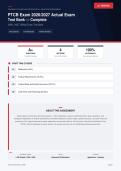
PTCB Exam 2026/2027 Actual Exam
Test Bank — Complete
Official Exam Test Bank
90 Questions Full Rationales Verified Answers
A+ 4 100%
QUESTIONS SECTIONS RATIONALES
Complete coverage Core exam domains Every answer explained
WHAT THIS COVERS
01 Medications (35%)
02 Federal Requirements (18.75%)
03 Patient Safety and Quality Assurance (23.75%)
04 Order Entry and Processing (22.25%)
ABOUT THIS ASSESSMENT
Build mastery in pharmacy technician practice — from medications, generic and brand names, drug interactions, and
therapeutic duplications to federal requirements, controlled substances, patient safety, quality assurance, and order entry and
processing. This original study bank targets application and analysis skills for the Pharmacy Technician Certification Exam
(PTCE), with full rationales for every answer. For review use only; not an institutional proctored assessment.
PASSING SCORE LEVEL FORMAT
1,400 Scaled (1,000–1,600) Advanced (Certification) Application / Analysis
STUVIA ACTUAL EXAM Page 1
, SECTION 1: Medications
Q1. A 62-year-old patient with type 2 diabetes picks up a new prescription for glipizide. The pharmacist asks the technician to verify
the patient's current medications before dispensing. The patient is already taking metformin and a beta-blocker. Which therapeutic
concern is most relevant when reviewing this combination?
A. Metformin and glipizide create a therapeutic duplication that must be rejected.
B. Beta-blockers reduce the absorption of sulfonylureas and require dose adjustment.
C. Glipizide may mask hypoglycemia symptoms when combined with a beta-blocker.
D. Glipizide is contraindicated in all patients over 60 years of age.
Correct Answer: C
Rationale:
Sulfonylureas such as glipizide stimulate insulin release and can cause hypoglycemia. Beta-blockers may mask the adrenergic warning
signs of hypoglycemia, making the combination clinically significant. Metformin and glipizide are often used together intentionally, so
therapeutic duplication is not automatic grounds for rejection.
Q2. While organizing the refrigerated medication shelf, a technician notices a bottle of insulin glargine that has been stored at room
temperature for 48 hours according to the temperature log. The package insert states the product is stable for 28 days at room
temperature after first use. What is the most appropriate next action?
A. Discard the vial because any temperature excursion voids stability data.
B. Continue using the vial and update the beyond-use date based on the first-use date.
C. Return the vial to refrigeration and extend the expiration by 14 days.
D. Quarantine the vial and notify the pharmacist for stability evaluation.
Correct Answer: B
Rationale:
Many insulin products, including insulin glargine, remain stable for a defined period at controlled room temperature once in use. The
technician should continue use within the manufacturer’s room-temperature window and document the new beyond-use date. Discarding
solely for a short, permitted excursion is unnecessary.
Q3. A patient presents a prescription for warfarin 5 mg daily. The technician reviewing the profile notes the patient also takes an
over-the-counter fish oil supplement and a multivitamin containing vitamin K. Which interaction requires the most careful counseling
by the pharmacist?
A. Vitamin K in the multivitamin will completely negate warfarin’s effect.
B. Fish oil reduces warfarin absorption and requires an increased dose.
C. Fish oil may potentiate bleeding risk when combined with warfarin.
D. Multivitamins are contraindicated with all anticoagulants.
Correct Answer: C
Rationale:
Omega-3 fatty acids in fish oil can increase bleeding tendency and may potentiate warfarin’s anticoagulant effect. Consistent vitamin K
intake is important, but typical multivitamin amounts rarely abolish warfarin activity. The pharmacist should counsel on bleeding signs and
consistent intake.
Q4. A prescription is written for atorvastatin 40 mg at bedtime. The patient reports taking gemfibrozil for high triglycerides. What is
the primary safety concern the technician should flag for pharmacist review?
A. Gemfibrozil completely blocks atorvastatin absorption.
B. Atorvastatin is contraindicated with any fibric acid derivative.
C. Increased risk of myopathy and rhabdomyolysis with the combination.
D. The combination causes severe hyperkalemia.
Correct Answer: C
Rationale:
Concurrent use of gemfibrozil and HMG-CoA reductase inhibitors significantly elevates the risk of muscle toxicity, including rhabdomyolysis.
Pharmacist review is required; alternative lipid-lowering strategies or close monitoring may be needed. Hyperkalemia is not the primary
concern with this pair.
STUVIA ACTUAL EXAM · Page 2
, SECTION 1: Medications
Q5. A community pharmacy receives a prescription for levothyroxine 75 mcg daily. The patient asks whether the medication can be
taken with breakfast along with calcium carbonate. Which counseling point is most accurate?
A. Calcium carbonate can decrease levothyroxine absorption; separate administration by at least 4 hours.
B. Levothyroxine must always be taken with food to improve bioavailability.
C. Calcium has no clinically significant interaction with thyroid hormone.
D. The dose should be doubled if taken with calcium.
Correct Answer: A
Rationale:
Divalent cations such as calcium can bind levothyroxine in the gut and reduce absorption. Standard counseling is to take levothyroxine on
an empty stomach and separate calcium or iron supplements by several hours. Taking with food generally decreases absorption rather than
improving it.
Q6. A technician is asked to identify the classification of metoprolol succinate. The patient has a history of heart failure and
hypertension. Which statement best describes this medication?
A. It is a non-selective beta blocker primarily used for anxiety.
B. It is an ACE inhibitor indicated only for diabetic nephropathy.
C. It is a selective beta-1 blocker commonly used for hypertension and heart failure.
D. It is a calcium-channel blocker used for rate control in atrial fibrillation.
Correct Answer: C
Rationale:
Metoprolol succinate is a cardioselective beta-1 adrenergic antagonist indicated for hypertension, angina, and heart-failure management. It
is not an ACE inhibitor or calcium-channel blocker. Non-selective beta blockers include propranolol and others with broader receptor
activity.
Q7. During inventory, a technician finds a bottle of nitroglycerin sublingual tablets that has been stored in a clear plastic vial on a
dispensing shelf exposed to fluorescent light. What is the most appropriate action?
A. Leave the tablets in the clear vial because light does not affect nitroglycerin.
B. Discard the entire bottle because any light exposure renders the product inactive.
C. Store the clear vial in the refrigerator to preserve potency.
D. Transfer the tablets to the original amber glass container and protect from light and moisture.
Correct Answer: D
Rationale:
Nitroglycerin sublingual tablets are sensitive to light, moisture, and heat. They should be kept in the original amber glass container tightly
closed. Transferring back to proper packaging and counseling the patient on storage is the correct response; refrigeration is not required.
Q8. A patient is prescribed clopidogrel after a recent stent placement. The profile shows the patient also takes omeprazole for
GERD. Why should this combination be reviewed by the pharmacist?
A. Clopidogrel increases the risk of gastric ulcers when taken with PPIs.
B. Omeprazole is contraindicated within 30 days of stent placement.
C. Omeprazole may reduce the activation of clopidogrel via CYP2C19 inhibition.
D. The combination causes clinically significant QT prolongation.
Correct Answer: C
Rationale:
Clopidogrel is a prodrug activated largely by CYP2C19. Omeprazole is a moderate CYP2C19 inhibitor and may diminish the antiplatelet
effect of clopidogrel. Alternative acid-suppression strategies are often preferred after coronary stenting.
STUVIA ACTUAL EXAM · Page 3
PHARMACY TECHNICIAN CERTIFICATION · OBJECTIVE ASSESSMENT
PTCB Exam 2026/2027 Actual Exam
Test Bank — Complete
Official Exam Test Bank
90 Questions Full Rationales Verified Answers
A+ 4 100%
QUESTIONS SECTIONS RATIONALES
Complete coverage Core exam domains Every answer explained
WHAT THIS COVERS
01 Medications (35%)
02 Federal Requirements (18.75%)
03 Patient Safety and Quality Assurance (23.75%)
04 Order Entry and Processing (22.25%)
ABOUT THIS ASSESSMENT
Build mastery in pharmacy technician practice — from medications, generic and brand names, drug interactions, and
therapeutic duplications to federal requirements, controlled substances, patient safety, quality assurance, and order entry and
processing. This original study bank targets application and analysis skills for the Pharmacy Technician Certification Exam
(PTCE), with full rationales for every answer. For review use only; not an institutional proctored assessment.
PASSING SCORE LEVEL FORMAT
1,400 Scaled (1,000–1,600) Advanced (Certification) Application / Analysis
STUVIA ACTUAL EXAM Page 1
, SECTION 1: Medications
Q1. A 62-year-old patient with type 2 diabetes picks up a new prescription for glipizide. The pharmacist asks the technician to verify
the patient's current medications before dispensing. The patient is already taking metformin and a beta-blocker. Which therapeutic
concern is most relevant when reviewing this combination?
A. Metformin and glipizide create a therapeutic duplication that must be rejected.
B. Beta-blockers reduce the absorption of sulfonylureas and require dose adjustment.
C. Glipizide may mask hypoglycemia symptoms when combined with a beta-blocker.
D. Glipizide is contraindicated in all patients over 60 years of age.
Correct Answer: C
Rationale:
Sulfonylureas such as glipizide stimulate insulin release and can cause hypoglycemia. Beta-blockers may mask the adrenergic warning
signs of hypoglycemia, making the combination clinically significant. Metformin and glipizide are often used together intentionally, so
therapeutic duplication is not automatic grounds for rejection.
Q2. While organizing the refrigerated medication shelf, a technician notices a bottle of insulin glargine that has been stored at room
temperature for 48 hours according to the temperature log. The package insert states the product is stable for 28 days at room
temperature after first use. What is the most appropriate next action?
A. Discard the vial because any temperature excursion voids stability data.
B. Continue using the vial and update the beyond-use date based on the first-use date.
C. Return the vial to refrigeration and extend the expiration by 14 days.
D. Quarantine the vial and notify the pharmacist for stability evaluation.
Correct Answer: B
Rationale:
Many insulin products, including insulin glargine, remain stable for a defined period at controlled room temperature once in use. The
technician should continue use within the manufacturer’s room-temperature window and document the new beyond-use date. Discarding
solely for a short, permitted excursion is unnecessary.
Q3. A patient presents a prescription for warfarin 5 mg daily. The technician reviewing the profile notes the patient also takes an
over-the-counter fish oil supplement and a multivitamin containing vitamin K. Which interaction requires the most careful counseling
by the pharmacist?
A. Vitamin K in the multivitamin will completely negate warfarin’s effect.
B. Fish oil reduces warfarin absorption and requires an increased dose.
C. Fish oil may potentiate bleeding risk when combined with warfarin.
D. Multivitamins are contraindicated with all anticoagulants.
Correct Answer: C
Rationale:
Omega-3 fatty acids in fish oil can increase bleeding tendency and may potentiate warfarin’s anticoagulant effect. Consistent vitamin K
intake is important, but typical multivitamin amounts rarely abolish warfarin activity. The pharmacist should counsel on bleeding signs and
consistent intake.
Q4. A prescription is written for atorvastatin 40 mg at bedtime. The patient reports taking gemfibrozil for high triglycerides. What is
the primary safety concern the technician should flag for pharmacist review?
A. Gemfibrozil completely blocks atorvastatin absorption.
B. Atorvastatin is contraindicated with any fibric acid derivative.
C. Increased risk of myopathy and rhabdomyolysis with the combination.
D. The combination causes severe hyperkalemia.
Correct Answer: C
Rationale:
Concurrent use of gemfibrozil and HMG-CoA reductase inhibitors significantly elevates the risk of muscle toxicity, including rhabdomyolysis.
Pharmacist review is required; alternative lipid-lowering strategies or close monitoring may be needed. Hyperkalemia is not the primary
concern with this pair.
STUVIA ACTUAL EXAM · Page 2
, SECTION 1: Medications
Q5. A community pharmacy receives a prescription for levothyroxine 75 mcg daily. The patient asks whether the medication can be
taken with breakfast along with calcium carbonate. Which counseling point is most accurate?
A. Calcium carbonate can decrease levothyroxine absorption; separate administration by at least 4 hours.
B. Levothyroxine must always be taken with food to improve bioavailability.
C. Calcium has no clinically significant interaction with thyroid hormone.
D. The dose should be doubled if taken with calcium.
Correct Answer: A
Rationale:
Divalent cations such as calcium can bind levothyroxine in the gut and reduce absorption. Standard counseling is to take levothyroxine on
an empty stomach and separate calcium or iron supplements by several hours. Taking with food generally decreases absorption rather than
improving it.
Q6. A technician is asked to identify the classification of metoprolol succinate. The patient has a history of heart failure and
hypertension. Which statement best describes this medication?
A. It is a non-selective beta blocker primarily used for anxiety.
B. It is an ACE inhibitor indicated only for diabetic nephropathy.
C. It is a selective beta-1 blocker commonly used for hypertension and heart failure.
D. It is a calcium-channel blocker used for rate control in atrial fibrillation.
Correct Answer: C
Rationale:
Metoprolol succinate is a cardioselective beta-1 adrenergic antagonist indicated for hypertension, angina, and heart-failure management. It
is not an ACE inhibitor or calcium-channel blocker. Non-selective beta blockers include propranolol and others with broader receptor
activity.
Q7. During inventory, a technician finds a bottle of nitroglycerin sublingual tablets that has been stored in a clear plastic vial on a
dispensing shelf exposed to fluorescent light. What is the most appropriate action?
A. Leave the tablets in the clear vial because light does not affect nitroglycerin.
B. Discard the entire bottle because any light exposure renders the product inactive.
C. Store the clear vial in the refrigerator to preserve potency.
D. Transfer the tablets to the original amber glass container and protect from light and moisture.
Correct Answer: D
Rationale:
Nitroglycerin sublingual tablets are sensitive to light, moisture, and heat. They should be kept in the original amber glass container tightly
closed. Transferring back to proper packaging and counseling the patient on storage is the correct response; refrigeration is not required.
Q8. A patient is prescribed clopidogrel after a recent stent placement. The profile shows the patient also takes omeprazole for
GERD. Why should this combination be reviewed by the pharmacist?
A. Clopidogrel increases the risk of gastric ulcers when taken with PPIs.
B. Omeprazole is contraindicated within 30 days of stent placement.
C. Omeprazole may reduce the activation of clopidogrel via CYP2C19 inhibition.
D. The combination causes clinically significant QT prolongation.
Correct Answer: C
Rationale:
Clopidogrel is a prodrug activated largely by CYP2C19. Omeprazole is a moderate CYP2C19 inhibitor and may diminish the antiplatelet
effect of clopidogrel. Alternative acid-suppression strategies are often preferred after coronary stenting.
STUVIA ACTUAL EXAM · Page 3


