
A+ VERIFIED
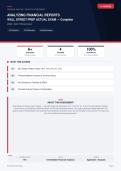
FINANCIAL ANALYSIS · OBJECTIVE ASSESSMENT
ANALYZING FINANCIAL REPORTS
WALL STREET PREP ACTUAL EXAM — Complete
Official Exam
40 Questions Full Rationales Verified Answers
A+ 4 100%
QUESTIONS SECTIONS RATIONALES
Complete coverage Core exam domains Every answer explained
WHAT THIS COVERS
01 SEC Filings & Report Types (10-K, 10-Q, 8-K, S-1, S-4)
02 Financial Statement Analysis & Common-Sizing
03 Key Disclosures, Footnotes & MD&A
04 Financial Analysis Process & Interpretation
ABOUT THIS ASSESSMENT
Build mastery in financial report analysis — from SEC filings and report types (10-K, 10-Q, 8-K, S-1, S-4) to financial statement analysis,
common-sizing, key disclosures, footnotes, MD&A, and the financial analysis process. This original study bank targets application and
analysis skills for the Wall Street Prep Analyzing Financial Reports certification exam, with full rationales for every answer. For review use
only; not an institutional proctored assessment.
PASSING SCORE LEVEL FORMAT
70% Intermediate (Financial Analysis) Application / Analysis
STUVIA ACTUAL EXAM Page 1
,SECTION 1: SEC Filings & Report Types (10-K, 10-Q, 8-K, S-1, S-4)
Q1. A mid-cap technology company filed its annual report with the SEC three weeks after the fiscal year-end. The document contains
audited financial statements, a detailed discussion of risk factors, and extensive footnotes. An equity research analyst needs to
confirm which form was used and the primary purpose of that filing relative to quarterly updates.
A. Form 10-Q, which provides unaudited interim financials and is filed within 40–45 days of quarter-end.
B. Form 10-K, which provides comprehensive audited annual financial statements and is the primary year-end disclosure vehicle.
C. Form 8-K, which reports material events as they occur and does not contain full audited statements.
D. Form S-1, which is used exclusively for initial public offerings and registration of securities.
Correct Answer: B
Rationale:
Form 10-K is the annual report that includes audited financial statements, MD&A, risk factors, and extensive footnotes. Form 10-Q is the
quarterly counterpart and is unaudited; Form 8-K covers current events; Form S-1 is a registration statement for securities offerings.
Q2. During the second quarter, a publicly traded retailer announced a material acquisition of a competitor. The company must disclose the
transaction promptly to the market. An analyst reviewing the subsequent filing notes that the document is relatively short and focuses
on the event rather than full financial statements. Which SEC form was most likely used?
A. Form 10-K, because major acquisitions require full audited restatements within the annual report.
B. Form 10-Q, because interim acquisitions are always disclosed only in quarterly filings.
C. Form S-4, which is reserved exclusively for mergers involving exchange of securities.
D. Form 8-K, which is designed for current reports of material events such as significant acquisitions.
Correct Answer: D
Rationale:
Form 8-K is the current report used to disclose material events on a near-real-time basis, including significant acquisitions. While a
subsequent 10-Q or 10-K will incorporate the transaction into financial statements, the immediate disclosure vehicle is the 8-K. Form S-4 is
used when securities are registered in connection with a business combination.
Q3. A growth-stage biotech firm is preparing to go public and must register its securities with the SEC. The registration statement will
include a prospectus describing the business, risk factors, use of proceeds, and audited financials. Which form is the standard vehicle
for this initial registration of equity securities?
A. Form 10-K, which is filed annually after the company is already public.
B. Form 8-K, which reports material events but does not register securities.
C. Form S-1, the primary registration statement for initial public offerings of equity securities.
D. Form 10-Q, which provides quarterly updates after the company has completed its IPO.
Correct Answer: C
Rationale:
Form S-1 is the standard registration statement used by companies conducting an initial public offering. It contains the prospectus and
required financial and narrative disclosures. Forms 10-K, 10-Q, and 8-K are periodic or current reports filed by companies that are already
public.
STUVIA ACTUAL EXAM · Page 2
, SECTION 1: SEC Filings & Report Types (10-K, 10-Q, 8-K, S-1, S-4)
Q4. Two public companies announce a stock-for-stock merger in which shareholders of the target will receive shares of the acquirer. The
acquirer must register the new shares being issued in the transaction. An investment banker advising on the deal identifies the correct
SEC form for this registration.
A. Form S-4, specifically designed for registration of securities issued in business combinations and exchange offers.
B. Form S-1, used only for primary equity offerings by companies that are not yet public.
C. Form 10-K, because the merger will be fully reflected in the next annual report.
D. Form 8-K, which is sufficient to both announce and register the securities issued in a merger.
Correct Answer: A
Rationale:
Form S-4 is the registration statement used when securities are issued in connection with a business combination, merger, or exchange offer.
Form S-1 is the general registration form for primary offerings, while 10-K and 8-K are reporting forms, not registration statements for newly
issued shares in a deal.
Q5. An analyst is comparing the filing deadlines and content depth of annual versus quarterly reports for a large accelerated filer. The
company has a December 31 fiscal year-end. Which statement correctly distinguishes the two primary periodic reports?
A. Both the 10-K and 10-Q contain audited financial statements and are due 60 days after period-end for large accelerated filers.
B. The 10-K contains audited annual financial statements and is due 60 days after year-end; the 10-Q contains unaudited interim
statements and is due 40 days after quarter-end for large accelerated filers.
C. The 10-Q is the more comprehensive document because it includes full risk-factor updates each quarter, while the 10-K is a
summary filing.
D. Large accelerated filers may file either a 10-K or a 10-Q for the fourth quarter; the choice depends on management preference.
Correct Answer: B
Rationale:
For large accelerated filers, the 10-K is due within 60 days of fiscal year-end and contains audited financial statements. The 10-Q is due
within 40 days of quarter-end and contains unaudited interim financial statements. The 10-K is the more comprehensive annual document;
the fourth quarter is covered within the 10-K rather than a separate 10-Q.
Q6. A company experiences a sudden change in its independent auditor. Under SEC rules, this event must be reported promptly. The
analyst reviewing the subsequent disclosure notes that the filing also includes a letter from the former auditor. Which form and content
combination is required?
A. Form 8-K under Item 4.01, disclosing the change in certifying accountant and including the former auditor’s letter regarding the
change.
B. Form 10-K only, with the auditor change disclosed in the footnotes to the audited financial statements.
C. Form 10-Q, because auditor changes are considered routine interim disclosures.
D. Form S-1, because a change in auditor requires re-registration of all outstanding securities.
Correct Answer: A
Rationale:
A change in independent auditor is a material event reported on Form 8-K under Item 4.01. The filing must include a letter from the former
accountant stating whether it agrees with the company’s disclosures. This is not deferred to the next 10-K or 10-Q.
STUVIA ACTUAL EXAM · Page 3
FINANCIAL ANALYSIS · OBJECTIVE ASSESSMENT
ANALYZING FINANCIAL REPORTS
WALL STREET PREP ACTUAL EXAM — Complete
Official Exam
40 Questions Full Rationales Verified Answers
A+ 4 100%
QUESTIONS SECTIONS RATIONALES
Complete coverage Core exam domains Every answer explained
WHAT THIS COVERS
01 SEC Filings & Report Types (10-K, 10-Q, 8-K, S-1, S-4)
02 Financial Statement Analysis & Common-Sizing
03 Key Disclosures, Footnotes & MD&A
04 Financial Analysis Process & Interpretation
ABOUT THIS ASSESSMENT
Build mastery in financial report analysis — from SEC filings and report types (10-K, 10-Q, 8-K, S-1, S-4) to financial statement analysis,
common-sizing, key disclosures, footnotes, MD&A, and the financial analysis process. This original study bank targets application and
analysis skills for the Wall Street Prep Analyzing Financial Reports certification exam, with full rationales for every answer. For review use
only; not an institutional proctored assessment.
PASSING SCORE LEVEL FORMAT
70% Intermediate (Financial Analysis) Application / Analysis
STUVIA ACTUAL EXAM Page 1
,SECTION 1: SEC Filings & Report Types (10-K, 10-Q, 8-K, S-1, S-4)
Q1. A mid-cap technology company filed its annual report with the SEC three weeks after the fiscal year-end. The document contains
audited financial statements, a detailed discussion of risk factors, and extensive footnotes. An equity research analyst needs to
confirm which form was used and the primary purpose of that filing relative to quarterly updates.
A. Form 10-Q, which provides unaudited interim financials and is filed within 40–45 days of quarter-end.
B. Form 10-K, which provides comprehensive audited annual financial statements and is the primary year-end disclosure vehicle.
C. Form 8-K, which reports material events as they occur and does not contain full audited statements.
D. Form S-1, which is used exclusively for initial public offerings and registration of securities.
Correct Answer: B
Rationale:
Form 10-K is the annual report that includes audited financial statements, MD&A, risk factors, and extensive footnotes. Form 10-Q is the
quarterly counterpart and is unaudited; Form 8-K covers current events; Form S-1 is a registration statement for securities offerings.
Q2. During the second quarter, a publicly traded retailer announced a material acquisition of a competitor. The company must disclose the
transaction promptly to the market. An analyst reviewing the subsequent filing notes that the document is relatively short and focuses
on the event rather than full financial statements. Which SEC form was most likely used?
A. Form 10-K, because major acquisitions require full audited restatements within the annual report.
B. Form 10-Q, because interim acquisitions are always disclosed only in quarterly filings.
C. Form S-4, which is reserved exclusively for mergers involving exchange of securities.
D. Form 8-K, which is designed for current reports of material events such as significant acquisitions.
Correct Answer: D
Rationale:
Form 8-K is the current report used to disclose material events on a near-real-time basis, including significant acquisitions. While a
subsequent 10-Q or 10-K will incorporate the transaction into financial statements, the immediate disclosure vehicle is the 8-K. Form S-4 is
used when securities are registered in connection with a business combination.
Q3. A growth-stage biotech firm is preparing to go public and must register its securities with the SEC. The registration statement will
include a prospectus describing the business, risk factors, use of proceeds, and audited financials. Which form is the standard vehicle
for this initial registration of equity securities?
A. Form 10-K, which is filed annually after the company is already public.
B. Form 8-K, which reports material events but does not register securities.
C. Form S-1, the primary registration statement for initial public offerings of equity securities.
D. Form 10-Q, which provides quarterly updates after the company has completed its IPO.
Correct Answer: C
Rationale:
Form S-1 is the standard registration statement used by companies conducting an initial public offering. It contains the prospectus and
required financial and narrative disclosures. Forms 10-K, 10-Q, and 8-K are periodic or current reports filed by companies that are already
public.
STUVIA ACTUAL EXAM · Page 2
, SECTION 1: SEC Filings & Report Types (10-K, 10-Q, 8-K, S-1, S-4)
Q4. Two public companies announce a stock-for-stock merger in which shareholders of the target will receive shares of the acquirer. The
acquirer must register the new shares being issued in the transaction. An investment banker advising on the deal identifies the correct
SEC form for this registration.
A. Form S-4, specifically designed for registration of securities issued in business combinations and exchange offers.
B. Form S-1, used only for primary equity offerings by companies that are not yet public.
C. Form 10-K, because the merger will be fully reflected in the next annual report.
D. Form 8-K, which is sufficient to both announce and register the securities issued in a merger.
Correct Answer: A
Rationale:
Form S-4 is the registration statement used when securities are issued in connection with a business combination, merger, or exchange offer.
Form S-1 is the general registration form for primary offerings, while 10-K and 8-K are reporting forms, not registration statements for newly
issued shares in a deal.
Q5. An analyst is comparing the filing deadlines and content depth of annual versus quarterly reports for a large accelerated filer. The
company has a December 31 fiscal year-end. Which statement correctly distinguishes the two primary periodic reports?
A. Both the 10-K and 10-Q contain audited financial statements and are due 60 days after period-end for large accelerated filers.
B. The 10-K contains audited annual financial statements and is due 60 days after year-end; the 10-Q contains unaudited interim
statements and is due 40 days after quarter-end for large accelerated filers.
C. The 10-Q is the more comprehensive document because it includes full risk-factor updates each quarter, while the 10-K is a
summary filing.
D. Large accelerated filers may file either a 10-K or a 10-Q for the fourth quarter; the choice depends on management preference.
Correct Answer: B
Rationale:
For large accelerated filers, the 10-K is due within 60 days of fiscal year-end and contains audited financial statements. The 10-Q is due
within 40 days of quarter-end and contains unaudited interim financial statements. The 10-K is the more comprehensive annual document;
the fourth quarter is covered within the 10-K rather than a separate 10-Q.
Q6. A company experiences a sudden change in its independent auditor. Under SEC rules, this event must be reported promptly. The
analyst reviewing the subsequent disclosure notes that the filing also includes a letter from the former auditor. Which form and content
combination is required?
A. Form 8-K under Item 4.01, disclosing the change in certifying accountant and including the former auditor’s letter regarding the
change.
B. Form 10-K only, with the auditor change disclosed in the footnotes to the audited financial statements.
C. Form 10-Q, because auditor changes are considered routine interim disclosures.
D. Form S-1, because a change in auditor requires re-registration of all outstanding securities.
Correct Answer: A
Rationale:
A change in independent auditor is a material event reported on Form 8-K under Item 4.01. The filing must include a letter from the former
accountant stating whether it agrees with the company’s disclosures. This is not deferred to the next 10-K or 10-Q.
STUVIA ACTUAL EXAM · Page 3


