
Test Bank – Hole’s Human Anatomy and Physiology (16th
Edition)
Chapter 1 — The Human Body: An Orientation
1. Which directional term means closer to the midline of the body?
Lateral
•
Medial
Distal
•
Superficial
•
Answer rationale: Medial means toward the body midline.
2. A sagittal plane divides the body into:
Anterior and posterior portions
•
Superior and inferior portions
•
Left and right portions
Superficial and deep portions
•
Answer rationale: Sagittal sections divide left and right.
3. Which cavity contains the lungs?
Cranial
•
Vertebral
•
Thoracic
Pelvic
•
Answer rationale: The lungs are in the thoracic cavity.
4. Which statement best describes homeostasis?
A permanent unchanging internal state
•
Maintenance of relatively stable internal conditions
Elimination of all external influences
•
Growth without regulation
•
Answer rationale: Homeostasis maintains variables within a functional range.
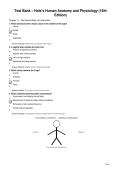
ANATOMICAL POSITION — ORIGINAL SCHEMATIC
Anterior Posterior
Feet forward; palms facing forward
Page 1
, MAJOR BODY CAVITIES — ORIGINAL SCHEMATIC
brain
cranial
heart/lungs thoracic
abdominopelvic
digestive & pelvic organs
5. Which organ is primarily located in the abdominopelvic cavity?
Brain
•
Spinal cord
•
Stomach
Heart
•
Answer rationale: The stomach is an abdominopelvic organ.
6. The term proximal means:
Farther from a point of attachment
•
Closer to a point of attachment
Toward the skin
•
Toward the back
•
Answer rationale: Proximal means nearer the point of attachment.
7. Which plane divides the body into superior and inferior portions?
Transverse
Sagittal
•
Frontal
•
Oblique
•
Answer rationale: A transverse plane separates upper and lower portions.
8. A person lying face down is in the:
Supine position
•
Prone position
Anatomical position
•
Lateral position
•
Answer rationale: Prone means face down.
9. Which level of organization immediately follows the cellular level?
Chemical
•
Tissue
Organism
•
Organ system
•
Answer rationale: Cells combine to form tissues.
10. Negative feedback usually:
Page 2
, Amplifies the original change
•
Reverses or reduces the original change
Stops all body functions
•
Acts only during disease
•
Answer rationale: Negative feedback counteracts a deviation.
Page 3
, MAJOR BODY CAVITIES — ORIGINAL SCHEMATIC
brain
cranial
heart/lungs thoracic
abdominopelvic
digestive & pelvic organs
Chapter 2 — Chemistry of Life
11. The smallest unit of an element that retains its chemical properties is a:
Molecule
•
Atom
Ion pair
•
Compound
•
Answer rationale: An atom is the basic unit of an element.
12. A bond formed by transfer of electrons is a:
Hydrogen bond
•
Peptide bond
•
Ionic bond
Nonpolar covalent bond
•
Answer rationale: Ionic bonds result from electron transfer and attraction of ions.
13. Water is an effective solvent largely because it is:
Nonpolar
•
Radioactive
•
Polar
Hydrophobic
•
Answer rationale: Water polarity allows it to dissolve many ionic and polar substances.
14. A solution with pH 3 is:
Neutral
•
Basic
•
Acidic
Always isotonic
•
Answer rationale: Lower pH indicates greater acidity.
15. Proteins are polymers built from:
Monosaccharides
•
Amino acids
Nucleotides
•
Fatty acids only
•
Page 4
Edition)
Chapter 1 — The Human Body: An Orientation
1. Which directional term means closer to the midline of the body?
Lateral
•
Medial
Distal
•
Superficial
•
Answer rationale: Medial means toward the body midline.
2. A sagittal plane divides the body into:
Anterior and posterior portions
•
Superior and inferior portions
•
Left and right portions
Superficial and deep portions
•
Answer rationale: Sagittal sections divide left and right.
3. Which cavity contains the lungs?
Cranial
•
Vertebral
•
Thoracic
Pelvic
•
Answer rationale: The lungs are in the thoracic cavity.
4. Which statement best describes homeostasis?
A permanent unchanging internal state
•
Maintenance of relatively stable internal conditions
Elimination of all external influences
•
Growth without regulation
•
Answer rationale: Homeostasis maintains variables within a functional range.
ANATOMICAL POSITION — ORIGINAL SCHEMATIC
Anterior Posterior
Feet forward; palms facing forward
Page 1
, MAJOR BODY CAVITIES — ORIGINAL SCHEMATIC
brain
cranial
heart/lungs thoracic
abdominopelvic
digestive & pelvic organs
5. Which organ is primarily located in the abdominopelvic cavity?
Brain
•
Spinal cord
•
Stomach
Heart
•
Answer rationale: The stomach is an abdominopelvic organ.
6. The term proximal means:
Farther from a point of attachment
•
Closer to a point of attachment
Toward the skin
•
Toward the back
•
Answer rationale: Proximal means nearer the point of attachment.
7. Which plane divides the body into superior and inferior portions?
Transverse
Sagittal
•
Frontal
•
Oblique
•
Answer rationale: A transverse plane separates upper and lower portions.
8. A person lying face down is in the:
Supine position
•
Prone position
Anatomical position
•
Lateral position
•
Answer rationale: Prone means face down.
9. Which level of organization immediately follows the cellular level?
Chemical
•
Tissue
Organism
•
Organ system
•
Answer rationale: Cells combine to form tissues.
10. Negative feedback usually:
Page 2
, Amplifies the original change
•
Reverses or reduces the original change
Stops all body functions
•
Acts only during disease
•
Answer rationale: Negative feedback counteracts a deviation.
Page 3
, MAJOR BODY CAVITIES — ORIGINAL SCHEMATIC
brain
cranial
heart/lungs thoracic
abdominopelvic
digestive & pelvic organs
Chapter 2 — Chemistry of Life
11. The smallest unit of an element that retains its chemical properties is a:
Molecule
•
Atom
Ion pair
•
Compound
•
Answer rationale: An atom is the basic unit of an element.
12. A bond formed by transfer of electrons is a:
Hydrogen bond
•
Peptide bond
•
Ionic bond
Nonpolar covalent bond
•
Answer rationale: Ionic bonds result from electron transfer and attraction of ions.
13. Water is an effective solvent largely because it is:
Nonpolar
•
Radioactive
•
Polar
Hydrophobic
•
Answer rationale: Water polarity allows it to dissolve many ionic and polar substances.
14. A solution with pH 3 is:
Neutral
•
Basic
•
Acidic
Always isotonic
•
Answer rationale: Lower pH indicates greater acidity.
15. Proteins are polymers built from:
Monosaccharides
•
Amino acids
Nucleotides
•
Fatty acids only
•
Page 4


