
Relias Dysrhythmia Basic A – 2024–2025 – Verified Exam
Questions and Correct Answers
250 large-print exam-style questions • Correct answers marked with a large green tick inside a box
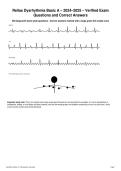
SINUS
AF
FLUTTER
Precordial lead placement (schematic)
V1 V2 V6
V3 V5
V4
Important study note: This is an original exam-style review bank focused on core dysrhythmia concepts. It is not a reproduction of
confidential, leaked, or live Relias test-bank material, and the title wording does not establish authenticity of any live exam item. Verify
current course content and clinical protocols.
Dysrhythmia Basic A • 250-question study bank Page 1
, 1. Which statement best describes normal sinus rhythm?
SINUS
■ A regular rhythm at 60–100/min with a P wave before every QRS and a consistent PR interval.
• atrial fibrillation
• ventricular fibrillation
• Mobitz II
Correct answer: A regular rhythm at 60–100/min with a P wave before every QRS and a consistent PR interval.. The correct choice is
A regular rhythm at 60–100/min with a P wave before every QRS and a consistent PR interval..
2. A patient/ECG finding is being assessed. Which finding is most consistent with normal sinus
rhythm?
• atrial fibrillation
• ventricular fibrillation
• Mobitz II
■ A regular rhythm at 60–100/min with a P wave before every QRS and a consistent PR interval.
Correct answer: A regular rhythm at 60–100/min with a P wave before every QRS and a consistent PR interval.. The correct choice is
A regular rhythm at 60–100/min with a P wave before every QRS and a consistent PR interval..
3. Which answer is correct regarding normal sinus rhythm?
• ventricular fibrillation
• Mobitz II
■ A regular rhythm at 60–100/min with a P wave before every QRS and a consistent PR interval.
• atrial fibrillation
Correct answer: A regular rhythm at 60–100/min with a P wave before every QRS and a consistent PR interval.. The correct choice is
A regular rhythm at 60–100/min with a P wave before every QRS and a consistent PR interval..
4. Which statement best describes P wave?
• QRS complex
• T wave
• ST segment
■ represents atrial depolarization
Correct answer: represents atrial depolarization. The correct choice is represents atrial depolarization.
Dysrhythmia Basic A • 250-question study bank Page 2
, 5. A patient/ECG finding is being assessed. Which finding is most consistent with P wave?
• T wave
• ST segment
■ represents atrial depolarization
• QRS complex
Correct answer: represents atrial depolarization. The correct choice is represents atrial depolarization.
6. Which answer is correct regarding P wave?
• ST segment
■ represents atrial depolarization
• QRS complex
• T wave
Correct answer: represents atrial depolarization. The correct choice is represents atrial depolarization.
7. Which statement best describes QRS complex?
• T wave
• PR interval
■ represents ventricular depolarization
• P wave
Correct answer: represents ventricular depolarization. The correct choice is represents ventricular depolarization.
8. A patient/ECG finding is being assessed. Which finding is most consistent with QRS complex?
• PR interval
■ represents ventricular depolarization
• P wave
• T wave
Correct answer: represents ventricular depolarization. The correct choice is represents ventricular depolarization.
9. Which answer is correct regarding QRS complex?
■ represents ventricular depolarization
• P wave
• T wave
• PR interval
Correct answer: represents ventricular depolarization. The correct choice is represents ventricular depolarization.
Dysrhythmia Basic A • 250-question study bank Page 3
, 10. Which statement best describes T wave?
• PR segment
■ represents ventricular repolarization
• P wave
• QRS complex
Correct answer: represents ventricular repolarization. The correct choice is represents ventricular repolarization.
11. A patient/ECG finding is being assessed. Which finding is most consistent with T wave?
■ represents ventricular repolarization
• P wave
• QRS complex
• PR segment
Correct answer: represents ventricular repolarization. The correct choice is represents ventricular repolarization.
12. Which answer is correct regarding T wave?
• P wave
• QRS complex
• PR segment
■ represents ventricular repolarization
Correct answer: represents ventricular repolarization. The correct choice is represents ventricular repolarization.
13. Which statement best describes normal PR interval?
■ 0.12–0.20 seconds
• 0.04–0.08 seconds
• 0.22–0.30 seconds
• 0.30–0.40 seconds
Correct answer: 0.12–0.20 seconds. The correct choice is 0.12–0.20 seconds.
14. A patient/ECG finding is being assessed. Which finding is most consistent with normal PR
interval?
• 0.04–0.08 seconds
• 0.22–0.30 seconds
• 0.30–0.40 seconds
■ 0.12–0.20 seconds
Correct answer: 0.12–0.20 seconds. The correct choice is 0.12–0.20 seconds.
Dysrhythmia Basic A • 250-question study bank Page 4
Questions and Correct Answers
250 large-print exam-style questions • Correct answers marked with a large green tick inside a box
SINUS
AF
FLUTTER
Precordial lead placement (schematic)
V1 V2 V6
V3 V5
V4
Important study note: This is an original exam-style review bank focused on core dysrhythmia concepts. It is not a reproduction of
confidential, leaked, or live Relias test-bank material, and the title wording does not establish authenticity of any live exam item. Verify
current course content and clinical protocols.
Dysrhythmia Basic A • 250-question study bank Page 1
, 1. Which statement best describes normal sinus rhythm?
SINUS
■ A regular rhythm at 60–100/min with a P wave before every QRS and a consistent PR interval.
• atrial fibrillation
• ventricular fibrillation
• Mobitz II
Correct answer: A regular rhythm at 60–100/min with a P wave before every QRS and a consistent PR interval.. The correct choice is
A regular rhythm at 60–100/min with a P wave before every QRS and a consistent PR interval..
2. A patient/ECG finding is being assessed. Which finding is most consistent with normal sinus
rhythm?
• atrial fibrillation
• ventricular fibrillation
• Mobitz II
■ A regular rhythm at 60–100/min with a P wave before every QRS and a consistent PR interval.
Correct answer: A regular rhythm at 60–100/min with a P wave before every QRS and a consistent PR interval.. The correct choice is
A regular rhythm at 60–100/min with a P wave before every QRS and a consistent PR interval..
3. Which answer is correct regarding normal sinus rhythm?
• ventricular fibrillation
• Mobitz II
■ A regular rhythm at 60–100/min with a P wave before every QRS and a consistent PR interval.
• atrial fibrillation
Correct answer: A regular rhythm at 60–100/min with a P wave before every QRS and a consistent PR interval.. The correct choice is
A regular rhythm at 60–100/min with a P wave before every QRS and a consistent PR interval..
4. Which statement best describes P wave?
• QRS complex
• T wave
• ST segment
■ represents atrial depolarization
Correct answer: represents atrial depolarization. The correct choice is represents atrial depolarization.
Dysrhythmia Basic A • 250-question study bank Page 2
, 5. A patient/ECG finding is being assessed. Which finding is most consistent with P wave?
• T wave
• ST segment
■ represents atrial depolarization
• QRS complex
Correct answer: represents atrial depolarization. The correct choice is represents atrial depolarization.
6. Which answer is correct regarding P wave?
• ST segment
■ represents atrial depolarization
• QRS complex
• T wave
Correct answer: represents atrial depolarization. The correct choice is represents atrial depolarization.
7. Which statement best describes QRS complex?
• T wave
• PR interval
■ represents ventricular depolarization
• P wave
Correct answer: represents ventricular depolarization. The correct choice is represents ventricular depolarization.
8. A patient/ECG finding is being assessed. Which finding is most consistent with QRS complex?
• PR interval
■ represents ventricular depolarization
• P wave
• T wave
Correct answer: represents ventricular depolarization. The correct choice is represents ventricular depolarization.
9. Which answer is correct regarding QRS complex?
■ represents ventricular depolarization
• P wave
• T wave
• PR interval
Correct answer: represents ventricular depolarization. The correct choice is represents ventricular depolarization.
Dysrhythmia Basic A • 250-question study bank Page 3
, 10. Which statement best describes T wave?
• PR segment
■ represents ventricular repolarization
• P wave
• QRS complex
Correct answer: represents ventricular repolarization. The correct choice is represents ventricular repolarization.
11. A patient/ECG finding is being assessed. Which finding is most consistent with T wave?
■ represents ventricular repolarization
• P wave
• QRS complex
• PR segment
Correct answer: represents ventricular repolarization. The correct choice is represents ventricular repolarization.
12. Which answer is correct regarding T wave?
• P wave
• QRS complex
• PR segment
■ represents ventricular repolarization
Correct answer: represents ventricular repolarization. The correct choice is represents ventricular repolarization.
13. Which statement best describes normal PR interval?
■ 0.12–0.20 seconds
• 0.04–0.08 seconds
• 0.22–0.30 seconds
• 0.30–0.40 seconds
Correct answer: 0.12–0.20 seconds. The correct choice is 0.12–0.20 seconds.
14. A patient/ECG finding is being assessed. Which finding is most consistent with normal PR
interval?
• 0.04–0.08 seconds
• 0.22–0.30 seconds
• 0.30–0.40 seconds
■ 0.12–0.20 seconds
Correct answer: 0.12–0.20 seconds. The correct choice is 0.12–0.20 seconds.
Dysrhythmia Basic A • 250-question study bank Page 4


