
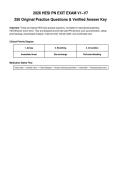
2026 HESI PN EXIT EXAM V1–V7
250 Original Practice Questions & Verified Answer Key
Important: These are original HESI-style practice questions, not leaked or reproduced proprietary
HESI/Elsevier exam items. They are designed around high-yield PN domains such as prioritization, safety,
pharmacology, physiological integrity, maternal-child, mental health, and coordinated care.
Clinical Priority Diagram
1. Airway 2. Breathing 3. Circulation
Immediate threat Gas exchange Perfusion/bleeding
Medication Safety Flow
Verify order → Identify client → Check allergies → Assess relevant parameters → Administer → Reassess/document
,1. A client receiving digoxin has an apical pulse of 54/min. What should the PN do first?
• Administer the medication with food
■ Hold the dose and report the finding
• Give half the prescribed dose
• Recheck the pulse after ambulation
Rationale: Bradycardia can indicate digoxin toxicity; the dose should be held and the finding reported.
2. Which client should the PN assess first?
• A client with chronic back pain rated 7/10
■ A client with new stridor after thyroid surgery
• A client requesting discharge teaching
• A client with a healed pressure injury
Rationale: Stridor signals possible airway obstruction and takes priority.
3. A client with diabetes is diaphoretic, shaky, and confused. Which action is priority?
• Check the urine for ketones
■ Give a rapid-acting carbohydrate if able to swallow
• Administer the scheduled long-acting insulin
• Encourage ambulation
Rationale: These are classic manifestations of hypoglycemia; give a fast carbohydrate when swallowing is safe.
4. Which finding in a client with heart failure requires immediate follow-up?
• 2+ ankle edema
• Weight gain of 0.5 kg in one week
■ Pink, frothy sputum and severe dyspnea
• Mild fatigue after walking
Rationale: Pink frothy sputum with severe dyspnea suggests acute pulmonary edema.
5. A postoperative client suddenly reports chest pain and shortness of breath. What is the priority?
• Offer oral fluids
■ Apply oxygen and seek immediate assistance
• Encourage coughing only
• Place the client flat
Rationale: Sudden chest pain and dyspnea may indicate pulmonary embolism; support oxygenation and obtain urgent help.
6. Which statement by a client using an inhaled corticosteroid indicates correct understanding?
■ I will rinse my mouth after use
• I will stop it when symptoms improve
• I will use it for immediate rescue
• I will share it with family
Rationale: Rinsing reduces the risk of oral candidiasis.
,7. A client with a new colostomy has a dusky, purple stoma. What should the PN do?
• Document it as normal
■ Report the finding promptly
• Apply ice directly
• Cover it with powder
Rationale: A healthy stoma is generally pink to red; dusky coloration can indicate impaired perfusion.
8. Which task is appropriate to delegate to trained assistive personnel for a stable client?
• Initial assessment
■ Routine vital signs
• Care-plan development
• Initial discharge teaching
Rationale: Routine vital signs for a stable client can be delegated when permitted by policy.
9. A client reports crushing substernal chest pain radiating to the jaw. Which action is priority?
• Ask the client to walk
■ Activate urgent cardiac evaluation and follow emergency protocol
• Offer a high-fat meal
• Delay assessment for one hour
Rationale: The symptoms are concerning for acute coronary syndrome and require immediate evaluation.
10. Which finding in a postpartum client should be reported immediately?
• Lochia gradually decreasing
■ Saturating a pad rapidly with bright-red blood
• Mild uterine cramping during breastfeeding
• Breast fullness on day three
Rationale: Rapid heavy bleeding may indicate postpartum hemorrhage.
11. A child with dehydration has no tears, dry mucous membranes, and decreased urine output. What
should the nurse prioritize?
■ Fluid assessment and prescribed rehydration
• Restrict all fluids
• Give a diuretic
• Encourage vigorous exercise
Rationale: These findings indicate significant fluid deficit.
12. Which communication technique is most therapeutic for an anxious client?
■ Use open-ended questions
• Tell the client not to worry
• Change the subject
• Give false reassurance
, Rationale: Open-ended questions encourage expression and assessment of concerns.
13. A client receiving furosemide should be monitored closely for which electrolyte abnormality?
• Hyperkalemia
■ Hypokalemia
• Hypernatremia only
• Hypercalcemia
Rationale: Loop diuretics can cause potassium loss.
14. A client with suspected meningitis requires which precaution initially?
■ Droplet precautions according to facility policy
• Protective isolation only
• No precautions
• Contact precautions only
Rationale: Suspected bacterial meningitis commonly requires droplet precautions initially.
15. A client with pneumonia has an increasing respiratory rate and new confusion. What is the priority
nursing action?
• Document the findings
■ Assess oxygenation and notify the RN/provider promptly
• Offer a snack
• Delay assessment until rounds
Rationale: New confusion with worsening respirations can indicate hypoxemia.
16. Which intervention best reduces infection risk when inserting an indwelling urinary catheter?
■ Use sterile technique
• Disconnect the drainage bag daily
• Keep the bag above the bladder
• Irrigate routinely without an order
Rationale: Sterile technique is essential during catheter insertion.
17. A client taking warfarin asks which food pattern is safest. Which response is best?
• Avoid all green vegetables
■ Keep vitamin K intake consistent
• Double vitamin K intake after bleeding
• Stop eating when INR rises
Rationale: Consistency of vitamin K intake helps maintain stable anticoagulation.
18. Which finding is most concerning after a blood transfusion begins?
• Mild thirst
■ Fever with chills and back pain
• Increased appetite
250 Original Practice Questions & Verified Answer Key
Important: These are original HESI-style practice questions, not leaked or reproduced proprietary
HESI/Elsevier exam items. They are designed around high-yield PN domains such as prioritization, safety,
pharmacology, physiological integrity, maternal-child, mental health, and coordinated care.
Clinical Priority Diagram
1. Airway 2. Breathing 3. Circulation
Immediate threat Gas exchange Perfusion/bleeding
Medication Safety Flow
Verify order → Identify client → Check allergies → Assess relevant parameters → Administer → Reassess/document
,1. A client receiving digoxin has an apical pulse of 54/min. What should the PN do first?
• Administer the medication with food
■ Hold the dose and report the finding
• Give half the prescribed dose
• Recheck the pulse after ambulation
Rationale: Bradycardia can indicate digoxin toxicity; the dose should be held and the finding reported.
2. Which client should the PN assess first?
• A client with chronic back pain rated 7/10
■ A client with new stridor after thyroid surgery
• A client requesting discharge teaching
• A client with a healed pressure injury
Rationale: Stridor signals possible airway obstruction and takes priority.
3. A client with diabetes is diaphoretic, shaky, and confused. Which action is priority?
• Check the urine for ketones
■ Give a rapid-acting carbohydrate if able to swallow
• Administer the scheduled long-acting insulin
• Encourage ambulation
Rationale: These are classic manifestations of hypoglycemia; give a fast carbohydrate when swallowing is safe.
4. Which finding in a client with heart failure requires immediate follow-up?
• 2+ ankle edema
• Weight gain of 0.5 kg in one week
■ Pink, frothy sputum and severe dyspnea
• Mild fatigue after walking
Rationale: Pink frothy sputum with severe dyspnea suggests acute pulmonary edema.
5. A postoperative client suddenly reports chest pain and shortness of breath. What is the priority?
• Offer oral fluids
■ Apply oxygen and seek immediate assistance
• Encourage coughing only
• Place the client flat
Rationale: Sudden chest pain and dyspnea may indicate pulmonary embolism; support oxygenation and obtain urgent help.
6. Which statement by a client using an inhaled corticosteroid indicates correct understanding?
■ I will rinse my mouth after use
• I will stop it when symptoms improve
• I will use it for immediate rescue
• I will share it with family
Rationale: Rinsing reduces the risk of oral candidiasis.
,7. A client with a new colostomy has a dusky, purple stoma. What should the PN do?
• Document it as normal
■ Report the finding promptly
• Apply ice directly
• Cover it with powder
Rationale: A healthy stoma is generally pink to red; dusky coloration can indicate impaired perfusion.
8. Which task is appropriate to delegate to trained assistive personnel for a stable client?
• Initial assessment
■ Routine vital signs
• Care-plan development
• Initial discharge teaching
Rationale: Routine vital signs for a stable client can be delegated when permitted by policy.
9. A client reports crushing substernal chest pain radiating to the jaw. Which action is priority?
• Ask the client to walk
■ Activate urgent cardiac evaluation and follow emergency protocol
• Offer a high-fat meal
• Delay assessment for one hour
Rationale: The symptoms are concerning for acute coronary syndrome and require immediate evaluation.
10. Which finding in a postpartum client should be reported immediately?
• Lochia gradually decreasing
■ Saturating a pad rapidly with bright-red blood
• Mild uterine cramping during breastfeeding
• Breast fullness on day three
Rationale: Rapid heavy bleeding may indicate postpartum hemorrhage.
11. A child with dehydration has no tears, dry mucous membranes, and decreased urine output. What
should the nurse prioritize?
■ Fluid assessment and prescribed rehydration
• Restrict all fluids
• Give a diuretic
• Encourage vigorous exercise
Rationale: These findings indicate significant fluid deficit.
12. Which communication technique is most therapeutic for an anxious client?
■ Use open-ended questions
• Tell the client not to worry
• Change the subject
• Give false reassurance
, Rationale: Open-ended questions encourage expression and assessment of concerns.
13. A client receiving furosemide should be monitored closely for which electrolyte abnormality?
• Hyperkalemia
■ Hypokalemia
• Hypernatremia only
• Hypercalcemia
Rationale: Loop diuretics can cause potassium loss.
14. A client with suspected meningitis requires which precaution initially?
■ Droplet precautions according to facility policy
• Protective isolation only
• No precautions
• Contact precautions only
Rationale: Suspected bacterial meningitis commonly requires droplet precautions initially.
15. A client with pneumonia has an increasing respiratory rate and new confusion. What is the priority
nursing action?
• Document the findings
■ Assess oxygenation and notify the RN/provider promptly
• Offer a snack
• Delay assessment until rounds
Rationale: New confusion with worsening respirations can indicate hypoxemia.
16. Which intervention best reduces infection risk when inserting an indwelling urinary catheter?
■ Use sterile technique
• Disconnect the drainage bag daily
• Keep the bag above the bladder
• Irrigate routinely without an order
Rationale: Sterile technique is essential during catheter insertion.
17. A client taking warfarin asks which food pattern is safest. Which response is best?
• Avoid all green vegetables
■ Keep vitamin K intake consistent
• Double vitamin K intake after bleeding
• Stop eating when INR rises
Rationale: Consistency of vitamin K intake helps maintain stable anticoagulation.
18. Which finding is most concerning after a blood transfusion begins?
• Mild thirst
■ Fever with chills and back pain
• Increased appetite


