
AP Biology Final Exam Review 2026
comprehensive Questions and Answers
with Verified Solutions
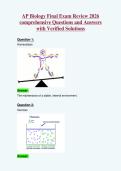
Question 1:
Homeostasis
Answer:
The maintenance of a stable, internal environment.
Question 2:
Osmosis
Answer:
,The diffusion of water.
Question 3:
Endosymbiotic Theory
Answer:
A theory about the origin of the eukaryotic cell, maintaining that the
forerunners of eukaryotic cells were symbiotic associations of prokaryotic
cells living inside larger prokaryotic cells..
Question 4:
DNA
Answer:
,Deoxyribonucleic acid (DNA) is an organic chemical that contains genetic
information and instructions for protein synthesis. It is the hereditary
material in humans and almost all other organisms.
Question 5:
Gene
Answer:
A discrete unit of hereditary information consisting of a specific nucleotide
sequence in DNA (or RNA, in some viruses) that codes for the production
of a specific protein molecule.
Question 6:
RNA
Answer:
Type of nucleic acid consisting of nucleotide monomers with a ribose
sugar and nitrogenous bases: adenine, cytosine, guanine, and uracil;
single-stranded; functions in protein synthesis.
Question 7:
Purines
, Answer:
Double-ring nitrogen bases (adenine and guanine) found in DNA.
Question 8:
Pyrimidines
Answer:
Single-ring nitrogen bases (thymine and cytocine) found in DNA.
comprehensive Questions and Answers
with Verified Solutions
Question 1:
Homeostasis
Answer:
The maintenance of a stable, internal environment.
Question 2:
Osmosis
Answer:
,The diffusion of water.
Question 3:
Endosymbiotic Theory
Answer:
A theory about the origin of the eukaryotic cell, maintaining that the
forerunners of eukaryotic cells were symbiotic associations of prokaryotic
cells living inside larger prokaryotic cells..
Question 4:
DNA
Answer:
,Deoxyribonucleic acid (DNA) is an organic chemical that contains genetic
information and instructions for protein synthesis. It is the hereditary
material in humans and almost all other organisms.
Question 5:
Gene
Answer:
A discrete unit of hereditary information consisting of a specific nucleotide
sequence in DNA (or RNA, in some viruses) that codes for the production
of a specific protein molecule.
Question 6:
RNA
Answer:
Type of nucleic acid consisting of nucleotide monomers with a ribose
sugar and nitrogenous bases: adenine, cytosine, guanine, and uracil;
single-stranded; functions in protein synthesis.
Question 7:
Purines
, Answer:
Double-ring nitrogen bases (adenine and guanine) found in DNA.
Question 8:
Pyrimidines
Answer:
Single-ring nitrogen bases (thymine and cytocine) found in DNA.


