@ StudentsSupports @
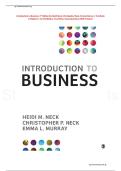
Introduction to Business 1st Edition By Heidi Neck, Christopher Neck, Emma Murray | Test Bank
| Chapters 1 to 18| MCQ,S, True/False, Essay Questions With Answers
Test Bank
StudentsSupports
@ StudentsSupports @
, @ StudentsSupports @
Neck, Introduction to Business, 1e
Chapter 01 - Complete Test Bank
Multiple Choice Questions
1. Entrepreneurs are skilled at channeling disruption into ______.
A. motivation
B. change
C. opportunity
D. training
Correct Answer: C. opportunity
2. Being entrepreneurial means combining the ability to create or notice opportunities and the ______.
A. courage to act on them
B. ability to hire quality team members
C. propensity to solicit funding for those ideas
D. aptitude to write a business plan
Test Bank
Correct Answer: A. courage to act on them
3. Today's platform for global impact is ______.
A. education
B. technology
C. business
StudentsSupports
D. sustainability
Correct Answer: C. business
4. Entities that produce or sell goods and services for profit are known as ______.
A. companies
B. organizations
C. businesses
D. startups
Correct Answer: C. businesses
5. Apple is an example of a(n) ______ because it is a company that is legally authorized to act as a single
entity.
A. business
B. corporation
C. industrial activity
D. professional activity
Correct Answer: B. corporation
Neck, Introduction to Business, 1e - Chapter 01 @ StudentsSupports @Page 1
, @ StudentsSupports @
6. Which type of business activity requires trained or certified skills?
A. commercial
B. industrial
C. professional
D. marketing
Correct Answer: C. professional
7. The price a product or service sells for is known as ______.
A. revenue
B. overhead cost
C. profit
D. the sales price
Correct Answer: A. revenue
8. The amount of money gained after selling goods and services is known as ______.
A. revenue
B. overhead cost
C. profit
D. the sales price
Correct Answer: C. profit
Test Bank
9. In the United States, businesses with more than 500 employees are considered ______.
A. conglomerates
B. large businesses
C. organizations
D. startups
StudentsSupports
Correct Answer: B. large businesses
10. If a company increases its revenue faster than its competitors in the same market, it is considered a
______.
A. corporation
B. growth company
C. multinational corporation
D. startup
Correct Answer: B. growth company
11. The way a business describes their rationale for creating, delivering, and capturing value is known as
a(n) ______.
A. offering
B. business model
C. customer base
D. financial incentive
Correct Answer: B. business model
Neck, Introduction to Business, 1e - Chapter 01 @ StudentsSupports @Page 2
, @ StudentsSupports @
12. Businesses create value by providing products and services that people ______.
A. create
B. want
C. need
D. desire
Correct Answer: C. need
13. The business component known as people refers to ______.
A. all organizational stakeholders
B. the business's customers
C. all employees that work at a business
D. those who design the marketing campaigns
Correct Answer: C. all employees that work at a business
14. The processes used to get daily work done within businesses are known as ______.
A. operations
B. culture
C. the business model
D. marketing
Correct Answer: A. operations
Test Bank
15. Which of these business components evaluates collected data in an attempt to inform decision making?
A. operations
B. people
C. money
D. competitive environment
StudentsSupports
Correct Answer: A. operations
16. Purpose-driven companies are defined as those that ______.
A. put stakeholders over shareholders
B. have an airtight business model
C. bring management, employees, and the community together
D. no longer make any profit
Correct Answer: C. bring management, employees, and the community together
17. The triple bottom line consists of ______.
A. people, planet, and profit
B. profit, productivity, and promise
C. people, productivity, and planet
D. profit, planet, and progress
Correct Answer: A. people, planet, and profit
Neck, Introduction to Business, 1e - Chapter 01 @ StudentsSupports @Page 3
Introduction to Business 1st Edition By Heidi Neck, Christopher Neck, Emma Murray | Test Bank
| Chapters 1 to 18| MCQ,S, True/False, Essay Questions With Answers
Test Bank
StudentsSupports
@ StudentsSupports @
, @ StudentsSupports @
Neck, Introduction to Business, 1e
Chapter 01 - Complete Test Bank
Multiple Choice Questions
1. Entrepreneurs are skilled at channeling disruption into ______.
A. motivation
B. change
C. opportunity
D. training
Correct Answer: C. opportunity
2. Being entrepreneurial means combining the ability to create or notice opportunities and the ______.
A. courage to act on them
B. ability to hire quality team members
C. propensity to solicit funding for those ideas
D. aptitude to write a business plan
Test Bank
Correct Answer: A. courage to act on them
3. Today's platform for global impact is ______.
A. education
B. technology
C. business
StudentsSupports
D. sustainability
Correct Answer: C. business
4. Entities that produce or sell goods and services for profit are known as ______.
A. companies
B. organizations
C. businesses
D. startups
Correct Answer: C. businesses
5. Apple is an example of a(n) ______ because it is a company that is legally authorized to act as a single
entity.
A. business
B. corporation
C. industrial activity
D. professional activity
Correct Answer: B. corporation
Neck, Introduction to Business, 1e - Chapter 01 @ StudentsSupports @Page 1
, @ StudentsSupports @
6. Which type of business activity requires trained or certified skills?
A. commercial
B. industrial
C. professional
D. marketing
Correct Answer: C. professional
7. The price a product or service sells for is known as ______.
A. revenue
B. overhead cost
C. profit
D. the sales price
Correct Answer: A. revenue
8. The amount of money gained after selling goods and services is known as ______.
A. revenue
B. overhead cost
C. profit
D. the sales price
Correct Answer: C. profit
Test Bank
9. In the United States, businesses with more than 500 employees are considered ______.
A. conglomerates
B. large businesses
C. organizations
D. startups
StudentsSupports
Correct Answer: B. large businesses
10. If a company increases its revenue faster than its competitors in the same market, it is considered a
______.
A. corporation
B. growth company
C. multinational corporation
D. startup
Correct Answer: B. growth company
11. The way a business describes their rationale for creating, delivering, and capturing value is known as
a(n) ______.
A. offering
B. business model
C. customer base
D. financial incentive
Correct Answer: B. business model
Neck, Introduction to Business, 1e - Chapter 01 @ StudentsSupports @Page 2
, @ StudentsSupports @
12. Businesses create value by providing products and services that people ______.
A. create
B. want
C. need
D. desire
Correct Answer: C. need
13. The business component known as people refers to ______.
A. all organizational stakeholders
B. the business's customers
C. all employees that work at a business
D. those who design the marketing campaigns
Correct Answer: C. all employees that work at a business
14. The processes used to get daily work done within businesses are known as ______.
A. operations
B. culture
C. the business model
D. marketing
Correct Answer: A. operations
Test Bank
15. Which of these business components evaluates collected data in an attempt to inform decision making?
A. operations
B. people
C. money
D. competitive environment
StudentsSupports
Correct Answer: A. operations
16. Purpose-driven companies are defined as those that ______.
A. put stakeholders over shareholders
B. have an airtight business model
C. bring management, employees, and the community together
D. no longer make any profit
Correct Answer: C. bring management, employees, and the community together
17. The triple bottom line consists of ______.
A. people, planet, and profit
B. profit, productivity, and promise
C. people, productivity, and planet
D. profit, planet, and progress
Correct Answer: A. people, planet, and profit
Neck, Introduction to Business, 1e - Chapter 01 @ StudentsSupports @Page 3