
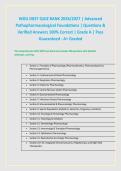
WGU D027 QUIZ BANK 2026/2027 | Advanced
Pathopharmacological Foundations | Questions &
Verified Answers 100% Correct | Grade A | Pass
Guaranteed - A+ Graded
This comprehensive WGU D027 quiz bank now includes 500 questions with detailed
rationales, covering:
• Section 1: Principles of Pharmacology (Pharmacokinetics, Pharmacodynamics,
Pharmacogenomics)
• Section 2: Cardiovascular & Renal Pharmacology
• Section 3: Respiratory Pharmacology
• Section 4: Endocrine Pharmacology
• Section 5: Central Nervous System Pharmacology
• Section 6: Gastrointestinal Pharmacology
• Section 7: Infectious Disease Pharmacology
• Section 8: Musculoskeletal & Rheumatologic Pharmacology
• Section 9: Special Populations (Pediatrics, Geriatrics, Pregnancy, Lactation)
• Section 10: Oncology & Hematology Pharmacology
• Section 11: Toxicology & Antidotes
• Section 12: Dermatology Pharmacology
• Section 13: Immunology & Transplant Pharmacology
• Section 14: Ophthalmic Pharmacology
• Section 15: Reproductive & Urologic Pharmacology
• Sections 16–25: Integrated Clinical Scenarios, Polypharmacy, and High-Yield
Therapeutics
,Section 1: Principles of Pharmacology
Q1: A 68-year-old patient with heart failure is started on oral digoxin 0.125 mg daily. The nurse
practitioner understands that this drug has a bioavailability of approximately 70%. Which factor
primarily accounts for the remaining 30% of the drug not reaching systemic circulation?
A. Distribution into adipose tissue before absorption is complete
B. First-pass metabolism by hepatic enzymes and biliary excretion [CORRECT]
C. Immediate renal excretion through glomerular filtration
D. Binding to plasma proteins in the portal circulation
Correct Answer: B
Rationale: First-pass effect refers to the metabolism of a drug during its first passage through
the liver via the portal circulation after oral absorption. For digoxin, approximately 30% is
metabolized or excreted by the liver before reaching systemic circulation. This is why IV digoxin
doses are typically 20-30% lower than oral doses. Option A describes distribution, which occurs
after absorption. Option C is incorrect because renal excretion happens after the drug reaches
systemic circulation. Option D is incorrect because protein binding occurs after the drug enters
the bloodstream, not during absorption.
Q2: A patient is prescribed phenytoin for seizure control. The NP recognizes that at higher
doses, small increases in dose lead to disproportionately large increases in plasma
concentration. This pharmacokinetic phenomenon is best described as:
A. First-order kinetics with decreased clearance
B. Zero-order kinetics due to enzyme saturation [CORRECT]
C. Capacity-limited protein binding
D. Time-dependent enzyme induction
Correct Answer: B
,Rationale: Phenytoin exhibits zero-order (or Michaelis-Menten) kinetics at therapeutic
concentrations because CYP2C9 becomes saturated. Once enzymes are saturated, metabolism
occurs at a constant rate regardless of drug concentration, causing plasma levels to rise
disproportionately with dose increases. This explains phenytoin's narrow therapeutic index and
need for careful monitoring. First-order kinetics (A) would show proportional increases. Protein
binding (C) is saturable but doesn't explain this pattern. Time-dependent induction (D) would
decrease levels over time, not increase them disproportionately.
Q3: A 45-year-old patient with liver cirrhosis is prescribed a highly protein-bound drug (95%
bound to albumin). The NP anticipates that the free fraction of this drug will be:
A. Unchanged because protein binding is not affected by liver disease
B. Decreased due to increased albumin production in cirrhosis
C. Increased due to decreased albumin synthesis and altered binding [CORRECT]
D. Decreased due to increased alpha-1 acid glycoprotein levels
Correct Answer: C
Rationale: Liver cirrhosis decreases albumin synthesis, leading to hypoalbuminemia. With less
albumin available for binding, the free (unbound) fraction of highly protein-bound drugs
increases. This increases pharmacologic effect and toxicity risk even with normal total drug
levels. Free drug is also more available for metabolism and elimination. Option A is incorrect
because liver disease significantly affects protein binding. Option B is wrong because albumin
decreases, not increases. Option D is incorrect because alpha-1 acid glycoprotein typically
decreases in liver disease, not increases.
Q4: A patient taking warfarin is started on amiodarone for atrial fibrillation. The NP recognizes
this combination requires careful INR monitoring because amiodarone:
A. Induces CYP2C9, increasing warfarin metabolism
B. Inhibits CYP2C9 and CYP3A4, decreasing warfarin metabolism [CORRECT]
C. Displaces warfarin from albumin binding sites
D. Increases vitamin K absorption from the GI tract
Correct Answer: B
Rationale: Amiodarone is a potent inhibitor of multiple CYP450 enzymes including CYP2C9
(primary warfarin metabolizing enzyme) and CYP3A4. This decreases warfarin metabolism,
increases its plasma concentration, and potentiates anticoagulant effects. INR should be
monitored closely and warfarin dose typically reduced by 30-50% when starting amiodarone.
Option A describes the opposite effect (induction). Option C describes a transient effect that
, doesn't explain the sustained interaction. Option D is incorrect as amiodarone doesn't affect
vitamin K absorption.
Q5: A patient asks why they must wait several days to feel the full effect of their new
antidepressant. The NP explains that the delay is primarily due to the time required to achieve:
A. Maximum receptor upregulation
B. Steady-state plasma concentrations [CORRECT]
C. Complete first-pass metabolism
D. Therapeutic protein binding levels
Correct Answer: B
Rationale: Steady-state concentration (Css) is reached after approximately 4-5 half-lives of a
drug. At this point, drug elimination equals drug administration, and plasma concentrations
plateau. For most antidepressants with half-lives of 24+ hours, this takes 5-7 days. While
receptor adaptations (A) occur and contribute to therapeutic effects, the pharmacokinetic
principle of steady-state explains the initial delay. First-pass metabolism (C) occurs with each
dose, not over days. Protein binding (D) reaches equilibrium quickly and doesn't cause delayed
effects.
Q6: The NP is explaining therapeutic index to a nursing student. Which statement best describes
a drug with a narrow therapeutic index?
A. The drug is highly effective at low doses with minimal side effects
B. The toxic dose is only slightly higher than the effective dose [CORRECT]
C. The drug requires therapeutic drug monitoring due to high protein binding
D. The effective dose varies widely between patients due to genetic factors
Correct Answer: B
Rationale: Therapeutic index (TI) is calculated as TD50/ED50 (toxic dose for 50% of population
divided by effective dose for 50%). A narrow TI means the toxic dose is close to the effective
dose, requiring careful dosing and monitoring (e.g., digoxin, lithium, phenytoin,
aminoglycosides). Option A describes a drug with favorable characteristics but doesn't define TI.
Option C confuses protein binding with narrow TI. Option D describes pharmacogenetic
variability, not TI.
Q7: A patient is administered a drug intravenously that has a very high volume of distribution
(Vd). The NP understands that this indicates:
A. The drug is highly bound to plasma proteins
B. The drug is extensively distributed into extravascular tissues [CORRECT]
Pathopharmacological Foundations | Questions &
Verified Answers 100% Correct | Grade A | Pass
Guaranteed - A+ Graded
This comprehensive WGU D027 quiz bank now includes 500 questions with detailed
rationales, covering:
• Section 1: Principles of Pharmacology (Pharmacokinetics, Pharmacodynamics,
Pharmacogenomics)
• Section 2: Cardiovascular & Renal Pharmacology
• Section 3: Respiratory Pharmacology
• Section 4: Endocrine Pharmacology
• Section 5: Central Nervous System Pharmacology
• Section 6: Gastrointestinal Pharmacology
• Section 7: Infectious Disease Pharmacology
• Section 8: Musculoskeletal & Rheumatologic Pharmacology
• Section 9: Special Populations (Pediatrics, Geriatrics, Pregnancy, Lactation)
• Section 10: Oncology & Hematology Pharmacology
• Section 11: Toxicology & Antidotes
• Section 12: Dermatology Pharmacology
• Section 13: Immunology & Transplant Pharmacology
• Section 14: Ophthalmic Pharmacology
• Section 15: Reproductive & Urologic Pharmacology
• Sections 16–25: Integrated Clinical Scenarios, Polypharmacy, and High-Yield
Therapeutics
,Section 1: Principles of Pharmacology
Q1: A 68-year-old patient with heart failure is started on oral digoxin 0.125 mg daily. The nurse
practitioner understands that this drug has a bioavailability of approximately 70%. Which factor
primarily accounts for the remaining 30% of the drug not reaching systemic circulation?
A. Distribution into adipose tissue before absorption is complete
B. First-pass metabolism by hepatic enzymes and biliary excretion [CORRECT]
C. Immediate renal excretion through glomerular filtration
D. Binding to plasma proteins in the portal circulation
Correct Answer: B
Rationale: First-pass effect refers to the metabolism of a drug during its first passage through
the liver via the portal circulation after oral absorption. For digoxin, approximately 30% is
metabolized or excreted by the liver before reaching systemic circulation. This is why IV digoxin
doses are typically 20-30% lower than oral doses. Option A describes distribution, which occurs
after absorption. Option C is incorrect because renal excretion happens after the drug reaches
systemic circulation. Option D is incorrect because protein binding occurs after the drug enters
the bloodstream, not during absorption.
Q2: A patient is prescribed phenytoin for seizure control. The NP recognizes that at higher
doses, small increases in dose lead to disproportionately large increases in plasma
concentration. This pharmacokinetic phenomenon is best described as:
A. First-order kinetics with decreased clearance
B. Zero-order kinetics due to enzyme saturation [CORRECT]
C. Capacity-limited protein binding
D. Time-dependent enzyme induction
Correct Answer: B
,Rationale: Phenytoin exhibits zero-order (or Michaelis-Menten) kinetics at therapeutic
concentrations because CYP2C9 becomes saturated. Once enzymes are saturated, metabolism
occurs at a constant rate regardless of drug concentration, causing plasma levels to rise
disproportionately with dose increases. This explains phenytoin's narrow therapeutic index and
need for careful monitoring. First-order kinetics (A) would show proportional increases. Protein
binding (C) is saturable but doesn't explain this pattern. Time-dependent induction (D) would
decrease levels over time, not increase them disproportionately.
Q3: A 45-year-old patient with liver cirrhosis is prescribed a highly protein-bound drug (95%
bound to albumin). The NP anticipates that the free fraction of this drug will be:
A. Unchanged because protein binding is not affected by liver disease
B. Decreased due to increased albumin production in cirrhosis
C. Increased due to decreased albumin synthesis and altered binding [CORRECT]
D. Decreased due to increased alpha-1 acid glycoprotein levels
Correct Answer: C
Rationale: Liver cirrhosis decreases albumin synthesis, leading to hypoalbuminemia. With less
albumin available for binding, the free (unbound) fraction of highly protein-bound drugs
increases. This increases pharmacologic effect and toxicity risk even with normal total drug
levels. Free drug is also more available for metabolism and elimination. Option A is incorrect
because liver disease significantly affects protein binding. Option B is wrong because albumin
decreases, not increases. Option D is incorrect because alpha-1 acid glycoprotein typically
decreases in liver disease, not increases.
Q4: A patient taking warfarin is started on amiodarone for atrial fibrillation. The NP recognizes
this combination requires careful INR monitoring because amiodarone:
A. Induces CYP2C9, increasing warfarin metabolism
B. Inhibits CYP2C9 and CYP3A4, decreasing warfarin metabolism [CORRECT]
C. Displaces warfarin from albumin binding sites
D. Increases vitamin K absorption from the GI tract
Correct Answer: B
Rationale: Amiodarone is a potent inhibitor of multiple CYP450 enzymes including CYP2C9
(primary warfarin metabolizing enzyme) and CYP3A4. This decreases warfarin metabolism,
increases its plasma concentration, and potentiates anticoagulant effects. INR should be
monitored closely and warfarin dose typically reduced by 30-50% when starting amiodarone.
Option A describes the opposite effect (induction). Option C describes a transient effect that
, doesn't explain the sustained interaction. Option D is incorrect as amiodarone doesn't affect
vitamin K absorption.
Q5: A patient asks why they must wait several days to feel the full effect of their new
antidepressant. The NP explains that the delay is primarily due to the time required to achieve:
A. Maximum receptor upregulation
B. Steady-state plasma concentrations [CORRECT]
C. Complete first-pass metabolism
D. Therapeutic protein binding levels
Correct Answer: B
Rationale: Steady-state concentration (Css) is reached after approximately 4-5 half-lives of a
drug. At this point, drug elimination equals drug administration, and plasma concentrations
plateau. For most antidepressants with half-lives of 24+ hours, this takes 5-7 days. While
receptor adaptations (A) occur and contribute to therapeutic effects, the pharmacokinetic
principle of steady-state explains the initial delay. First-pass metabolism (C) occurs with each
dose, not over days. Protein binding (D) reaches equilibrium quickly and doesn't cause delayed
effects.
Q6: The NP is explaining therapeutic index to a nursing student. Which statement best describes
a drug with a narrow therapeutic index?
A. The drug is highly effective at low doses with minimal side effects
B. The toxic dose is only slightly higher than the effective dose [CORRECT]
C. The drug requires therapeutic drug monitoring due to high protein binding
D. The effective dose varies widely between patients due to genetic factors
Correct Answer: B
Rationale: Therapeutic index (TI) is calculated as TD50/ED50 (toxic dose for 50% of population
divided by effective dose for 50%). A narrow TI means the toxic dose is close to the effective
dose, requiring careful dosing and monitoring (e.g., digoxin, lithium, phenytoin,
aminoglycosides). Option A describes a drug with favorable characteristics but doesn't define TI.
Option C confuses protein binding with narrow TI. Option D describes pharmacogenetic
variability, not TI.
Q7: A patient is administered a drug intravenously that has a very high volume of distribution
(Vd). The NP understands that this indicates:
A. The drug is highly bound to plasma proteins
B. The drug is extensively distributed into extravascular tissues [CORRECT]


