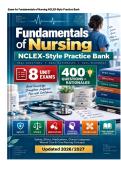
Exam for Fundamentals of Nursing NCLEX-Style Practice Bank
,TABLE OF CONTENTS
Unit Exam 1 — Foundations, Safety & Ethics
Nursing process, communication, client rights, documentation, delegation, fall prevention, and professional
accountability.
Unit Exam 2 — Infection Control, Hygiene & Mobility
Precautions, PPE, sterile technique, skin care, pressure injury prevention, mobility aids, transfers, and safe
handling.
Unit Exam 3 — Medication Administration & Safety
Medication rights, dosage calculations, injections, insulin, anticoagulants, IV therapy, medication errors, and
adverse reactions.
Unit Exam 4 — Oxygenation, Perfusion & Electrolytes
Oxygen therapy, respiratory assessment, ABGs, acid-base balance, fluid balance, perfusion, and electrolyte
disorders.
Unit Exam 5 — Nutrition, Elimination & Metabolic Care
Enteral feeding, aspiration prevention, nutrition, bowel and urinary elimination, ostomy care, hydration, and
glucose management.
Unit Exam 6 — Wound, Pain & Perioperative Care
Wound healing, pressure injuries, pain management, surgical care, dehiscence, evisceration, VTE prevention,
and recovery.
Unit Exam 7 — Clinical Judgment & Delegation
Prioritization, delegation, handoff, documentation, advocacy, care-plan revision, discharge planning, and
outcome evaluation.
Unit Exam 8 — Comprehensive Final Review
Integrated NCLEX-style review of safety, medications, mobility, wounds, oxygenation, fluids, nutrition,
elimination, ethics, and clinical judgment.
Total: 8 Unit Exams | 400 Questions + Rationales
,UNIT EXAM 1
Foundations, Safety, Nursing Process, Communication & Ethics
Question 1
Reviewing the start-of-shift report, the RN identifies four situations. Which finding requires the most
immediate assessment?
A. Client scheduled for discharge who needs clarification about home medications
B. Client reporting constipation after receiving opioid analgesics for two days
C. Client requesting assistance to ambulate to the bathroom after hip surgery
D. Client with new restlessness, respiratory rate of 32/min, and oxygen saturation of 88%
Correct Answer: D
Rationale: New restlessness, tachypnea, and hypoxemia suggest impaired oxygenation and possible acute
deterioration. Airway and breathing problems take priority over teaching, elimination, or routine mobility
needs. Rapid assessment and intervention can prevent respiratory failure.
Clinical Pearl: Restlessness can be an early manifestation of hypoxia before more obvious signs develop.
Exam Strategy: When several needs compete, prioritize airway, breathing, circulation, and acute changes from
baseline.
Question 2
Following a medication error that caused no apparent harm, which nursing action best demonstrates
professional accountability?
A. Assess the client, notify the appropriate provider, report the error, and document the client's response
B. Document only that the medication was administered without mentioning the error
C. Ask the next-shift nurse to observe the client before deciding whether to report it
D. Complete an incident report only if the client later develops complications
Correct Answer: A
Rationale: Accountability requires immediate client assessment, appropriate notification, monitoring, and
completion of required safety reporting. The health record should objectively describe the client's condition
and interventions, while the incident report is handled according to organizational policy.
Clinical Pearl: Incident reports support quality improvement and are not substitutes for clinical
documentation.
Exam Strategy: Medication errors are managed by protecting the client first, then reporting and documenting
appropriately.
,Question 3
A hospitalized adult says, “I don't want that procedure until someone explains why I need it.” Which response
by the nurse is most appropriate?
A. “The provider would not have ordered it unless it was necessary.”
B. “You already signed the admission forms, so the procedure may continue.”
C. “You have the right to receive an explanation before deciding whether to proceed.”
D. “I can ask your family to help convince you to accept the procedure.”
Correct Answer: C
Rationale: Informed consent requires that the client receive understandable information about the procedure,
risks, benefits, and alternatives before voluntarily agreeing. The nurse should protect the client's autonomy
and notify the responsible provider when additional explanation is needed.
Clinical Pearl: Signing a form does not eliminate the client's right to ask questions or withdraw consent.
Exam Strategy: Questions involving consent usually center on autonomy, adequate information, voluntariness,
and capacity.
Question 4
During bedside handoff, which information should the nurse communicate first about a postoperative client?
A. The client prefers tea rather than coffee with breakfast
B. Blood pressure has fallen from 128/76 mm Hg to 92/58 mm Hg over the past hour
C. Family members plan to visit in the afternoon
D. The client requested assistance completing insurance forms
Correct Answer: B
Rationale: A significant postoperative blood pressure decline may indicate bleeding, fluid loss, or
hemodynamic instability and therefore requires prompt evaluation. Preferences, visitors, and administrative
needs are relevant but do not have the same immediate physiologic importance.
Clinical Pearl: Trends in vital signs are often more clinically meaningful than a single isolated value.
Exam Strategy: In handoff questions, prioritize new instability, abnormal trends, and safety threats.
Question 5
A nurse discovers that an older adult has nearly fallen twice while attempting to walk independently. Which
intervention best addresses the client's immediate safety?
A. Apply wrist restraints whenever the client is alone
B. Place frequently needed items within reach and establish scheduled toileting and assistance
C. Keep all four side rails elevated throughout the shift
D. Encourage the client to remain in bed until discharge
Correct Answer: B
Rationale: Environmental modification and proactive assistance reduce fall risk while preserving mobility and
independence. Restraints and four raised side rails may increase injury risk and restrict autonomy. Prolonged
bed rest also increases deconditioning and other complications.
Clinical Pearl: Effective fall prevention targets the reason the client keeps attempting to get up.
,Exam Strategy: Choose the least restrictive, most individualized safety intervention whenever possible.
Question 6
The nurse uses the following priority framework:
Finding Acute? Threat to ABCs? Priority
Mild nausea No No Low
New stridor Yes Yes ?
Chronic knee pain No No Low
Request for discharge teaching No No Moderate
Which priority should be assigned to new stridor?
A. Routine
B. Delayed
C. Intermediate
D. Immediate
Correct Answer: D
Rationale: Stridor indicates upper-airway narrowing and can progress rapidly to complete airway obstruction.
Because the finding is acute and directly threatens airway patency, it requires immediate assessment and
intervention before less urgent problems.
Clinical Pearl: Stridor is an emergency warning sign, particularly when it appears suddenly.
Exam Strategy: Any acute finding that threatens an ABC function generally outranks comfort or teaching
needs.
Question 7
Which action best represents the assessment phase of the nursing process?
A. Obtaining the client's pain rating and observing nonverbal indicators of discomfort
B. Selecting interventions to reduce pain within 30 minutes
C. Administering prescribed analgesic medication
D. Determining whether pain improved after treatment
Correct Answer: A
Rationale: Assessment involves systematically collecting subjective and objective information. Planning
involves selecting outcomes and interventions, implementation involves performing care, and evaluation
determines whether expected outcomes were achieved.
Clinical Pearl: Accurate nursing diagnoses depend on complete and reliable assessment data.
Exam Strategy: When identifying nursing-process steps, ask: collecting, analyzing, planning, doing, or
evaluating?
,Question 8
A client begins crying after learning that a chronic illness will require major lifestyle changes. Which response
demonstrates therapeutic communication?
A. “You shouldn't worry until you know exactly what will happen.”
B. “Many people have it much worse than you do.”
C. “This sounds overwhelming. What concerns you most right now?”
D. “Everything will be fine once you become accustomed to the treatment.”
Correct Answer: C
Rationale: Acknowledging emotion and using an open-ended question encourages expression and further
assessment. False reassurance, minimizing the experience, and comparing the client with others can block
communication and reduce trust.
Clinical Pearl: Therapeutic communication focuses on understanding the client's experience rather than
immediately fixing it.
Exam Strategy: Prefer responses that acknowledge feelings and invite elaboration.
Question 9
Which nursing documentation entry is most appropriate?
A. “Client acted strangely and appeared upset after breakfast.”
B. “Client seems better today and will probably be discharged soon.”
C. “Client was difficult and refused to cooperate with morning care.”
D. “Client stated, ‘I feel dizzy when I stand’; BP decreased from 122/74 lying to 98/60 standing.”
Correct Answer: D
Rationale: High-quality documentation is objective, specific, measurable, and includes direct client statements
when relevant. The other entries contain vague descriptions, judgmental wording, or unsupported predictions.
Clinical Pearl: If another clinician cannot visualize what happened from the note, the documentation may be
too vague.
Exam Strategy: Select charting that contains observable facts, measurements, and direct quotations.
Question 10
A competent adult refuses a prescribed blood transfusion after receiving information about the risks of
refusing. Which nursing action is appropriate?
A. Obtain permission from the client's family instead
B. Respect the refusal and notify the healthcare provider
C. Administer the transfusion because it may prevent harm
D. Ask another nurse to obtain consent
Correct Answer: B
Rationale: Competent adults have the right to refuse treatment even when refusal may increase health risks.
The nurse should verify understanding, respect the decision, communicate it to the provider, and continue
appropriate care.
Clinical Pearl: Autonomy includes both the right to accept and the right to refuse treatment.
,Exam Strategy: Do not confuse beneficence with permission to override a competent client's informed refusal.
Question 11
Which task is most appropriate for the RN to delegate to experienced unlicensed assistive personnel (UAP)?
A. Assist a stable client with bathing and record the client's intake and output
B. Teach a newly diagnosed client how to use a glucometer
C. Determine why a postoperative client's urine output has decreased
D. Evaluate whether an analgesic effectively relieved pain
Correct Answer: A
Rationale: Routine, predictable activities for stable clients can generally be delegated to UAP. Teaching,
assessment, interpretation, clinical judgment, and evaluation remain nursing responsibilities and should not be
delegated.
Clinical Pearl: Delegation transfers the task, not the RN's accountability for appropriate supervision.
Exam Strategy: Delegate stable + routine + predictable tasks; retain assessment, teaching, and evaluation.
Question 12
Consider this nursing-process pathway:
Collect data
↓
Analyze findings
↓
Identify nursing problem
↓
Set measurable outcome
↓
Choose interventions
↓
Implement care
↓
Evaluate response
After identifying that a client is at high risk for falls, which action comes next?
A. Perform the intervention immediately without establishing an outcome
B. Reassess only at the end of hospitalization
C. Establish a measurable safety outcome and select appropriate interventions
D. Document that the client will not fall without specifying actions
,Correct Answer: C
Rationale: After assessment and identification of the nursing problem, the nurse develops measurable
outcomes and selects interventions. Implementation follows planning, and evaluation occurs after
interventions have had an opportunity to affect the client's condition.
Clinical Pearl: A measurable outcome provides the standard used later to evaluate effectiveness.
Exam Strategy: Follow the sequence assessment → diagnosis/analysis → planning → implementation →
evaluation.
Question 13
Which client statement indicates a need for further teaching about use of the call light?
A. “I'll keep it near my stronger hand.”
B. “If I need the bathroom urgently, I'll try to stand first and then call.”
C. “I'll call before getting up if the nurse told me I need assistance.”
D. “I'll use it if I develop new pain or shortness of breath.”
Correct Answer: B
Rationale: A client identified as needing assistance should call before attempting to stand. Getting up first
increases the risk of a fall, particularly when urgency, weakness, medication effects, or unfamiliar surroundings
are present.
Clinical Pearl: Many inpatient falls occur during unsupervised toileting attempts.
Exam Strategy: Teaching is ineffective when the client's statement still contains the unsafe behavior.
Question 14
Which action best demonstrates the ethical principle of fidelity?
A. Allocating limited supplies fairly among clients
B. Preventing foreseeable harm to a confused client
C. Respecting a client's refusal of treatment
D. Returning at the promised time to help a client contact family
Correct Answer: D
Rationale: Fidelity means keeping promises and honoring professional commitments. Justice concerns fairness,
nonmaleficence involves avoiding harm, and autonomy protects the client's right to make personal decisions.
Clinical Pearl: Trust in the nurse-client relationship is strengthened when commitments are reliably honored.
Exam Strategy: Associate fidelity = keeping promises and commitments.
Question 15
A client with limited English proficiency needs teaching about a high-risk medication. Which approach is most
appropriate?
A. Ask an adult family member to translate the medication instructions
B. Provide written English instructions and ask the client to sign them
C. Use a qualified medical interpreter and communicate directly with the client
D. Delay teaching until a bilingual visitor becomes available
,Correct Answer: C
Rationale: Qualified interpreters improve accuracy, confidentiality, and client understanding during important
healthcare communication. Family members may unintentionally alter or omit information and should not
replace professional interpretation when critical teaching is required.
Clinical Pearl: Speak to the client—not the interpreter—even when an interpreter is facilitating
communication.
Exam Strategy: For consent, medications, discharge, or complex teaching, choose a qualified interpreter.
Question 16
Which statement by the nurse is an example of clarification?
A. “When you say you feel ‘funny,’ can you describe exactly what you mean?”
B. “You seem anxious because you are afraid of surgery.”
C. “Why didn't you tell anyone sooner?”
D. “I'm sure the procedure will go well.”
Correct Answer: A
Rationale: Clarification helps the nurse understand vague or ambiguous statements by asking the client to
explain their meaning. Assuming feelings, asking judgmental “why” questions, and offering false reassurance
can interfere with therapeutic communication.
Clinical Pearl: Words such as “dizzy,” “weak,” or “funny” often require clarification because clients may mean
different things.
Exam Strategy: Clarification usually involves asking the client to explain an unclear statement.
Question 17
The RN receives four updates. Which client should be reassessed first?
A. Client awaiting routine dressing change for a clean surgical incision
B. Client requesting acetaminophen for a headache rated 3/10
C. Client who needs reinforcement of low-sodium diet teaching
D. Client who has become newly confused and difficult to arouse
Correct Answer: D
Rationale: Acute mental-status change and decreased responsiveness may indicate hypoxia, neurologic
deterioration, medication effects, or metabolic instability. This represents a significant change from baseline
and takes priority over stable, routine needs.
Clinical Pearl: Sudden confusion should never automatically be attributed to age.
Exam Strategy: Acute change from baseline is a major NCLEX priority clue.
Question 18
The nurse reviews the following safety data:
Client Finding
1 Uses walker consistently and asks for help
, Client Finding
2 Received sedative 30 minutes ago and repeatedly attempts to stand
3 Independent ambulation with steady gait
4 Bedbound client able to reposition independently
Which client has the greatest immediate fall risk?
A. Client 1
B. Client 2
C. Client 3
D. Client 4
Correct Answer: B
Rationale: Sedation combined with repeated attempts to stand creates a high and immediate fall risk. The
other clients either use appropriate safety behaviors, ambulate independently, or are not currently attempting
unsafe mobility.
Clinical Pearl: Medication effects are a major modifiable contributor to inpatient falls.
Exam Strategy: Combine risk factors rather than judging each factor in isolation.
Question 19
Which outcome statement is written most appropriately?
A. “Client will understand fall prevention.”
B. “Nurse will teach the client to call for assistance.”
C. “Client will use the call light before getting out of bed throughout this shift.”
D. “Client will receive adequate safety care.”
Correct Answer: C
Rationale: Effective outcomes are client-centered, observable, measurable, and time limited. “Understand”
and “adequate” are difficult to measure, while a statement describing what the nurse will do is an intervention
rather than a client outcome.
Clinical Pearl: Outcomes describe the client's expected response, not the nurse's activity.
Exam Strategy: Look for a statement containing who + observable behavior + time frame.
Question 20
A family member asks the nurse for detailed information about an alert adult client's diagnosis. The client has
not given permission to share information. What should the nurse do?
A. Protect the client's confidentiality and ask the client what information may be shared
B. Provide details because family members usually assist with care
C. Share only laboratory results because they are objective
D. Provide information if the relative promises not to tell anyone else
Correct Answer: A
,TABLE OF CONTENTS
Unit Exam 1 — Foundations, Safety & Ethics
Nursing process, communication, client rights, documentation, delegation, fall prevention, and professional
accountability.
Unit Exam 2 — Infection Control, Hygiene & Mobility
Precautions, PPE, sterile technique, skin care, pressure injury prevention, mobility aids, transfers, and safe
handling.
Unit Exam 3 — Medication Administration & Safety
Medication rights, dosage calculations, injections, insulin, anticoagulants, IV therapy, medication errors, and
adverse reactions.
Unit Exam 4 — Oxygenation, Perfusion & Electrolytes
Oxygen therapy, respiratory assessment, ABGs, acid-base balance, fluid balance, perfusion, and electrolyte
disorders.
Unit Exam 5 — Nutrition, Elimination & Metabolic Care
Enteral feeding, aspiration prevention, nutrition, bowel and urinary elimination, ostomy care, hydration, and
glucose management.
Unit Exam 6 — Wound, Pain & Perioperative Care
Wound healing, pressure injuries, pain management, surgical care, dehiscence, evisceration, VTE prevention,
and recovery.
Unit Exam 7 — Clinical Judgment & Delegation
Prioritization, delegation, handoff, documentation, advocacy, care-plan revision, discharge planning, and
outcome evaluation.
Unit Exam 8 — Comprehensive Final Review
Integrated NCLEX-style review of safety, medications, mobility, wounds, oxygenation, fluids, nutrition,
elimination, ethics, and clinical judgment.
Total: 8 Unit Exams | 400 Questions + Rationales
,UNIT EXAM 1
Foundations, Safety, Nursing Process, Communication & Ethics
Question 1
Reviewing the start-of-shift report, the RN identifies four situations. Which finding requires the most
immediate assessment?
A. Client scheduled for discharge who needs clarification about home medications
B. Client reporting constipation after receiving opioid analgesics for two days
C. Client requesting assistance to ambulate to the bathroom after hip surgery
D. Client with new restlessness, respiratory rate of 32/min, and oxygen saturation of 88%
Correct Answer: D
Rationale: New restlessness, tachypnea, and hypoxemia suggest impaired oxygenation and possible acute
deterioration. Airway and breathing problems take priority over teaching, elimination, or routine mobility
needs. Rapid assessment and intervention can prevent respiratory failure.
Clinical Pearl: Restlessness can be an early manifestation of hypoxia before more obvious signs develop.
Exam Strategy: When several needs compete, prioritize airway, breathing, circulation, and acute changes from
baseline.
Question 2
Following a medication error that caused no apparent harm, which nursing action best demonstrates
professional accountability?
A. Assess the client, notify the appropriate provider, report the error, and document the client's response
B. Document only that the medication was administered without mentioning the error
C. Ask the next-shift nurse to observe the client before deciding whether to report it
D. Complete an incident report only if the client later develops complications
Correct Answer: A
Rationale: Accountability requires immediate client assessment, appropriate notification, monitoring, and
completion of required safety reporting. The health record should objectively describe the client's condition
and interventions, while the incident report is handled according to organizational policy.
Clinical Pearl: Incident reports support quality improvement and are not substitutes for clinical
documentation.
Exam Strategy: Medication errors are managed by protecting the client first, then reporting and documenting
appropriately.
,Question 3
A hospitalized adult says, “I don't want that procedure until someone explains why I need it.” Which response
by the nurse is most appropriate?
A. “The provider would not have ordered it unless it was necessary.”
B. “You already signed the admission forms, so the procedure may continue.”
C. “You have the right to receive an explanation before deciding whether to proceed.”
D. “I can ask your family to help convince you to accept the procedure.”
Correct Answer: C
Rationale: Informed consent requires that the client receive understandable information about the procedure,
risks, benefits, and alternatives before voluntarily agreeing. The nurse should protect the client's autonomy
and notify the responsible provider when additional explanation is needed.
Clinical Pearl: Signing a form does not eliminate the client's right to ask questions or withdraw consent.
Exam Strategy: Questions involving consent usually center on autonomy, adequate information, voluntariness,
and capacity.
Question 4
During bedside handoff, which information should the nurse communicate first about a postoperative client?
A. The client prefers tea rather than coffee with breakfast
B. Blood pressure has fallen from 128/76 mm Hg to 92/58 mm Hg over the past hour
C. Family members plan to visit in the afternoon
D. The client requested assistance completing insurance forms
Correct Answer: B
Rationale: A significant postoperative blood pressure decline may indicate bleeding, fluid loss, or
hemodynamic instability and therefore requires prompt evaluation. Preferences, visitors, and administrative
needs are relevant but do not have the same immediate physiologic importance.
Clinical Pearl: Trends in vital signs are often more clinically meaningful than a single isolated value.
Exam Strategy: In handoff questions, prioritize new instability, abnormal trends, and safety threats.
Question 5
A nurse discovers that an older adult has nearly fallen twice while attempting to walk independently. Which
intervention best addresses the client's immediate safety?
A. Apply wrist restraints whenever the client is alone
B. Place frequently needed items within reach and establish scheduled toileting and assistance
C. Keep all four side rails elevated throughout the shift
D. Encourage the client to remain in bed until discharge
Correct Answer: B
Rationale: Environmental modification and proactive assistance reduce fall risk while preserving mobility and
independence. Restraints and four raised side rails may increase injury risk and restrict autonomy. Prolonged
bed rest also increases deconditioning and other complications.
Clinical Pearl: Effective fall prevention targets the reason the client keeps attempting to get up.
,Exam Strategy: Choose the least restrictive, most individualized safety intervention whenever possible.
Question 6
The nurse uses the following priority framework:
Finding Acute? Threat to ABCs? Priority
Mild nausea No No Low
New stridor Yes Yes ?
Chronic knee pain No No Low
Request for discharge teaching No No Moderate
Which priority should be assigned to new stridor?
A. Routine
B. Delayed
C. Intermediate
D. Immediate
Correct Answer: D
Rationale: Stridor indicates upper-airway narrowing and can progress rapidly to complete airway obstruction.
Because the finding is acute and directly threatens airway patency, it requires immediate assessment and
intervention before less urgent problems.
Clinical Pearl: Stridor is an emergency warning sign, particularly when it appears suddenly.
Exam Strategy: Any acute finding that threatens an ABC function generally outranks comfort or teaching
needs.
Question 7
Which action best represents the assessment phase of the nursing process?
A. Obtaining the client's pain rating and observing nonverbal indicators of discomfort
B. Selecting interventions to reduce pain within 30 minutes
C. Administering prescribed analgesic medication
D. Determining whether pain improved after treatment
Correct Answer: A
Rationale: Assessment involves systematically collecting subjective and objective information. Planning
involves selecting outcomes and interventions, implementation involves performing care, and evaluation
determines whether expected outcomes were achieved.
Clinical Pearl: Accurate nursing diagnoses depend on complete and reliable assessment data.
Exam Strategy: When identifying nursing-process steps, ask: collecting, analyzing, planning, doing, or
evaluating?
,Question 8
A client begins crying after learning that a chronic illness will require major lifestyle changes. Which response
demonstrates therapeutic communication?
A. “You shouldn't worry until you know exactly what will happen.”
B. “Many people have it much worse than you do.”
C. “This sounds overwhelming. What concerns you most right now?”
D. “Everything will be fine once you become accustomed to the treatment.”
Correct Answer: C
Rationale: Acknowledging emotion and using an open-ended question encourages expression and further
assessment. False reassurance, minimizing the experience, and comparing the client with others can block
communication and reduce trust.
Clinical Pearl: Therapeutic communication focuses on understanding the client's experience rather than
immediately fixing it.
Exam Strategy: Prefer responses that acknowledge feelings and invite elaboration.
Question 9
Which nursing documentation entry is most appropriate?
A. “Client acted strangely and appeared upset after breakfast.”
B. “Client seems better today and will probably be discharged soon.”
C. “Client was difficult and refused to cooperate with morning care.”
D. “Client stated, ‘I feel dizzy when I stand’; BP decreased from 122/74 lying to 98/60 standing.”
Correct Answer: D
Rationale: High-quality documentation is objective, specific, measurable, and includes direct client statements
when relevant. The other entries contain vague descriptions, judgmental wording, or unsupported predictions.
Clinical Pearl: If another clinician cannot visualize what happened from the note, the documentation may be
too vague.
Exam Strategy: Select charting that contains observable facts, measurements, and direct quotations.
Question 10
A competent adult refuses a prescribed blood transfusion after receiving information about the risks of
refusing. Which nursing action is appropriate?
A. Obtain permission from the client's family instead
B. Respect the refusal and notify the healthcare provider
C. Administer the transfusion because it may prevent harm
D. Ask another nurse to obtain consent
Correct Answer: B
Rationale: Competent adults have the right to refuse treatment even when refusal may increase health risks.
The nurse should verify understanding, respect the decision, communicate it to the provider, and continue
appropriate care.
Clinical Pearl: Autonomy includes both the right to accept and the right to refuse treatment.
,Exam Strategy: Do not confuse beneficence with permission to override a competent client's informed refusal.
Question 11
Which task is most appropriate for the RN to delegate to experienced unlicensed assistive personnel (UAP)?
A. Assist a stable client with bathing and record the client's intake and output
B. Teach a newly diagnosed client how to use a glucometer
C. Determine why a postoperative client's urine output has decreased
D. Evaluate whether an analgesic effectively relieved pain
Correct Answer: A
Rationale: Routine, predictable activities for stable clients can generally be delegated to UAP. Teaching,
assessment, interpretation, clinical judgment, and evaluation remain nursing responsibilities and should not be
delegated.
Clinical Pearl: Delegation transfers the task, not the RN's accountability for appropriate supervision.
Exam Strategy: Delegate stable + routine + predictable tasks; retain assessment, teaching, and evaluation.
Question 12
Consider this nursing-process pathway:
Collect data
↓
Analyze findings
↓
Identify nursing problem
↓
Set measurable outcome
↓
Choose interventions
↓
Implement care
↓
Evaluate response
After identifying that a client is at high risk for falls, which action comes next?
A. Perform the intervention immediately without establishing an outcome
B. Reassess only at the end of hospitalization
C. Establish a measurable safety outcome and select appropriate interventions
D. Document that the client will not fall without specifying actions
,Correct Answer: C
Rationale: After assessment and identification of the nursing problem, the nurse develops measurable
outcomes and selects interventions. Implementation follows planning, and evaluation occurs after
interventions have had an opportunity to affect the client's condition.
Clinical Pearl: A measurable outcome provides the standard used later to evaluate effectiveness.
Exam Strategy: Follow the sequence assessment → diagnosis/analysis → planning → implementation →
evaluation.
Question 13
Which client statement indicates a need for further teaching about use of the call light?
A. “I'll keep it near my stronger hand.”
B. “If I need the bathroom urgently, I'll try to stand first and then call.”
C. “I'll call before getting up if the nurse told me I need assistance.”
D. “I'll use it if I develop new pain or shortness of breath.”
Correct Answer: B
Rationale: A client identified as needing assistance should call before attempting to stand. Getting up first
increases the risk of a fall, particularly when urgency, weakness, medication effects, or unfamiliar surroundings
are present.
Clinical Pearl: Many inpatient falls occur during unsupervised toileting attempts.
Exam Strategy: Teaching is ineffective when the client's statement still contains the unsafe behavior.
Question 14
Which action best demonstrates the ethical principle of fidelity?
A. Allocating limited supplies fairly among clients
B. Preventing foreseeable harm to a confused client
C. Respecting a client's refusal of treatment
D. Returning at the promised time to help a client contact family
Correct Answer: D
Rationale: Fidelity means keeping promises and honoring professional commitments. Justice concerns fairness,
nonmaleficence involves avoiding harm, and autonomy protects the client's right to make personal decisions.
Clinical Pearl: Trust in the nurse-client relationship is strengthened when commitments are reliably honored.
Exam Strategy: Associate fidelity = keeping promises and commitments.
Question 15
A client with limited English proficiency needs teaching about a high-risk medication. Which approach is most
appropriate?
A. Ask an adult family member to translate the medication instructions
B. Provide written English instructions and ask the client to sign them
C. Use a qualified medical interpreter and communicate directly with the client
D. Delay teaching until a bilingual visitor becomes available
,Correct Answer: C
Rationale: Qualified interpreters improve accuracy, confidentiality, and client understanding during important
healthcare communication. Family members may unintentionally alter or omit information and should not
replace professional interpretation when critical teaching is required.
Clinical Pearl: Speak to the client—not the interpreter—even when an interpreter is facilitating
communication.
Exam Strategy: For consent, medications, discharge, or complex teaching, choose a qualified interpreter.
Question 16
Which statement by the nurse is an example of clarification?
A. “When you say you feel ‘funny,’ can you describe exactly what you mean?”
B. “You seem anxious because you are afraid of surgery.”
C. “Why didn't you tell anyone sooner?”
D. “I'm sure the procedure will go well.”
Correct Answer: A
Rationale: Clarification helps the nurse understand vague or ambiguous statements by asking the client to
explain their meaning. Assuming feelings, asking judgmental “why” questions, and offering false reassurance
can interfere with therapeutic communication.
Clinical Pearl: Words such as “dizzy,” “weak,” or “funny” often require clarification because clients may mean
different things.
Exam Strategy: Clarification usually involves asking the client to explain an unclear statement.
Question 17
The RN receives four updates. Which client should be reassessed first?
A. Client awaiting routine dressing change for a clean surgical incision
B. Client requesting acetaminophen for a headache rated 3/10
C. Client who needs reinforcement of low-sodium diet teaching
D. Client who has become newly confused and difficult to arouse
Correct Answer: D
Rationale: Acute mental-status change and decreased responsiveness may indicate hypoxia, neurologic
deterioration, medication effects, or metabolic instability. This represents a significant change from baseline
and takes priority over stable, routine needs.
Clinical Pearl: Sudden confusion should never automatically be attributed to age.
Exam Strategy: Acute change from baseline is a major NCLEX priority clue.
Question 18
The nurse reviews the following safety data:
Client Finding
1 Uses walker consistently and asks for help
, Client Finding
2 Received sedative 30 minutes ago and repeatedly attempts to stand
3 Independent ambulation with steady gait
4 Bedbound client able to reposition independently
Which client has the greatest immediate fall risk?
A. Client 1
B. Client 2
C. Client 3
D. Client 4
Correct Answer: B
Rationale: Sedation combined with repeated attempts to stand creates a high and immediate fall risk. The
other clients either use appropriate safety behaviors, ambulate independently, or are not currently attempting
unsafe mobility.
Clinical Pearl: Medication effects are a major modifiable contributor to inpatient falls.
Exam Strategy: Combine risk factors rather than judging each factor in isolation.
Question 19
Which outcome statement is written most appropriately?
A. “Client will understand fall prevention.”
B. “Nurse will teach the client to call for assistance.”
C. “Client will use the call light before getting out of bed throughout this shift.”
D. “Client will receive adequate safety care.”
Correct Answer: C
Rationale: Effective outcomes are client-centered, observable, measurable, and time limited. “Understand”
and “adequate” are difficult to measure, while a statement describing what the nurse will do is an intervention
rather than a client outcome.
Clinical Pearl: Outcomes describe the client's expected response, not the nurse's activity.
Exam Strategy: Look for a statement containing who + observable behavior + time frame.
Question 20
A family member asks the nurse for detailed information about an alert adult client's diagnosis. The client has
not given permission to share information. What should the nurse do?
A. Protect the client's confidentiality and ask the client what information may be shared
B. Provide details because family members usually assist with care
C. Share only laboratory results because they are objective
D. Provide information if the relative promises not to tell anyone else
Correct Answer: A