
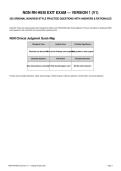
NGN RN HESI EXIT EXAM — VERSION 1 (V1)
250 ORIGINAL NGN/HESI-STYLE PRACTICE QUESTIONS WITH ANSWERS & RATIONALES
Important: These are original practice items designed to reflect current NGN/HESI-style clinical judgment. They are not leaked or reproduced HESI
exam questions, and no practice set can guarantee a passing score.
NGN Clinical Judgment Quick Map
Recognize Cues Analyze Cues Prioritize Hypotheses
What data are abnormal?
What do the findings mean together?
What problem is most urgent?
Generate Solutions Take Action Evaluate Outcomes
What interventions could help? What should happen now? Did the client improve?
Practice areas include prioritization, safety, pharmacology, medical-surgical, maternity, pediatrics, mental health, and clinical judgment.
NGN RN HESI Exit Exam V1 — Original Practice Set Page 1
, 1. [Prioritization] A nurse receives report on four clients. Which client should the nurse assess first?
■ A client 2 hours after thyroidectomy who has new inspiratory stridor
• A client with chronic heart failure who has 2+ ankle edema
• A client with pneumonia whose temperature is 38.1°C (100.6°F)
• A client with diabetes whose premeal glucose is 184 mg/dL
Answer: A client 2 hours after thyroidectomy who has new inspiratory stridor
Rationale: Airway compromise is an immediate life threat and takes priority over stable or less urgent findings.
2. [Medication Safety] A client receiving IV potassium chloride has a prescription for 20 mEq IV push. What
should the nurse do?
• Give it intramuscularly
■ Question the prescription because potassium chloride must never be administered IV push
• Administer it slowly through a peripheral line
• Dilute it in sterile water and give it IV push
Answer: Question the prescription because potassium chloride must never be administered IV push
Rationale: IV potassium is a high-alert medication and must be diluted and infused according to facility policy; IV push administration can cause
fatal dysrhythmias.
3. [Respiratory] Which finding in a client with asthma requires immediate intervention?
• Respiratory rate of 20/min
• Oxygen saturation of 96% on room air
■ Silent chest with markedly decreased breath sounds
• Mild expiratory wheezing
Answer: Silent chest with markedly decreased breath sounds
Rationale: A silent chest can indicate critically reduced airflow and impending respiratory failure.
4. [Sepsis] A client is suspected of having septic shock. Which finding is most concerning?
• Temperature 38.4°C (101.1°F)
• Heart rate 104/min
• WBC 15,000/mm³
■ MAP 58 mm Hg with altered mental status
Answer: MAP 58 mm Hg with altered mental status
Rationale: Hypotension with altered mentation suggests inadequate organ perfusion and possible septic shock.
5. [Stroke] A client arrives with sudden aphasia and right-sided weakness. What is the priority action?
■ Determine the exact time the client was last known well
• Offer oral fluids
• Ambulate the client
• Give aspirin before brain imaging
Answer: Determine the exact time the client was last known well
Rationale: Eligibility for time-sensitive reperfusion therapies depends on the last-known-well time; rapid stroke evaluation is essential.
NGN RN HESI Exit Exam V1 — Original Practice Set Page 2
, 6. [Diabetes] A conscious client with diabetes has diaphoresis, tremor, and glucose 52 mg/dL. What is the
priority intervention?
• Restrict oral intake
■ Give 15 g of rapid-acting carbohydrate
• Administer long-acting insulin
• Encourage a high-fat meal
Answer: Give 15 g of rapid-acting carbohydrate
Rationale: A conscious client with symptomatic hypoglycemia should receive a rapid source of glucose and be reassessed.
7. [Heart Failure] Which statement by a client with heart failure indicates correct understanding of home
monitoring?
• I should increase sodium intake when I feel tired.
• I can stop my diuretic when my weight falls.
■ I will weigh myself every morning under similar conditions.
• I only need to weigh myself when my ankles swell.
Answer: I will weigh myself every morning under similar conditions.
Rationale: Daily weights under consistent conditions help detect fluid retention before severe symptoms develop.
8. [Postpartum] A postpartum client has heavy lochia and a boggy uterus. What should the nurse do first?
• Place the client in Trendelenburg position
• Give oral iron
• Encourage ambulation
■ Massage the uterine fundus
Answer: Massage the uterine fundus
Rationale: A boggy uterus with heavy bleeding suggests uterine atony; fundal massage is an immediate nursing action.
9. [Pediatrics] Which finding in an infant with bronchiolitis requires immediate action?
■ Nasal flaring and oxygen saturation 88%
• Mild rhinorrhea
• Occasional cough
• Temperature 37.4°C (99.3°F)
Answer: Nasal flaring and oxygen saturation 88%
Rationale: Hypoxemia and increased work of breathing are urgent signs of respiratory compromise in an infant.
10. [Mental Health] A client says, 'I don't want to live anymore.' Which response is best?
• Your family needs you.
■ Are you thinking about killing yourself?
• You have a lot to live for.
• Try not to think that way.
Answer: Are you thinking about killing yourself?
Rationale: Directly asking about suicide does not create suicidal thoughts and helps assess immediate risk.
NGN RN HESI Exit Exam V1 — Original Practice Set Page 3
, 11. [Prioritization] A nurse receives report on four clients. Which client should the nurse assess first?
• A client with pneumonia whose temperature is 38.1°C (100.6°F)
• A client with diabetes whose premeal glucose is 184 mg/dL
■ A client 2 hours after thyroidectomy who has new inspiratory stridor
• A client with chronic heart failure who has 2+ ankle edema
Answer: A client 2 hours after thyroidectomy who has new inspiratory stridor
Rationale: Airway compromise is an immediate life threat and takes priority over stable or less urgent findings.
12. [Medication Safety] A client receiving IV potassium chloride has a prescription for 20 mEq IV push. What
should the nurse do?
• Administer it slowly through a peripheral line
• Dilute it in sterile water and give it IV push
• Give it intramuscularly
■ Question the prescription because potassium chloride must never be administered IV push
Answer: Question the prescription because potassium chloride must never be administered IV push
Rationale: IV potassium is a high-alert medication and must be diluted and infused according to facility policy; IV push administration can cause
fatal dysrhythmias.
13. [Respiratory] Which finding in a client with asthma requires immediate intervention?
■ Silent chest with markedly decreased breath sounds
• Mild expiratory wheezing
• Respiratory rate of 20/min
• Oxygen saturation of 96% on room air
Answer: Silent chest with markedly decreased breath sounds
Rationale: A silent chest can indicate critically reduced airflow and impending respiratory failure.
14. [Sepsis] A client is suspected of having septic shock. Which finding is most concerning?
• WBC 15,000/mm³
■ MAP 58 mm Hg with altered mental status
• Temperature 38.4°C (101.1°F)
• Heart rate 104/min
Answer: MAP 58 mm Hg with altered mental status
Rationale: Hypotension with altered mentation suggests inadequate organ perfusion and possible septic shock.
15. [Stroke] A client arrives with sudden aphasia and right-sided weakness. What is the priority action?
• Ambulate the client
• Give aspirin before brain imaging
■ Determine the exact time the client was last known well
• Offer oral fluids
Answer: Determine the exact time the client was last known well
Rationale: Eligibility for time-sensitive reperfusion therapies depends on the last-known-well time; rapid stroke evaluation is essential.
NGN RN HESI Exit Exam V1 — Original Practice Set Page 4
250 ORIGINAL NGN/HESI-STYLE PRACTICE QUESTIONS WITH ANSWERS & RATIONALES
Important: These are original practice items designed to reflect current NGN/HESI-style clinical judgment. They are not leaked or reproduced HESI
exam questions, and no practice set can guarantee a passing score.
NGN Clinical Judgment Quick Map
Recognize Cues Analyze Cues Prioritize Hypotheses
What data are abnormal?
What do the findings mean together?
What problem is most urgent?
Generate Solutions Take Action Evaluate Outcomes
What interventions could help? What should happen now? Did the client improve?
Practice areas include prioritization, safety, pharmacology, medical-surgical, maternity, pediatrics, mental health, and clinical judgment.
NGN RN HESI Exit Exam V1 — Original Practice Set Page 1
, 1. [Prioritization] A nurse receives report on four clients. Which client should the nurse assess first?
■ A client 2 hours after thyroidectomy who has new inspiratory stridor
• A client with chronic heart failure who has 2+ ankle edema
• A client with pneumonia whose temperature is 38.1°C (100.6°F)
• A client with diabetes whose premeal glucose is 184 mg/dL
Answer: A client 2 hours after thyroidectomy who has new inspiratory stridor
Rationale: Airway compromise is an immediate life threat and takes priority over stable or less urgent findings.
2. [Medication Safety] A client receiving IV potassium chloride has a prescription for 20 mEq IV push. What
should the nurse do?
• Give it intramuscularly
■ Question the prescription because potassium chloride must never be administered IV push
• Administer it slowly through a peripheral line
• Dilute it in sterile water and give it IV push
Answer: Question the prescription because potassium chloride must never be administered IV push
Rationale: IV potassium is a high-alert medication and must be diluted and infused according to facility policy; IV push administration can cause
fatal dysrhythmias.
3. [Respiratory] Which finding in a client with asthma requires immediate intervention?
• Respiratory rate of 20/min
• Oxygen saturation of 96% on room air
■ Silent chest with markedly decreased breath sounds
• Mild expiratory wheezing
Answer: Silent chest with markedly decreased breath sounds
Rationale: A silent chest can indicate critically reduced airflow and impending respiratory failure.
4. [Sepsis] A client is suspected of having septic shock. Which finding is most concerning?
• Temperature 38.4°C (101.1°F)
• Heart rate 104/min
• WBC 15,000/mm³
■ MAP 58 mm Hg with altered mental status
Answer: MAP 58 mm Hg with altered mental status
Rationale: Hypotension with altered mentation suggests inadequate organ perfusion and possible septic shock.
5. [Stroke] A client arrives with sudden aphasia and right-sided weakness. What is the priority action?
■ Determine the exact time the client was last known well
• Offer oral fluids
• Ambulate the client
• Give aspirin before brain imaging
Answer: Determine the exact time the client was last known well
Rationale: Eligibility for time-sensitive reperfusion therapies depends on the last-known-well time; rapid stroke evaluation is essential.
NGN RN HESI Exit Exam V1 — Original Practice Set Page 2
, 6. [Diabetes] A conscious client with diabetes has diaphoresis, tremor, and glucose 52 mg/dL. What is the
priority intervention?
• Restrict oral intake
■ Give 15 g of rapid-acting carbohydrate
• Administer long-acting insulin
• Encourage a high-fat meal
Answer: Give 15 g of rapid-acting carbohydrate
Rationale: A conscious client with symptomatic hypoglycemia should receive a rapid source of glucose and be reassessed.
7. [Heart Failure] Which statement by a client with heart failure indicates correct understanding of home
monitoring?
• I should increase sodium intake when I feel tired.
• I can stop my diuretic when my weight falls.
■ I will weigh myself every morning under similar conditions.
• I only need to weigh myself when my ankles swell.
Answer: I will weigh myself every morning under similar conditions.
Rationale: Daily weights under consistent conditions help detect fluid retention before severe symptoms develop.
8. [Postpartum] A postpartum client has heavy lochia and a boggy uterus. What should the nurse do first?
• Place the client in Trendelenburg position
• Give oral iron
• Encourage ambulation
■ Massage the uterine fundus
Answer: Massage the uterine fundus
Rationale: A boggy uterus with heavy bleeding suggests uterine atony; fundal massage is an immediate nursing action.
9. [Pediatrics] Which finding in an infant with bronchiolitis requires immediate action?
■ Nasal flaring and oxygen saturation 88%
• Mild rhinorrhea
• Occasional cough
• Temperature 37.4°C (99.3°F)
Answer: Nasal flaring and oxygen saturation 88%
Rationale: Hypoxemia and increased work of breathing are urgent signs of respiratory compromise in an infant.
10. [Mental Health] A client says, 'I don't want to live anymore.' Which response is best?
• Your family needs you.
■ Are you thinking about killing yourself?
• You have a lot to live for.
• Try not to think that way.
Answer: Are you thinking about killing yourself?
Rationale: Directly asking about suicide does not create suicidal thoughts and helps assess immediate risk.
NGN RN HESI Exit Exam V1 — Original Practice Set Page 3
, 11. [Prioritization] A nurse receives report on four clients. Which client should the nurse assess first?
• A client with pneumonia whose temperature is 38.1°C (100.6°F)
• A client with diabetes whose premeal glucose is 184 mg/dL
■ A client 2 hours after thyroidectomy who has new inspiratory stridor
• A client with chronic heart failure who has 2+ ankle edema
Answer: A client 2 hours after thyroidectomy who has new inspiratory stridor
Rationale: Airway compromise is an immediate life threat and takes priority over stable or less urgent findings.
12. [Medication Safety] A client receiving IV potassium chloride has a prescription for 20 mEq IV push. What
should the nurse do?
• Administer it slowly through a peripheral line
• Dilute it in sterile water and give it IV push
• Give it intramuscularly
■ Question the prescription because potassium chloride must never be administered IV push
Answer: Question the prescription because potassium chloride must never be administered IV push
Rationale: IV potassium is a high-alert medication and must be diluted and infused according to facility policy; IV push administration can cause
fatal dysrhythmias.
13. [Respiratory] Which finding in a client with asthma requires immediate intervention?
■ Silent chest with markedly decreased breath sounds
• Mild expiratory wheezing
• Respiratory rate of 20/min
• Oxygen saturation of 96% on room air
Answer: Silent chest with markedly decreased breath sounds
Rationale: A silent chest can indicate critically reduced airflow and impending respiratory failure.
14. [Sepsis] A client is suspected of having septic shock. Which finding is most concerning?
• WBC 15,000/mm³
■ MAP 58 mm Hg with altered mental status
• Temperature 38.4°C (101.1°F)
• Heart rate 104/min
Answer: MAP 58 mm Hg with altered mental status
Rationale: Hypotension with altered mentation suggests inadequate organ perfusion and possible septic shock.
15. [Stroke] A client arrives with sudden aphasia and right-sided weakness. What is the priority action?
• Ambulate the client
• Give aspirin before brain imaging
■ Determine the exact time the client was last known well
• Offer oral fluids
Answer: Determine the exact time the client was last known well
Rationale: Eligibility for time-sensitive reperfusion therapies depends on the last-known-well time; rapid stroke evaluation is essential.
NGN RN HESI Exit Exam V1 — Original Practice Set Page 4


