
NUR 104 MIDTERM — 250 QUESTION & ANSWER PRACTICE
EXAM
Nursing Fundamentals • Exam-style review • 2026 study edition
Important: These are original exam-style practice questions based on recurring NUR 104/fundamentals topics and current nursing-safety guidance. They are not
represented as leaked, stolen, or verbatim current exam questions. Public previews of NUR 104 study materials show recurring themes such as nursing
process, safety, pressure injury prevention, assessment, teaching, and infection control. Use your course syllabus and instructor materials for the exact exam scope.
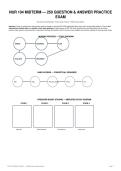
NURSING PROCESS — STUDY DIAGRAM
ASSESS DIAGNOSE PLAN
EVALUATE IMPLEMENT
HAND HYGIENE — CONCEPTUAL SEQUENCE
Wet Soap Rub all surfaces Rinse Dry
PRESSURE-INJURY STAGING — SIMPLIFIED STUDY DIAGRAM
STAGE 1 STAGE 2 STAGE 3 STAGE 4
Intact skin Partial-thickness Full-thickness Deep tissue
NUR 104 Midterm Practice — Original exam-style questions Page 1
, Human-body orientation reference
NUR 104 Midterm Practice — Original exam-style questions Page 2
, 1. Which action best represents the assessment phase of the nursing process?
■ Collecting subjective and objective patient data
• Writing measurable outcomes
• Choosing nursing interventions
•Rationale:
Determining whether outcomes were met
Assessment is the systematic collection and validation of patient data.
2. A nurse compares actual patient outcomes with expected outcomes. Which nursing-process step is being
performed?
• Assessment
• Planning
• Implementation
■ Evaluation
Rationale: Evaluation determines whether expected outcomes were achieved and whether the plan needs revision.
3. Which finding is objective data?
• “My pain is a 7.”
• “I feel dizzy.”
■ Blood pressure 88/54 mm Hg
•Rationale:
“I am worried.”
Objective data are observable or measurable findings, such as vital signs.
4. Which question is most appropriate when beginning an open-ended health history?
• “Does your chest hurt?”
■ “Tell me what brought you to the clinic today.”
• “Is the pain sharp?”
•Rationale:
“Is your pain a 6?”
Open-ended questions encourage the patient to describe the concern in their own words.
5. Which patient has the highest immediate fall risk?
• A stable adult reading in bed
• An alert adult with a steady gait
■ An older adult who is dizzy after receiving a sedative
•Rationale:
A patient wearing eyeglasses and hearing aids
Sedation plus dizziness and age-related vulnerability substantially increase fall risk.
6. Which intervention is most appropriate for a patient identified as high risk for falls?
• Keep the bed in the highest position
■ Place the call light within reach and reinforce its use
• Keep all four side rails raised routinely
•Rationale:
Encourage the patient to walk without assistance
A low bed, accessible call light, appropriate assistance, and environmental safety reduce fall risk.
7. Which action is most important before touching a patient?
• Adjust the room temperature
■ Perform hand hygiene
• Document the diagnosis
•Rationale:
Raise the bed
Hand hygiene is a core infection-prevention measure before patient contact.
8. When removing gloves, which technique helps avoid contaminating the hands?
• Touch the outside of both gloves
■ Grasp the outside of one glove near the wrist and peel it away
• Pull both gloves off by the fingertips
•Rationale:
Remove the mask first by touching its front
The outside of gloves is considered contaminated; peel from the wrist while avoiding skin contact.
9. A patient has an open sacral wound with partial-thickness skin loss and a pink-red wound bed without exposed fat.
Which stage is most consistent?
• Stage 1
■ Stage 2
• Stage 3
•Rationale:
Stage 4
Stage 2 pressure injury involves partial-thickness skin loss with exposed dermis and no exposed adipose, muscle, tendon, or bone.
NUR 104 Midterm Practice — Original exam-style questions Page 3
, 10. Which intervention best supports pressure-injury prevention?
• Massage reddened bony prominences
■ Reposition according to the individualized plan and offload pressure
• Keep the patient in one position to avoid friction
•Rationale:
Use a donut ring under the sacrum
Regular repositioning and pressure redistribution reduce tissue loading; massage over erythema can injure tissue.
11. Which position generally promotes lung expansion in a patient who is short of breath?
• Flat supine
■ High Fowler position
• Prone with the head flat
•Rationale:
Trendelenburg
Upright positioning can improve diaphragmatic excursion and ease breathing.
12. Which pain-assessment statement is most therapeutic?
• “You do not look like you are in much pain.”
• “Pain is expected after surgery, so try to ignore it.”
■ “Tell me what makes the pain better or worse.”
•Rationale:
“Your pain should be gone after the medication.”
Open-ended assessment explores the patient's experience and supports individualized treatment.
13. Which documentation entry is most objective?
• “Patient seems better today.”
• “Patient tolerated treatment well.”
■ “Incision edges approximated; 2-cm area of serosanguineous drainage noted.”
•Rationale:
“Patient is comfortable.”
Objective documentation describes observable, measurable findings without vague judgments.
14. Which action best verifies patient identity before medication administration?
• Ask the roommate to identify the patient
■ Use two approved patient identifiers
• Check only the room number
•Rationale:
Ask, “Are you Mr. Smith?”
Two approved identifiers help ensure the right patient receives the right medication or treatment.
15. A patient reports difficulty swallowing. Which nursing action is safest before giving an oral medication?
• Crush every tablet automatically
■ Assess swallowing ability and verify whether the medication may be altered
• Give the medication with a large amount of water
•Rationale:
Ask the family to administer it
Some medications must not be crushed, and dysphagia increases aspiration risk; assess and verify the formulation first.
16. Which finding most strongly suggests dehydration?
• Moist mucous membranes
• Clear urine every hour
■ Orthostatic dizziness with concentrated urine
•Rationale:
Sudden weight gain
Orthostatic symptoms and concentrated urine are common indicators of fluid deficit.
17. Which intervention best promotes normal bowel elimination?
• Restrict fluids unless the patient is thirsty
■ Encourage activity, appropriate fluids, and dietary fiber when not contraindicated
• Provide a bedpan for every bowel movement
•Rationale:
Avoid a regular toileting routine
Mobility, adequate fluid intake, fiber, and routine toileting support bowel function when appropriate.
18. Which nursing action best promotes sleep?
■ Cluster care to reduce repeated nighttime interruptions
• Turn on bright lights hourly
• Offer caffeine at bedtime
•Rationale:
Schedule all medications at midnight
Clustering care minimizes interruptions and supports a more continuous sleep period.
NUR 104 Midterm Practice — Original exam-style questions Page 4
EXAM
Nursing Fundamentals • Exam-style review • 2026 study edition
Important: These are original exam-style practice questions based on recurring NUR 104/fundamentals topics and current nursing-safety guidance. They are not
represented as leaked, stolen, or verbatim current exam questions. Public previews of NUR 104 study materials show recurring themes such as nursing
process, safety, pressure injury prevention, assessment, teaching, and infection control. Use your course syllabus and instructor materials for the exact exam scope.
NURSING PROCESS — STUDY DIAGRAM
ASSESS DIAGNOSE PLAN
EVALUATE IMPLEMENT
HAND HYGIENE — CONCEPTUAL SEQUENCE
Wet Soap Rub all surfaces Rinse Dry
PRESSURE-INJURY STAGING — SIMPLIFIED STUDY DIAGRAM
STAGE 1 STAGE 2 STAGE 3 STAGE 4
Intact skin Partial-thickness Full-thickness Deep tissue
NUR 104 Midterm Practice — Original exam-style questions Page 1
, Human-body orientation reference
NUR 104 Midterm Practice — Original exam-style questions Page 2
, 1. Which action best represents the assessment phase of the nursing process?
■ Collecting subjective and objective patient data
• Writing measurable outcomes
• Choosing nursing interventions
•Rationale:
Determining whether outcomes were met
Assessment is the systematic collection and validation of patient data.
2. A nurse compares actual patient outcomes with expected outcomes. Which nursing-process step is being
performed?
• Assessment
• Planning
• Implementation
■ Evaluation
Rationale: Evaluation determines whether expected outcomes were achieved and whether the plan needs revision.
3. Which finding is objective data?
• “My pain is a 7.”
• “I feel dizzy.”
■ Blood pressure 88/54 mm Hg
•Rationale:
“I am worried.”
Objective data are observable or measurable findings, such as vital signs.
4. Which question is most appropriate when beginning an open-ended health history?
• “Does your chest hurt?”
■ “Tell me what brought you to the clinic today.”
• “Is the pain sharp?”
•Rationale:
“Is your pain a 6?”
Open-ended questions encourage the patient to describe the concern in their own words.
5. Which patient has the highest immediate fall risk?
• A stable adult reading in bed
• An alert adult with a steady gait
■ An older adult who is dizzy after receiving a sedative
•Rationale:
A patient wearing eyeglasses and hearing aids
Sedation plus dizziness and age-related vulnerability substantially increase fall risk.
6. Which intervention is most appropriate for a patient identified as high risk for falls?
• Keep the bed in the highest position
■ Place the call light within reach and reinforce its use
• Keep all four side rails raised routinely
•Rationale:
Encourage the patient to walk without assistance
A low bed, accessible call light, appropriate assistance, and environmental safety reduce fall risk.
7. Which action is most important before touching a patient?
• Adjust the room temperature
■ Perform hand hygiene
• Document the diagnosis
•Rationale:
Raise the bed
Hand hygiene is a core infection-prevention measure before patient contact.
8. When removing gloves, which technique helps avoid contaminating the hands?
• Touch the outside of both gloves
■ Grasp the outside of one glove near the wrist and peel it away
• Pull both gloves off by the fingertips
•Rationale:
Remove the mask first by touching its front
The outside of gloves is considered contaminated; peel from the wrist while avoiding skin contact.
9. A patient has an open sacral wound with partial-thickness skin loss and a pink-red wound bed without exposed fat.
Which stage is most consistent?
• Stage 1
■ Stage 2
• Stage 3
•Rationale:
Stage 4
Stage 2 pressure injury involves partial-thickness skin loss with exposed dermis and no exposed adipose, muscle, tendon, or bone.
NUR 104 Midterm Practice — Original exam-style questions Page 3
, 10. Which intervention best supports pressure-injury prevention?
• Massage reddened bony prominences
■ Reposition according to the individualized plan and offload pressure
• Keep the patient in one position to avoid friction
•Rationale:
Use a donut ring under the sacrum
Regular repositioning and pressure redistribution reduce tissue loading; massage over erythema can injure tissue.
11. Which position generally promotes lung expansion in a patient who is short of breath?
• Flat supine
■ High Fowler position
• Prone with the head flat
•Rationale:
Trendelenburg
Upright positioning can improve diaphragmatic excursion and ease breathing.
12. Which pain-assessment statement is most therapeutic?
• “You do not look like you are in much pain.”
• “Pain is expected after surgery, so try to ignore it.”
■ “Tell me what makes the pain better or worse.”
•Rationale:
“Your pain should be gone after the medication.”
Open-ended assessment explores the patient's experience and supports individualized treatment.
13. Which documentation entry is most objective?
• “Patient seems better today.”
• “Patient tolerated treatment well.”
■ “Incision edges approximated; 2-cm area of serosanguineous drainage noted.”
•Rationale:
“Patient is comfortable.”
Objective documentation describes observable, measurable findings without vague judgments.
14. Which action best verifies patient identity before medication administration?
• Ask the roommate to identify the patient
■ Use two approved patient identifiers
• Check only the room number
•Rationale:
Ask, “Are you Mr. Smith?”
Two approved identifiers help ensure the right patient receives the right medication or treatment.
15. A patient reports difficulty swallowing. Which nursing action is safest before giving an oral medication?
• Crush every tablet automatically
■ Assess swallowing ability and verify whether the medication may be altered
• Give the medication with a large amount of water
•Rationale:
Ask the family to administer it
Some medications must not be crushed, and dysphagia increases aspiration risk; assess and verify the formulation first.
16. Which finding most strongly suggests dehydration?
• Moist mucous membranes
• Clear urine every hour
■ Orthostatic dizziness with concentrated urine
•Rationale:
Sudden weight gain
Orthostatic symptoms and concentrated urine are common indicators of fluid deficit.
17. Which intervention best promotes normal bowel elimination?
• Restrict fluids unless the patient is thirsty
■ Encourage activity, appropriate fluids, and dietary fiber when not contraindicated
• Provide a bedpan for every bowel movement
•Rationale:
Avoid a regular toileting routine
Mobility, adequate fluid intake, fiber, and routine toileting support bowel function when appropriate.
18. Which nursing action best promotes sleep?
■ Cluster care to reduce repeated nighttime interruptions
• Turn on bright lights hourly
• Offer caffeine at bedtime
•Rationale:
Schedule all medications at midnight
Clustering care minimizes interruptions and supports a more continuous sleep period.
NUR 104 Midterm Practice — Original exam-style questions Page 4


