
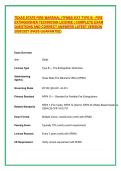
TEXAS STATE FIRE MARSHAL (TFM02) EXT TYPE B - FIRE
EXTINGUISHER TECHNICIAN LICENSE | COMPLETE EXAM
QUESTIONS AND CORRECT ANSWERS LATEST VERSION
2026/2027 (PASS GUARANTEE)
Exam Overview
Item Detail
License Type Type B — Fire Extinguisher Technician
Administering
Texas State Fire Marshal's Office (SFMO)
Agency
Governing Rules 28 TAC §34.401–34.412
Primary Standard NFPA 10 — Standard for Portable Fire Extinguishers
NFPA 1 (Fire Code), NFPA 72 (Alarm), NFPA 25 (Water-Based Systems),
Related Standards
OSHA 29 CFR 1910.157
Exam Format Multiple choice, closed book (verify with SFMO)
Passing Score Typically 70% (verify current requirement)
License Renewal Every 3 years (verify with SFMO)
CE Requirement Verify current requirement with SFMO
,Section 1: Fire Science & Fire Classes (Q1–Q15)
Q1. Which class of fire involves ordinary combustible materials such as wood,
paper, cloth, and plastics?
A. Class A
B. Class B
C. Class C
D. Class D
Answer: A
Rationale: Class A fires involve ordinary combustibles (wood, paper, cloth, rubber,
plastics). Extinguishing agents include water, foam, and dry chemical (ABC).
Q2. Which class of fire involves flammable liquids and gases?
A. Class A
B. Class B
C. Class C
D. Class K
Answer: B
Rationale: Class B fires involve flammable liquids (gasoline, oil, paint, solvents) and
flammable gases. Extinguishing agents include foam, CO₂, and dry chemical.
Q3. Which class of fire involves energized electrical equipment?
A. Class A
B. Class B
C. Class C
D. Class D
Answer: C
Rationale: Class C fires involve energized electrical equipment. Once power is
disconnected, the fire becomes Class A or B. Non-conductive agents (CO₂, dry
chemical) are used.
Q4. Which class of fire involves combustible metals such as magnesium,
titanium, and sodium?
A. Class A
B. Class B
,C. Class C
D. Class D
Answer: D
Rationale: Class D fires involve combustible metals. Special dry powder agents are
required; water and standard extinguishers are dangerous.
Q5. Which class of fire involves cooking oils and fats (vegetable or animal)?
A. Class A
B. Class B
C. Class K
D. Class D
Answer: C
Rationale: Class K fires involve cooking oils and fats in commercial cooking equipment.
Wet chemical extinguishing agents are required.
Q6. What is the fire tetrahedron?
A. Fuel, oxygen, heat, and chain reaction
B. Fuel, water, heat, and smoke
C. Oxygen, nitrogen, heat, and fuel
D. Heat, smoke, flame, and fuel
Answer: A
Rationale: The fire tetrahedron consists of fuel, oxygen, heat, and the chemical chain
reaction. Removing any element extinguishes the fire.
Q7. Which method of fire extinguishment involves cooling the fuel below its
ignition temperature?
A. Smothering
B. Cooling
C. Starvation
D. Chemical chain reaction inhibition
Answer: B
Rationale: Cooling (e.g., water) reduces the temperature of the fuel below its ignition
point. Smothering excludes oxygen; starvation removes fuel; chain reaction inhibition
interrupts the chemical reaction.
, Q8. Which method of fire extinguishment involves separating the fuel from the
fire?
A. Smothering
B. Cooling
C. Starvation
D. Chemical chain reaction inhibition
Answer: C
Rationale: Starvation removes the fuel source. Smothering excludes oxygen; cooling
reduces temperature; chain reaction inhibition interrupts the chemical reaction.
Q9. What is the primary extinguishing mechanism of carbon dioxide (CO₂)?
A. Cooling
B. Smothering (oxygen displacement)
C. Starvation
D. Chain reaction inhibition
Answer: B
Rationale: CO₂ displaces oxygen (smothering) and provides some cooling. It leaves no
residue, making it ideal for electrical and electronic equipment.
Q10. What is the primary extinguishing mechanism of dry chemical (ABC)?
A. Cooling only
B. Smothering and chain reaction inhibition
C. Starvation
D. Oxygen displacement only
Answer: B
Rationale: Dry chemical extinguishes by smothering (forming a barrier) and interrupting
the chemical chain reaction.
Q11. What is the primary extinguishing mechanism of water?
A. Smothering
B. Cooling
C. Starvation
D. Chain reaction inhibition
EXTINGUISHER TECHNICIAN LICENSE | COMPLETE EXAM
QUESTIONS AND CORRECT ANSWERS LATEST VERSION
2026/2027 (PASS GUARANTEE)
Exam Overview
Item Detail
License Type Type B — Fire Extinguisher Technician
Administering
Texas State Fire Marshal's Office (SFMO)
Agency
Governing Rules 28 TAC §34.401–34.412
Primary Standard NFPA 10 — Standard for Portable Fire Extinguishers
NFPA 1 (Fire Code), NFPA 72 (Alarm), NFPA 25 (Water-Based Systems),
Related Standards
OSHA 29 CFR 1910.157
Exam Format Multiple choice, closed book (verify with SFMO)
Passing Score Typically 70% (verify current requirement)
License Renewal Every 3 years (verify with SFMO)
CE Requirement Verify current requirement with SFMO
,Section 1: Fire Science & Fire Classes (Q1–Q15)
Q1. Which class of fire involves ordinary combustible materials such as wood,
paper, cloth, and plastics?
A. Class A
B. Class B
C. Class C
D. Class D
Answer: A
Rationale: Class A fires involve ordinary combustibles (wood, paper, cloth, rubber,
plastics). Extinguishing agents include water, foam, and dry chemical (ABC).
Q2. Which class of fire involves flammable liquids and gases?
A. Class A
B. Class B
C. Class C
D. Class K
Answer: B
Rationale: Class B fires involve flammable liquids (gasoline, oil, paint, solvents) and
flammable gases. Extinguishing agents include foam, CO₂, and dry chemical.
Q3. Which class of fire involves energized electrical equipment?
A. Class A
B. Class B
C. Class C
D. Class D
Answer: C
Rationale: Class C fires involve energized electrical equipment. Once power is
disconnected, the fire becomes Class A or B. Non-conductive agents (CO₂, dry
chemical) are used.
Q4. Which class of fire involves combustible metals such as magnesium,
titanium, and sodium?
A. Class A
B. Class B
,C. Class C
D. Class D
Answer: D
Rationale: Class D fires involve combustible metals. Special dry powder agents are
required; water and standard extinguishers are dangerous.
Q5. Which class of fire involves cooking oils and fats (vegetable or animal)?
A. Class A
B. Class B
C. Class K
D. Class D
Answer: C
Rationale: Class K fires involve cooking oils and fats in commercial cooking equipment.
Wet chemical extinguishing agents are required.
Q6. What is the fire tetrahedron?
A. Fuel, oxygen, heat, and chain reaction
B. Fuel, water, heat, and smoke
C. Oxygen, nitrogen, heat, and fuel
D. Heat, smoke, flame, and fuel
Answer: A
Rationale: The fire tetrahedron consists of fuel, oxygen, heat, and the chemical chain
reaction. Removing any element extinguishes the fire.
Q7. Which method of fire extinguishment involves cooling the fuel below its
ignition temperature?
A. Smothering
B. Cooling
C. Starvation
D. Chemical chain reaction inhibition
Answer: B
Rationale: Cooling (e.g., water) reduces the temperature of the fuel below its ignition
point. Smothering excludes oxygen; starvation removes fuel; chain reaction inhibition
interrupts the chemical reaction.
, Q8. Which method of fire extinguishment involves separating the fuel from the
fire?
A. Smothering
B. Cooling
C. Starvation
D. Chemical chain reaction inhibition
Answer: C
Rationale: Starvation removes the fuel source. Smothering excludes oxygen; cooling
reduces temperature; chain reaction inhibition interrupts the chemical reaction.
Q9. What is the primary extinguishing mechanism of carbon dioxide (CO₂)?
A. Cooling
B. Smothering (oxygen displacement)
C. Starvation
D. Chain reaction inhibition
Answer: B
Rationale: CO₂ displaces oxygen (smothering) and provides some cooling. It leaves no
residue, making it ideal for electrical and electronic equipment.
Q10. What is the primary extinguishing mechanism of dry chemical (ABC)?
A. Cooling only
B. Smothering and chain reaction inhibition
C. Starvation
D. Oxygen displacement only
Answer: B
Rationale: Dry chemical extinguishes by smothering (forming a barrier) and interrupting
the chemical chain reaction.
Q11. What is the primary extinguishing mechanism of water?
A. Smothering
B. Cooling
C. Starvation
D. Chain reaction inhibition


