
TEST BANK For Edelman and Kudzma's Canadian Health Promotion
Throughout the Life Span, Policy
1st& systems
Edition by Dames, Luctkar-Flude &
Tyerman — 250Community
Original Exam-Style Questions
& environment
Family & social support
Individual
Health
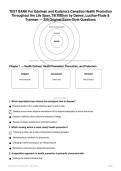
Original diagram: health is influenced by interacting individual, social, community, and system factors.
Chapter 1 — Health Defined: Health Promotion, Prevention, and Protection
PRIMARY SECONDARY TERTIARY
Prevent disease Detect early Reduce impact
Original study diagram.
1. Which description best reflects the ecological view of disease?
Disease results from a single infectious agent in every case.
✓ Disease occurs when adaptive mechanisms fail to respond adequately to stimuli and stress.
Disease is defined only by abnormal laboratory findings.
Disease is always caused by an inherited mutation.
2. Which nursing action is most clearly health promotion?
✓ Teaching a client how to stop smoking before disease develops.
Administering an antibiotic for pneumonia.
Changing a sterile dressing on an infected wound.
Monitoring a client during a diagnostic procedure.
3. A population approach to health promotion is primarily concerned with:
Treating the sickest individual first.
Original exam-style study bank • 250 questions Page 1
, ✓ Improving health across the population while reducing inequities.
Replacing primary care with hospital care.
Focusing only on genetic risk.
4. Which activity is an example of primary prevention?
Rehabilitation after a stroke.
Screening for colorectal cancer.
✓ Immunization against an infectious disease.
Treating hypertension after diagnosis.
5. Which activity is an example of secondary prevention?
Smoking cessation before illness occurs.
✓ Screening to detect disease at an early stage.
Physiotherapy after a fracture.
Palliative care for advanced disease.
6. Which activity is an example of tertiary prevention?
Vaccination.
Health teaching about sunscreen.
✓ Rehabilitation after a disabling injury.
Screening mammography.
7. The nurse's best first step when planning a health-promotion intervention is to:
Select teaching materials.
✓ Assess the person's or population's needs and context.
Choose a medication.
Schedule a follow-up visit.
8. Which factor is a determinant of health?
✓ Income and social status.
Blood type alone.
Eye colour.
Hand dominance.
9. Health protection is best represented by:
Original exam-style study bank • 250 questions Page 2
, ✓ Measures that reduce exposure to health hazards.
Treatment after complications occur.
Replacing client decisions with professional decisions.
Avoiding all physical activity.
10. A client says, “Health means being able to do what matters to me.” The nurse should recognize
this as:
✓ A functional and holistic view of health.
A purely biomedical definition.
A definition limited to disease absence.
A definition based only on laboratory values.
Chapter 2 — Diverse Populations and Health
11. Which approach best demonstrates cultural safety?
Assuming all members of a cultural group share identical beliefs.
✓ Asking the client how culture and identity affect their health choices.
Using the nurse's own cultural practices as the standard.
Avoiding discussion of culture entirely.
12. A health inequity is best described as:
Any difference in health between two people.
✓ An avoidable and unfair difference in health associated with social conditions.
A difference caused only by age.
A variation in blood pressure within one family.
13. When caring for a client who speaks limited English, the nurse should preferably:
Ask a young child to interpret.
✓ Use a qualified health-care interpreter.
Speak louder in English.
Skip informed teaching.
14. Which action is most consistent with cultural humility?
Claiming competence in every culture.
✓ Engaging in ongoing self-reflection about one's assumptions and power.
Original exam-style study bank • 250 questions Page 3
, Memorizing a list of beliefs for every cultural group.
Treating culture as irrelevant to care.
15. Which factor can contribute to health disparities among newcomers?
✓ Language barriers and difficulty navigating services.
Having a different eye colour.
Living in a household with more than one person.
Knowing two languages.
16. A nurse should avoid stereotyping because stereotypes:
Always improve communication.
✓ Reduce an individual to assumptions about a group.
Are required for culturally safe care.
Replace the need for assessment.
17. Which statement about Indigenous health is most appropriate?
Health can be understood without considering historical and social context.
✓ Colonization and ongoing structural factors can influence health and access to care.
All Indigenous communities have identical health needs.
Culture should never be discussed in health care.
18. The best way to assess a client's preferred health practices is to:
✓ Ask open-ended, nonjudgmental questions.
Tell the client which practices are acceptable.
Assume practices from the client's surname.
Use a generic checklist without discussion.
Prenatal Infant Child Adolescent Adult Older adult
Original study diagram.
19. A community program designed with community members rather than for them emphasizes:
Original exam-style study bank • 250 questions Page 4
Throughout the Life Span, Policy
1st& systems
Edition by Dames, Luctkar-Flude &
Tyerman — 250Community
Original Exam-Style Questions
& environment
Family & social support
Individual
Health
Original diagram: health is influenced by interacting individual, social, community, and system factors.
Chapter 1 — Health Defined: Health Promotion, Prevention, and Protection
PRIMARY SECONDARY TERTIARY
Prevent disease Detect early Reduce impact
Original study diagram.
1. Which description best reflects the ecological view of disease?
Disease results from a single infectious agent in every case.
✓ Disease occurs when adaptive mechanisms fail to respond adequately to stimuli and stress.
Disease is defined only by abnormal laboratory findings.
Disease is always caused by an inherited mutation.
2. Which nursing action is most clearly health promotion?
✓ Teaching a client how to stop smoking before disease develops.
Administering an antibiotic for pneumonia.
Changing a sterile dressing on an infected wound.
Monitoring a client during a diagnostic procedure.
3. A population approach to health promotion is primarily concerned with:
Treating the sickest individual first.
Original exam-style study bank • 250 questions Page 1
, ✓ Improving health across the population while reducing inequities.
Replacing primary care with hospital care.
Focusing only on genetic risk.
4. Which activity is an example of primary prevention?
Rehabilitation after a stroke.
Screening for colorectal cancer.
✓ Immunization against an infectious disease.
Treating hypertension after diagnosis.
5. Which activity is an example of secondary prevention?
Smoking cessation before illness occurs.
✓ Screening to detect disease at an early stage.
Physiotherapy after a fracture.
Palliative care for advanced disease.
6. Which activity is an example of tertiary prevention?
Vaccination.
Health teaching about sunscreen.
✓ Rehabilitation after a disabling injury.
Screening mammography.
7. The nurse's best first step when planning a health-promotion intervention is to:
Select teaching materials.
✓ Assess the person's or population's needs and context.
Choose a medication.
Schedule a follow-up visit.
8. Which factor is a determinant of health?
✓ Income and social status.
Blood type alone.
Eye colour.
Hand dominance.
9. Health protection is best represented by:
Original exam-style study bank • 250 questions Page 2
, ✓ Measures that reduce exposure to health hazards.
Treatment after complications occur.
Replacing client decisions with professional decisions.
Avoiding all physical activity.
10. A client says, “Health means being able to do what matters to me.” The nurse should recognize
this as:
✓ A functional and holistic view of health.
A purely biomedical definition.
A definition limited to disease absence.
A definition based only on laboratory values.
Chapter 2 — Diverse Populations and Health
11. Which approach best demonstrates cultural safety?
Assuming all members of a cultural group share identical beliefs.
✓ Asking the client how culture and identity affect their health choices.
Using the nurse's own cultural practices as the standard.
Avoiding discussion of culture entirely.
12. A health inequity is best described as:
Any difference in health between two people.
✓ An avoidable and unfair difference in health associated with social conditions.
A difference caused only by age.
A variation in blood pressure within one family.
13. When caring for a client who speaks limited English, the nurse should preferably:
Ask a young child to interpret.
✓ Use a qualified health-care interpreter.
Speak louder in English.
Skip informed teaching.
14. Which action is most consistent with cultural humility?
Claiming competence in every culture.
✓ Engaging in ongoing self-reflection about one's assumptions and power.
Original exam-style study bank • 250 questions Page 3
, Memorizing a list of beliefs for every cultural group.
Treating culture as irrelevant to care.
15. Which factor can contribute to health disparities among newcomers?
✓ Language barriers and difficulty navigating services.
Having a different eye colour.
Living in a household with more than one person.
Knowing two languages.
16. A nurse should avoid stereotyping because stereotypes:
Always improve communication.
✓ Reduce an individual to assumptions about a group.
Are required for culturally safe care.
Replace the need for assessment.
17. Which statement about Indigenous health is most appropriate?
Health can be understood without considering historical and social context.
✓ Colonization and ongoing structural factors can influence health and access to care.
All Indigenous communities have identical health needs.
Culture should never be discussed in health care.
18. The best way to assess a client's preferred health practices is to:
✓ Ask open-ended, nonjudgmental questions.
Tell the client which practices are acceptable.
Assume practices from the client's surname.
Use a generic checklist without discussion.
Prenatal Infant Child Adolescent Adult Older adult
Original study diagram.
19. A community program designed with community members rather than for them emphasizes:
Original exam-style study bank • 250 questions Page 4


