
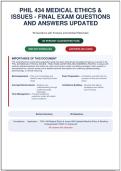
PHIL 434 MEDICAL ETHICS &
ISSUES - FINAL EXAM QUESTIONS
AND ANSWERS UPDATED
99 Questions with Answers and Detailed Rationales
100 PERCENT GUARANTEED PASS
INSTANT DOWNLOAD ANSWERS INCLUDED
IMPORTANCE OF THIS DOCUMENT
This comprehensive examination preparation guide has been meticulously developed to help you succeed in the
PHIL 434 MEDICAL ETHICS & ISSUES - FINAL EXAM QUESTIONS AND ANSWERS UPDATED. It contains 99
carefully selected questions that reflect the most current exam content and testing strategies. Each question is
accompanied by a correct answer and a detailed rationale that explains the underlying pathophysiology,
pharmacology, or clinical reasoning.
Self-Assessment – Test your knowledge and Exam Preparation – Familiarize yourself with the
identify areas requiring further question format and content
study areas
Concept Reinforcement – Deepen your Confidence Building – Develop test-taking
understanding through strategies and reduce
evidence-based exam anxiety
rationales
Time Management – Practice answering
questions under simulated
exam conditions
Review Summary 99 Questions
Foundations - Application - PHIL 434 Medical Ethics & Issues AND Updated Medical Ethics & Bioethics
Undergraduate YEAR 3-4 Advanced
All answers with rationales
,Table of Contents
Content Area Questions Key Topics
PHIL 434 Medical Ethics & 1-17 Ethical, Principle, Directly, Clinical, Hospital
Issues AND Updated Medical
Ethics & Bioethics
Undergraduate YEAR 3-4
Advanced
Directly 18-34 Ethical, Contemporary, Ethics, Patient S, Refusal
Policy 35-51 Ethical, Directly, Ethics, Consent, Health
Patient S 52-68 Ethical, Consent, Directly, Trial, Without
Principle 69-85 Ethical, Directly, Patients, Policy, Trial
Ethics 86-99 Ethical, Directly, Physician, Treatment, Standard
TOTAL 99 All questions include answers and detailed rationales
,Section A - PHIL 434 Medical Ethics & Issues AND Updated
Medical Ethics & Bioethics Undergraduate YEAR 3-4
Advanced
Q1.
A patient with decision-making capacity refuses a life-saving blood transfusion due to
religious beliefs. The clinical team disagrees. Which ethical principle most directly
supports honoring the refusal?
A. Beneficence B. Nonmaleficence
C. Autonomy D. Justice
Correct: C - Autonomy
Rationale:Autonomy emphasizes the patient's right to self-determination, even if the decision
may lead to harm. Beneficence and nonmaleficence would support overriding the refusal to
save life, while justice concerns fair distribution of resources. Thus, autonomy is the correct
principle.
Q2.
In a resource-limited setting, a hospital must allocate a single ventilator. Which allocation
framework is most consistent with utilitarian ethics?
A. First-come, first-served B. Save the most lives
C. Priority to the youngest D. Random lottery
Correct: B - Save the most lives
Rationale:Utilitarianism seeks to maximize overall benefit, so saving the most lives aligns
with that goal. First-come, first-served and random lottery are fair but not utility-maximizing,
while prioritizing the youngest is not strictly utilitarian. Thus, B is correct.
Q3.
Which of the following best illustrates the ethical concept of 'therapeutic misconception'
in clinical research?
A. A participant believes the trial will directly B. A researcher fails to obtain informed
benefit them personally. consent.
C. A participant is randomized to a placebo D. A researcher has a financial conflict of
group. interest.
Correct: A - A participant believes the trial will directly benefit them personally.
Page 3
, Section A - PHIL 434 Medical Ethics & Issues AND Updated Medical Ethics & Bioethics Undergraduate YEAR 3-4 Advanced
Rationale: Therapeutic misconception occurs when research participants conflate the goals of
research (producing generalizable knowledge) with the goals of clinical care (personal
benefit). The other options describe separate ethical issues: consent violations, trial design,
and conflicts of interest.
Q4.
A patient with advanced dementia has no advance directive. The family requests
aggressive treatment, but the care team believes it is futile. Which ethical approach is
most appropriate?
A. Unilateral decision by the physician B. Family-centered decision making
C. Institutional ethics committee review D. Immediate withdrawal of treatment
Correct: C - Institutional ethics committee review
Rationale:When there is disagreement about futility and no advance directive, an ethics
committee can mediate and provide guidance. Unilateral physician decisions may violate
patient/family rights, family-centered decision making may not address futility, and immediate
withdrawal is premature. Thus, ethics committee review is best.
Q5.
Which of the following scenarios best exemplifies a 'duty to warn' in genetic counseling?
A. A patient refuses to disclose a BRCA B. A patient requests genetic testing for
mutation to relatives. ancestry.
C. A patient consents to share genetic data D. A patient seeks prenatal testing for Down
with a research database. syndrome.
Correct: A - A patient refuses to disclose a BRCA mutation to relatives.
Rationale:Duty to warn arises when a genetic condition poses a serious, preventable risk to
identifiable relatives. Refusing to disclose a BRCA mutation may trigger this duty. The other
options involve non-disclosure of risk, research participation, or reproductive testing, which do
not directly invoke duty to warn.
Q6.
During a pandemic, a government implements mandatory vaccination. Which ethical
justification is most consistent with public health ethics?
A. Respect for individual autonomy B. Principle of least restrictive means
C. Harm principle D. Reciprocity
Correct: C - Harm principle
Page 4
ISSUES - FINAL EXAM QUESTIONS
AND ANSWERS UPDATED
99 Questions with Answers and Detailed Rationales
100 PERCENT GUARANTEED PASS
INSTANT DOWNLOAD ANSWERS INCLUDED
IMPORTANCE OF THIS DOCUMENT
This comprehensive examination preparation guide has been meticulously developed to help you succeed in the
PHIL 434 MEDICAL ETHICS & ISSUES - FINAL EXAM QUESTIONS AND ANSWERS UPDATED. It contains 99
carefully selected questions that reflect the most current exam content and testing strategies. Each question is
accompanied by a correct answer and a detailed rationale that explains the underlying pathophysiology,
pharmacology, or clinical reasoning.
Self-Assessment – Test your knowledge and Exam Preparation – Familiarize yourself with the
identify areas requiring further question format and content
study areas
Concept Reinforcement – Deepen your Confidence Building – Develop test-taking
understanding through strategies and reduce
evidence-based exam anxiety
rationales
Time Management – Practice answering
questions under simulated
exam conditions
Review Summary 99 Questions
Foundations - Application - PHIL 434 Medical Ethics & Issues AND Updated Medical Ethics & Bioethics
Undergraduate YEAR 3-4 Advanced
All answers with rationales
,Table of Contents
Content Area Questions Key Topics
PHIL 434 Medical Ethics & 1-17 Ethical, Principle, Directly, Clinical, Hospital
Issues AND Updated Medical
Ethics & Bioethics
Undergraduate YEAR 3-4
Advanced
Directly 18-34 Ethical, Contemporary, Ethics, Patient S, Refusal
Policy 35-51 Ethical, Directly, Ethics, Consent, Health
Patient S 52-68 Ethical, Consent, Directly, Trial, Without
Principle 69-85 Ethical, Directly, Patients, Policy, Trial
Ethics 86-99 Ethical, Directly, Physician, Treatment, Standard
TOTAL 99 All questions include answers and detailed rationales
,Section A - PHIL 434 Medical Ethics & Issues AND Updated
Medical Ethics & Bioethics Undergraduate YEAR 3-4
Advanced
Q1.
A patient with decision-making capacity refuses a life-saving blood transfusion due to
religious beliefs. The clinical team disagrees. Which ethical principle most directly
supports honoring the refusal?
A. Beneficence B. Nonmaleficence
C. Autonomy D. Justice
Correct: C - Autonomy
Rationale:Autonomy emphasizes the patient's right to self-determination, even if the decision
may lead to harm. Beneficence and nonmaleficence would support overriding the refusal to
save life, while justice concerns fair distribution of resources. Thus, autonomy is the correct
principle.
Q2.
In a resource-limited setting, a hospital must allocate a single ventilator. Which allocation
framework is most consistent with utilitarian ethics?
A. First-come, first-served B. Save the most lives
C. Priority to the youngest D. Random lottery
Correct: B - Save the most lives
Rationale:Utilitarianism seeks to maximize overall benefit, so saving the most lives aligns
with that goal. First-come, first-served and random lottery are fair but not utility-maximizing,
while prioritizing the youngest is not strictly utilitarian. Thus, B is correct.
Q3.
Which of the following best illustrates the ethical concept of 'therapeutic misconception'
in clinical research?
A. A participant believes the trial will directly B. A researcher fails to obtain informed
benefit them personally. consent.
C. A participant is randomized to a placebo D. A researcher has a financial conflict of
group. interest.
Correct: A - A participant believes the trial will directly benefit them personally.
Page 3
, Section A - PHIL 434 Medical Ethics & Issues AND Updated Medical Ethics & Bioethics Undergraduate YEAR 3-4 Advanced
Rationale: Therapeutic misconception occurs when research participants conflate the goals of
research (producing generalizable knowledge) with the goals of clinical care (personal
benefit). The other options describe separate ethical issues: consent violations, trial design,
and conflicts of interest.
Q4.
A patient with advanced dementia has no advance directive. The family requests
aggressive treatment, but the care team believes it is futile. Which ethical approach is
most appropriate?
A. Unilateral decision by the physician B. Family-centered decision making
C. Institutional ethics committee review D. Immediate withdrawal of treatment
Correct: C - Institutional ethics committee review
Rationale:When there is disagreement about futility and no advance directive, an ethics
committee can mediate and provide guidance. Unilateral physician decisions may violate
patient/family rights, family-centered decision making may not address futility, and immediate
withdrawal is premature. Thus, ethics committee review is best.
Q5.
Which of the following scenarios best exemplifies a 'duty to warn' in genetic counseling?
A. A patient refuses to disclose a BRCA B. A patient requests genetic testing for
mutation to relatives. ancestry.
C. A patient consents to share genetic data D. A patient seeks prenatal testing for Down
with a research database. syndrome.
Correct: A - A patient refuses to disclose a BRCA mutation to relatives.
Rationale:Duty to warn arises when a genetic condition poses a serious, preventable risk to
identifiable relatives. Refusing to disclose a BRCA mutation may trigger this duty. The other
options involve non-disclosure of risk, research participation, or reproductive testing, which do
not directly invoke duty to warn.
Q6.
During a pandemic, a government implements mandatory vaccination. Which ethical
justification is most consistent with public health ethics?
A. Respect for individual autonomy B. Principle of least restrictive means
C. Harm principle D. Reciprocity
Correct: C - Harm principle
Page 4


