
WGU D115 OA — Advanced Pathophysiology
Original OA-Style Practice Exam • 250 Questions • Detailed Answers & Study Guide
Important: These are original practice questions designed around advanced pathophysiology concepts and case-based reasoning. They are not copies of
current WGU OA questions, and no score/pass guarantee is implied.
Aorta
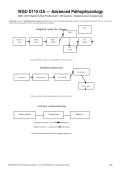
Simplified cardiac flow diagram
Lungs
Systemic Right Right Left
veins atrium ventricle ventricle
Left
atrium
Deoxygenated blood → lungs → oxygenated blood → systemic circulation
Simplified nephron flow
Distal tubule
Glomerulus Proximal tubule Loop of Henle
Collecting duct
Filtrate is modified by tubular reabsorption and secretion before urine exits.
Acid–base compensation map
Primary problem Compensation pH moves
Respiratory disorders → renal HCO■■ compensation
Metabolic disorders → respiratory PaCO■ compensation
Identify the primary abnormality before judging compensation.
Original WGU D115 OA-style practice material — not an official WGU exam or leaked question bank. Page 1
, 1. A patient has a localized increase in tissue size caused by enlargement of individual skeletal muscle fibers after
resistance training. Which adaptation is this?
• Hyperplasia
■ Hypertrophy
• Metaplasia
• Atrophy
✓ Correct answer: Hypertrophy
Why: Hypertrophy is an increase in cell size. Skeletal muscle primarily adapts to increased workload through hypertrophy rather than true
hyperplasia.
Domain: Cellular injury & adaptation • Key concept: Hypertrophy
2. A chronically acid-exposed esophageal epithelium changes from squamous to a columnar intestinal-type
epithelium. This process is best described as:
• Dysplasia
■ Metaplasia
• Hypertrophy
• Apoptosis
✓ Correct answer: Metaplasia
Why: Metaplasia is a reversible substitution of one differentiated cell type for another in response to chronic stress. It can increase the risk
of subsequent dysplasia and malignancy.
Domain: Cellular injury & adaptation • Key concept: Metaplasia
3. Which feature most strongly distinguishes apoptosis from necrosis?
• Marked cell swelling
• Leakage of intracellular enzymes
■ Programmed cell death with minimal inflammation
• Always caused by ischemia
✓ Correct answer: Programmed cell death with minimal inflammation
Why: Apoptosis is regulated cell death with cell shrinkage and fragmentation into apoptotic bodies, generally without the inflammatory
response typical of necrosis.
Domain: Cellular injury & adaptation • Key concept: Apoptosis
4. During prolonged hypoxia, failure of the sodium-potassium pump causes intracellular accumulation of which
substance?
• Calcium
■ Sodium
• Chloride
• Bicarbonate
✓ Correct answer: Sodium
Why: ATP depletion impairs Na+/K+-ATPase activity, allowing sodium and water to accumulate inside cells and causing cellular swelling.
Domain: Cellular injury & adaptation • Key concept: ATP depletion
5. A patient with severe ischemia develops irreversible mitochondrial damage and plasma-membrane disruption.
Which finding most supports irreversible cell injury?
• Transient ATP reduction
• Cellular swelling
■ Loss of membrane integrity
• Glycogen depletion
✓ Correct answer: Loss of membrane integrity
Why: Irreversible injury is associated with profound mitochondrial dysfunction and loss of membrane integrity, leading to leakage of
intracellular contents.
Domain: Cellular injury & adaptation • Key concept: Irreversible injury
6. Which inflammatory mediator is most directly responsible for fever through effects on the hypothalamic
temperature set point?
Original WGU D115 OA-style practice material — not an official WGU exam or leaked question bank. Page 2
, • Histamine
■ Prostaglandin E2
• Bradykinin
• Complement C3b
✓ Correct answer: Prostaglandin E2
Why: Pyrogenic cytokines stimulate prostaglandin E2 production in the hypothalamus, raising the temperature set point and producing
fever.
Domain: Inflammation & immunity • Key concept: PGE2
7. A patient develops urticaria, bronchospasm, and hypotension minutes after exposure to an allergen. Which
immunoglobulin is most directly involved?
• IgA
• IgG
• IgM
■ IgE
✓ Correct answer: IgE
Why: IgE binds mast cells and basophils. Cross-linking by antigen triggers rapid degranulation and release of mediators responsible for
immediate hypersensitivity.
Domain: Inflammation & immunity • Key concept: IgE
8. Which leukocyte is usually the predominant cell during the earliest phase of acute bacterial inflammation?
■ Neutrophil
• Eosinophil
• Lymphocyte
• Monocyte
✓ Correct answer: Neutrophil
Why: Neutrophils are rapidly recruited to sites of acute inflammation and commonly predominate during the first hours to roughly 24–48
hours.
Domain: Inflammation & immunity • Key concept: Neutrophil
9. A patient has a chronic inflammatory disorder with tissue destruction and fibrosis. Which cell type is especially
important in sustaining chronic inflammation?
■ Macrophage
• Platelet
• Erythrocyte
• Basophil
✓ Correct answer: Macrophage
Why: Macrophages release cytokines, growth factors, and enzymes that can perpetuate inflammation, promote tissue injury, and stimulate
fibrosis.
Domain: Inflammation & immunity • Key concept: Macrophage
10. Which complement fragment is a potent chemoattractant for neutrophils?
• C1 inhibitor
• C3b
■ C5a
• C9
✓ Correct answer: C5a
Why: C5a promotes leukocyte chemotaxis and activation and contributes to inflammatory amplification.
Domain: Inflammation & immunity • Key concept: C5a
11. A patient develops a painless, fluctuant collection of purulent material after a bacterial infection. Which process
best explains the lesion?
• Serous inflammation
■ Abscess formation
Original WGU D115 OA-style practice material — not an official WGU exam or leaked question bank. Page 3
, • Granuloma formation
• Transudation
✓ Correct answer: Abscess formation
Why: An abscess is a localized collection of pus containing neutrophils, necrotic debris, and microorganisms, usually caused by pyogenic
bacteria.
Domain: Inflammation & immunity • Key concept: Abscess
12. Which immune cell is primarily responsible for producing antibodies after differentiation into a plasma cell?
• T helper cell
■ B lymphocyte
• Natural killer cell
• Neutrophil
✓ Correct answer: B lymphocyte
Why: Activated B lymphocytes differentiate into plasma cells, which synthesize and secrete immunoglobulins.
Domain: Inflammation & immunity • Key concept: B cell
13. A patient with a viral infection has cells displaying viral peptides on major histocompatibility complex class I
molecules. Which cells recognize these peptides most directly?
■ CD8+ cytotoxic T cells
• CD4+ helper T cells
• B cells
• Eosinophils
✓ Correct answer: CD8+ cytotoxic T cells
Why: MHC class I presents endogenous intracellular peptides to CD8+ cytotoxic T lymphocytes, which can kill infected cells.
Domain: Inflammation & immunity • Key concept: MHC I
14. Which cytokine is a major endogenous mediator of fever and the acute-phase response?
■ IL-1
• IL-4
• IL-5
• IL-10
✓ Correct answer: IL-1
Why: IL-1 is a key pro-inflammatory cytokine that contributes to fever and stimulates acute-phase responses.
Domain: Inflammation & immunity • Key concept: IL-1
15. A patient with systemic inflammation has elevated C-reactive protein. CRP is best classified as a:
• Tumor marker
■ Acute-phase reactant
• Clotting factor inhibitor
• Complement deficiency
✓ Correct answer: Acute-phase reactant
Why: CRP is an acute-phase protein produced by the liver in response to inflammatory cytokines, especially IL-6.
Domain: Inflammation & immunity • Key concept: CRP
16. Which hypersensitivity reaction is mediated primarily by immune-complex deposition?
• Type I
• Type II
■ Type III
• Type IV
✓ Correct answer: Type III
Why: Type III hypersensitivity results from circulating antigen-antibody complexes depositing in tissues and activating complement and
inflammation.
Domain: Inflammation & immunity • Key concept: Type III
Original WGU D115 OA-style practice material — not an official WGU exam or leaked question bank. Page 4
Original OA-Style Practice Exam • 250 Questions • Detailed Answers & Study Guide
Important: These are original practice questions designed around advanced pathophysiology concepts and case-based reasoning. They are not copies of
current WGU OA questions, and no score/pass guarantee is implied.
Aorta
Simplified cardiac flow diagram
Lungs
Systemic Right Right Left
veins atrium ventricle ventricle
Left
atrium
Deoxygenated blood → lungs → oxygenated blood → systemic circulation
Simplified nephron flow
Distal tubule
Glomerulus Proximal tubule Loop of Henle
Collecting duct
Filtrate is modified by tubular reabsorption and secretion before urine exits.
Acid–base compensation map
Primary problem Compensation pH moves
Respiratory disorders → renal HCO■■ compensation
Metabolic disorders → respiratory PaCO■ compensation
Identify the primary abnormality before judging compensation.
Original WGU D115 OA-style practice material — not an official WGU exam or leaked question bank. Page 1
, 1. A patient has a localized increase in tissue size caused by enlargement of individual skeletal muscle fibers after
resistance training. Which adaptation is this?
• Hyperplasia
■ Hypertrophy
• Metaplasia
• Atrophy
✓ Correct answer: Hypertrophy
Why: Hypertrophy is an increase in cell size. Skeletal muscle primarily adapts to increased workload through hypertrophy rather than true
hyperplasia.
Domain: Cellular injury & adaptation • Key concept: Hypertrophy
2. A chronically acid-exposed esophageal epithelium changes from squamous to a columnar intestinal-type
epithelium. This process is best described as:
• Dysplasia
■ Metaplasia
• Hypertrophy
• Apoptosis
✓ Correct answer: Metaplasia
Why: Metaplasia is a reversible substitution of one differentiated cell type for another in response to chronic stress. It can increase the risk
of subsequent dysplasia and malignancy.
Domain: Cellular injury & adaptation • Key concept: Metaplasia
3. Which feature most strongly distinguishes apoptosis from necrosis?
• Marked cell swelling
• Leakage of intracellular enzymes
■ Programmed cell death with minimal inflammation
• Always caused by ischemia
✓ Correct answer: Programmed cell death with minimal inflammation
Why: Apoptosis is regulated cell death with cell shrinkage and fragmentation into apoptotic bodies, generally without the inflammatory
response typical of necrosis.
Domain: Cellular injury & adaptation • Key concept: Apoptosis
4. During prolonged hypoxia, failure of the sodium-potassium pump causes intracellular accumulation of which
substance?
• Calcium
■ Sodium
• Chloride
• Bicarbonate
✓ Correct answer: Sodium
Why: ATP depletion impairs Na+/K+-ATPase activity, allowing sodium and water to accumulate inside cells and causing cellular swelling.
Domain: Cellular injury & adaptation • Key concept: ATP depletion
5. A patient with severe ischemia develops irreversible mitochondrial damage and plasma-membrane disruption.
Which finding most supports irreversible cell injury?
• Transient ATP reduction
• Cellular swelling
■ Loss of membrane integrity
• Glycogen depletion
✓ Correct answer: Loss of membrane integrity
Why: Irreversible injury is associated with profound mitochondrial dysfunction and loss of membrane integrity, leading to leakage of
intracellular contents.
Domain: Cellular injury & adaptation • Key concept: Irreversible injury
6. Which inflammatory mediator is most directly responsible for fever through effects on the hypothalamic
temperature set point?
Original WGU D115 OA-style practice material — not an official WGU exam or leaked question bank. Page 2
, • Histamine
■ Prostaglandin E2
• Bradykinin
• Complement C3b
✓ Correct answer: Prostaglandin E2
Why: Pyrogenic cytokines stimulate prostaglandin E2 production in the hypothalamus, raising the temperature set point and producing
fever.
Domain: Inflammation & immunity • Key concept: PGE2
7. A patient develops urticaria, bronchospasm, and hypotension minutes after exposure to an allergen. Which
immunoglobulin is most directly involved?
• IgA
• IgG
• IgM
■ IgE
✓ Correct answer: IgE
Why: IgE binds mast cells and basophils. Cross-linking by antigen triggers rapid degranulation and release of mediators responsible for
immediate hypersensitivity.
Domain: Inflammation & immunity • Key concept: IgE
8. Which leukocyte is usually the predominant cell during the earliest phase of acute bacterial inflammation?
■ Neutrophil
• Eosinophil
• Lymphocyte
• Monocyte
✓ Correct answer: Neutrophil
Why: Neutrophils are rapidly recruited to sites of acute inflammation and commonly predominate during the first hours to roughly 24–48
hours.
Domain: Inflammation & immunity • Key concept: Neutrophil
9. A patient has a chronic inflammatory disorder with tissue destruction and fibrosis. Which cell type is especially
important in sustaining chronic inflammation?
■ Macrophage
• Platelet
• Erythrocyte
• Basophil
✓ Correct answer: Macrophage
Why: Macrophages release cytokines, growth factors, and enzymes that can perpetuate inflammation, promote tissue injury, and stimulate
fibrosis.
Domain: Inflammation & immunity • Key concept: Macrophage
10. Which complement fragment is a potent chemoattractant for neutrophils?
• C1 inhibitor
• C3b
■ C5a
• C9
✓ Correct answer: C5a
Why: C5a promotes leukocyte chemotaxis and activation and contributes to inflammatory amplification.
Domain: Inflammation & immunity • Key concept: C5a
11. A patient develops a painless, fluctuant collection of purulent material after a bacterial infection. Which process
best explains the lesion?
• Serous inflammation
■ Abscess formation
Original WGU D115 OA-style practice material — not an official WGU exam or leaked question bank. Page 3
, • Granuloma formation
• Transudation
✓ Correct answer: Abscess formation
Why: An abscess is a localized collection of pus containing neutrophils, necrotic debris, and microorganisms, usually caused by pyogenic
bacteria.
Domain: Inflammation & immunity • Key concept: Abscess
12. Which immune cell is primarily responsible for producing antibodies after differentiation into a plasma cell?
• T helper cell
■ B lymphocyte
• Natural killer cell
• Neutrophil
✓ Correct answer: B lymphocyte
Why: Activated B lymphocytes differentiate into plasma cells, which synthesize and secrete immunoglobulins.
Domain: Inflammation & immunity • Key concept: B cell
13. A patient with a viral infection has cells displaying viral peptides on major histocompatibility complex class I
molecules. Which cells recognize these peptides most directly?
■ CD8+ cytotoxic T cells
• CD4+ helper T cells
• B cells
• Eosinophils
✓ Correct answer: CD8+ cytotoxic T cells
Why: MHC class I presents endogenous intracellular peptides to CD8+ cytotoxic T lymphocytes, which can kill infected cells.
Domain: Inflammation & immunity • Key concept: MHC I
14. Which cytokine is a major endogenous mediator of fever and the acute-phase response?
■ IL-1
• IL-4
• IL-5
• IL-10
✓ Correct answer: IL-1
Why: IL-1 is a key pro-inflammatory cytokine that contributes to fever and stimulates acute-phase responses.
Domain: Inflammation & immunity • Key concept: IL-1
15. A patient with systemic inflammation has elevated C-reactive protein. CRP is best classified as a:
• Tumor marker
■ Acute-phase reactant
• Clotting factor inhibitor
• Complement deficiency
✓ Correct answer: Acute-phase reactant
Why: CRP is an acute-phase protein produced by the liver in response to inflammatory cytokines, especially IL-6.
Domain: Inflammation & immunity • Key concept: CRP
16. Which hypersensitivity reaction is mediated primarily by immune-complex deposition?
• Type I
• Type II
■ Type III
• Type IV
✓ Correct answer: Type III
Why: Type III hypersensitivity results from circulating antigen-antibody complexes depositing in tissues and activating complement and
inflammation.
Domain: Inflammation & immunity • Key concept: Type III
Original WGU D115 OA-style practice material — not an official WGU exam or leaked question bank. Page 4


