
M100 COMMUNITY ASSOCIATION MANAGEMENT EXAM |
COMPLETE EXAM QUESTIONS AND CORRECT ANSWERS
WITH RATIONALES | GRADED A+ | VERIFIED ANSWERS |
LATEST EXAM
250-question practice exam — original questions aligned to the current M-100 subject areas. These are not leaked or reproduced official exam
questions; they are exam-style practice questions based on the published M-100 topic outline.
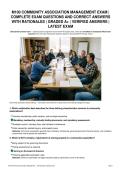
Community association board meeting — real-world visual reference for governance and meeting-management topics.
1. Which combination best describes the three defining characteristics common to community
associations?
• Voluntary membership, public taxation, and municipal ownership
■ Mandatory membership, mutually binding documents, and mandatory assessments
• Developer control, voluntary dues, and individual maintenance
• Public ownership, elected mayors, and property taxes
Rationale: Community associations generally have mandatory membership, governing documents that bind owners, and mandatory
assessments used to operate the association.
2. Which is NOT normally a requirement of owning property in a community association?
• Being subject to the governing documents
• Paying assessments as required
■ Serving on the board of directors
• Following applicable association rules
Rationale: Owners are generally not legally required simply by ownership to serve on the board.
M100 Community Association Management — 250-Question Practice Exam Page 1
, 3. What is the primary purpose of a community association?
• To operate a private business for the developer
■ To provide governance, business, and community services for the association
• To replace every municipal service
• To maximize profits for individual owners
Rationale: The association exists to manage the community's governance, business operations, and community functions.
4. Which type of association generally involves ownership of a unit plus an undivided interest in common
elements?
■ Condominium
• Cooperative
• Municipality
• Commercial partnership
Rationale: In a condominium, an owner typically owns the unit and shares an interest in common elements.
5. In a cooperative, the resident generally owns:
• A separate condominium unit and a percentage of the land
■ Shares or membership interests in the corporation that owns the property
• A municipal franchise
• Only the furniture inside the unit
Rationale: A cooperative corporation typically owns the real estate, while residents own shares or proprietary interests.
6. In a planned community, an owner commonly owns:
■ A lot or dwelling while the association owns or maintains specified common areas
• Only shares of a corporation
• Only the common areas
• A municipal district
Rationale: Planned communities commonly involve individual ownership of lots or homes with association-owned or controlled
common areas.
7. Mandatory assessments primarily exist to:
• Punish owners for disagreements
■ Fund the association's authorized expenses and obligations
• Replace individual mortgages
• Pay owners dividends
Rationale: Assessments fund the association's operations, maintenance, services, reserves, and other authorized costs.
8. Why are governing documents important?
■ They provide the legal framework for association operations and owner obligations
• They are merely suggestions
• They apply only to vendors
• They eliminate the need for state law
Rationale: Governing documents establish rights, responsibilities, procedures, and authority within the association.
M100 Community Association Management — 250-Question Practice Exam Page 2
, 9. Which statement about community association membership is generally correct?
• It is optional after purchase
■ It is mandatory and typically tied to ownership
• It applies only to renters
• It ends whenever an owner disagrees with a rule
Rationale: Membership normally runs with ownership and is not optional for an owner.
10. Which is a common association service?
■ Maintaining common property
• Issuing driver's licenses
• Operating the public court system
• Collecting federal income tax
Rationale: Common-property maintenance is a central association responsibility, subject to the governing documents.
11. When two governing provisions conflict, the manager should first:
• Choose the provision that is easiest to enforce
■ Identify the applicable hierarchy of authority and governing law
• Ask the loudest owner to decide
• Ignore both provisions
Rationale: Managers should determine which document or law has superior authority before applying a conflicting rule.
12. Rules and architectural guidelines should generally:
• Conflict with higher-level governing documents
■ Clarify or implement higher-level authority without contradicting it
• Replace state law
• Apply only to board members
Rationale: Lower-level rules can add reasonable detail but should not contradict controlling documents or law.
13. The articles of incorporation primarily establish:
■ The corporation's legal existence and basic corporate framework
• A vendor's pricing schedule
• A resident's personal budget
• A maintenance calendar
Rationale: Articles establish the corporation as a legal entity and provide foundational corporate information.
14. Bylaws typically address:
■ Corporate governance matters such as directors, meetings, and elections
• Only landscaping specifications
• Only insurance deductibles
• Individual mortgage terms
Rationale: Bylaws commonly address governance, meetings, elections, officers, and related procedures.
15. CC&Rs; or declaration documents commonly establish:
M100 Community Association Management — 250-Question Practice Exam Page 3
, ■ Property rights, restrictions, and obligations tied to the property
• Federal tax rates
• Employee payroll taxes
• A manager's vacation schedule
Rationale: Declarations and CC&Rs; commonly establish property-use rights, restrictions, easements, and owner/association
obligations.
16. A manager discovers a proposed rule conflicts with the declaration. What is the best action?
• Enforce the rule immediately
■ Seek legal/board review and resolve the conflict before enforcement
• Hide the conflict
• Tell owners the declaration no longer matters
Rationale: A conflicting rule should not simply be enforced; the board and counsel should address authority and consistency.
17. A board's authority ultimately comes from:
■ Applicable law and the association's governing documents
• The manager's personal preference
• A vendor contract
• Social-media comments
Rationale: Board powers are derived from law and the association's governing documents.
18. A manager should use the governing documents when:
■ Evaluating authority, procedures, owner obligations, and enforcement
• Choosing a personal investment
• Setting national tax policy
• Replacing all legal advice
Rationale: The documents guide management decisions, while legal questions may require qualified counsel.
19. If a rule is ambiguous, the manager should:
• Invent a new interpretation without review
■ Review the governing documents, applicable law, and obtain appropriate guidance
• Enforce it differently for each owner
• Ignore it permanently
Rationale: Ambiguity should be handled consistently and based on controlling authority and appropriate advice.
20. A sound records system helps the association demonstrate:
■ What decisions were made, why, and how procedures were followed
• That meetings never occurred
• That owners cannot ask questions
• That vendors control the board
Rationale: Good records support accountability, continuity, and legal defensibility.
21. The board's fiduciary duty means directors should:
■ Act in the association's and community's best interests
M100 Community Association Management — 250-Question Practice Exam Page 4
COMPLETE EXAM QUESTIONS AND CORRECT ANSWERS
WITH RATIONALES | GRADED A+ | VERIFIED ANSWERS |
LATEST EXAM
250-question practice exam — original questions aligned to the current M-100 subject areas. These are not leaked or reproduced official exam
questions; they are exam-style practice questions based on the published M-100 topic outline.
Community association board meeting — real-world visual reference for governance and meeting-management topics.
1. Which combination best describes the three defining characteristics common to community
associations?
• Voluntary membership, public taxation, and municipal ownership
■ Mandatory membership, mutually binding documents, and mandatory assessments
• Developer control, voluntary dues, and individual maintenance
• Public ownership, elected mayors, and property taxes
Rationale: Community associations generally have mandatory membership, governing documents that bind owners, and mandatory
assessments used to operate the association.
2. Which is NOT normally a requirement of owning property in a community association?
• Being subject to the governing documents
• Paying assessments as required
■ Serving on the board of directors
• Following applicable association rules
Rationale: Owners are generally not legally required simply by ownership to serve on the board.
M100 Community Association Management — 250-Question Practice Exam Page 1
, 3. What is the primary purpose of a community association?
• To operate a private business for the developer
■ To provide governance, business, and community services for the association
• To replace every municipal service
• To maximize profits for individual owners
Rationale: The association exists to manage the community's governance, business operations, and community functions.
4. Which type of association generally involves ownership of a unit plus an undivided interest in common
elements?
■ Condominium
• Cooperative
• Municipality
• Commercial partnership
Rationale: In a condominium, an owner typically owns the unit and shares an interest in common elements.
5. In a cooperative, the resident generally owns:
• A separate condominium unit and a percentage of the land
■ Shares or membership interests in the corporation that owns the property
• A municipal franchise
• Only the furniture inside the unit
Rationale: A cooperative corporation typically owns the real estate, while residents own shares or proprietary interests.
6. In a planned community, an owner commonly owns:
■ A lot or dwelling while the association owns or maintains specified common areas
• Only shares of a corporation
• Only the common areas
• A municipal district
Rationale: Planned communities commonly involve individual ownership of lots or homes with association-owned or controlled
common areas.
7. Mandatory assessments primarily exist to:
• Punish owners for disagreements
■ Fund the association's authorized expenses and obligations
• Replace individual mortgages
• Pay owners dividends
Rationale: Assessments fund the association's operations, maintenance, services, reserves, and other authorized costs.
8. Why are governing documents important?
■ They provide the legal framework for association operations and owner obligations
• They are merely suggestions
• They apply only to vendors
• They eliminate the need for state law
Rationale: Governing documents establish rights, responsibilities, procedures, and authority within the association.
M100 Community Association Management — 250-Question Practice Exam Page 2
, 9. Which statement about community association membership is generally correct?
• It is optional after purchase
■ It is mandatory and typically tied to ownership
• It applies only to renters
• It ends whenever an owner disagrees with a rule
Rationale: Membership normally runs with ownership and is not optional for an owner.
10. Which is a common association service?
■ Maintaining common property
• Issuing driver's licenses
• Operating the public court system
• Collecting federal income tax
Rationale: Common-property maintenance is a central association responsibility, subject to the governing documents.
11. When two governing provisions conflict, the manager should first:
• Choose the provision that is easiest to enforce
■ Identify the applicable hierarchy of authority and governing law
• Ask the loudest owner to decide
• Ignore both provisions
Rationale: Managers should determine which document or law has superior authority before applying a conflicting rule.
12. Rules and architectural guidelines should generally:
• Conflict with higher-level governing documents
■ Clarify or implement higher-level authority without contradicting it
• Replace state law
• Apply only to board members
Rationale: Lower-level rules can add reasonable detail but should not contradict controlling documents or law.
13. The articles of incorporation primarily establish:
■ The corporation's legal existence and basic corporate framework
• A vendor's pricing schedule
• A resident's personal budget
• A maintenance calendar
Rationale: Articles establish the corporation as a legal entity and provide foundational corporate information.
14. Bylaws typically address:
■ Corporate governance matters such as directors, meetings, and elections
• Only landscaping specifications
• Only insurance deductibles
• Individual mortgage terms
Rationale: Bylaws commonly address governance, meetings, elections, officers, and related procedures.
15. CC&Rs; or declaration documents commonly establish:
M100 Community Association Management — 250-Question Practice Exam Page 3
, ■ Property rights, restrictions, and obligations tied to the property
• Federal tax rates
• Employee payroll taxes
• A manager's vacation schedule
Rationale: Declarations and CC&Rs; commonly establish property-use rights, restrictions, easements, and owner/association
obligations.
16. A manager discovers a proposed rule conflicts with the declaration. What is the best action?
• Enforce the rule immediately
■ Seek legal/board review and resolve the conflict before enforcement
• Hide the conflict
• Tell owners the declaration no longer matters
Rationale: A conflicting rule should not simply be enforced; the board and counsel should address authority and consistency.
17. A board's authority ultimately comes from:
■ Applicable law and the association's governing documents
• The manager's personal preference
• A vendor contract
• Social-media comments
Rationale: Board powers are derived from law and the association's governing documents.
18. A manager should use the governing documents when:
■ Evaluating authority, procedures, owner obligations, and enforcement
• Choosing a personal investment
• Setting national tax policy
• Replacing all legal advice
Rationale: The documents guide management decisions, while legal questions may require qualified counsel.
19. If a rule is ambiguous, the manager should:
• Invent a new interpretation without review
■ Review the governing documents, applicable law, and obtain appropriate guidance
• Enforce it differently for each owner
• Ignore it permanently
Rationale: Ambiguity should be handled consistently and based on controlling authority and appropriate advice.
20. A sound records system helps the association demonstrate:
■ What decisions were made, why, and how procedures were followed
• That meetings never occurred
• That owners cannot ask questions
• That vendors control the board
Rationale: Good records support accountability, continuity, and legal defensibility.
21. The board's fiduciary duty means directors should:
■ Act in the association's and community's best interests
M100 Community Association Management — 250-Question Practice Exam Page 4


