
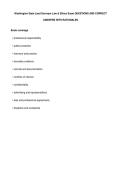
Washington State Land Surveyor Law & Ethics Exam QUESTIONS AND CORRECT
ANSWERS WITH RATIONALES
Exam coverage
• professional responsibility
• public protection
• licensure and practice
• boundary evidence
• records and documentation
• conflicts of interest
• confidentiality
• advertising and representations
• fees and professional agreements
• discipline and complaints
,1. A supervisor asks a trainee to explain the requirement before work begins. Which statement
most accurately describes professional responsibility when evaluating a professional situation?
A. Land surveyors must comply with Washington licensing requirements, professional
standards, statutes, and rules.
B. Surveying practice carries a professional duty to protect the public through competent,
ethical, lawful work.
C. Boundary decisions rely on records, physical evidence, occupation, monuments, and
applicable legal principles.
D. Only appropriately licensed professionals may perform or supervise reserved surveying
activities as required by law.
Correct answer: A
Rationale: The correct answer is A because Land surveyors must comply with Washington
licensing requirements, professional standards, statutes, and rules. This directly addresses the
principle described in the question, while the other choices concern different topics or
responsibilities.
2. A supervisor asks a trainee to explain the requirement before work begins. When reviewing
a case concerning public protection, what conclusion is most consistent with standard
requirements?
A. Only appropriately licensed professionals may perform or supervise reserved surveying
activities as required by law.
,B. Surveying practice carries a professional duty to protect the public through competent,
ethical, lawful work.
C. Surveyors should maintain adequate project records, field notes, calculations, maps, and
supporting evidence.
D. Boundary decisions rely on records, physical evidence, occupation, monuments, and
applicable legal principles.
Correct answer: B
Rationale: The correct answer is B because Surveying practice carries a professional duty to
protect the public through competent, ethical, lawful work. This directly addresses the principle
described in the question, while the other choices concern different topics or responsibilities.
3. A supervisor asks a trainee to explain the requirement before work begins. Why is licensure
and practice important when performing duties associated with this subject?
A. Potential conflicts should be identified and managed so professional judgment remains
independent.
B. Surveyors should maintain adequate project records, field notes, calculations, maps, and
supporting evidence.
C. Boundary decisions rely on records, physical evidence, occupation, monuments, and
applicable legal principles.
D. Only appropriately licensed professionals may perform or supervise reserved surveying
activities as required by law.
, Correct answer: D
Rationale: The correct answer is D because Only appropriately licensed professionals may
perform or supervise reserved surveying activities as required by law. This directly addresses
the principle described in the question, while the other choices concern different topics or
responsibilities.
4. A supervisor asks a trainee to explain the requirement before work begins. During a routine
review involving boundary evidence, which approach is most appropriate?
A. Client information and project materials should be handled according to applicable legal and
professional duties.
B. Potential conflicts should be identified and managed so professional judgment remains
independent.
C. Surveyors should maintain adequate project records, field notes, calculations, maps, and
supporting evidence.
D. Boundary decisions rely on records, physical evidence, occupation, monuments, and
applicable legal principles.
Correct answer: D
Rationale: The correct answer is D because Boundary decisions rely on records, physical
evidence, occupation, monuments, and applicable legal principles. This directly addresses the
principle described in the question, while the other choices concern different topics or
responsibilities.
ANSWERS WITH RATIONALES
Exam coverage
• professional responsibility
• public protection
• licensure and practice
• boundary evidence
• records and documentation
• conflicts of interest
• confidentiality
• advertising and representations
• fees and professional agreements
• discipline and complaints
,1. A supervisor asks a trainee to explain the requirement before work begins. Which statement
most accurately describes professional responsibility when evaluating a professional situation?
A. Land surveyors must comply with Washington licensing requirements, professional
standards, statutes, and rules.
B. Surveying practice carries a professional duty to protect the public through competent,
ethical, lawful work.
C. Boundary decisions rely on records, physical evidence, occupation, monuments, and
applicable legal principles.
D. Only appropriately licensed professionals may perform or supervise reserved surveying
activities as required by law.
Correct answer: A
Rationale: The correct answer is A because Land surveyors must comply with Washington
licensing requirements, professional standards, statutes, and rules. This directly addresses the
principle described in the question, while the other choices concern different topics or
responsibilities.
2. A supervisor asks a trainee to explain the requirement before work begins. When reviewing
a case concerning public protection, what conclusion is most consistent with standard
requirements?
A. Only appropriately licensed professionals may perform or supervise reserved surveying
activities as required by law.
,B. Surveying practice carries a professional duty to protect the public through competent,
ethical, lawful work.
C. Surveyors should maintain adequate project records, field notes, calculations, maps, and
supporting evidence.
D. Boundary decisions rely on records, physical evidence, occupation, monuments, and
applicable legal principles.
Correct answer: B
Rationale: The correct answer is B because Surveying practice carries a professional duty to
protect the public through competent, ethical, lawful work. This directly addresses the principle
described in the question, while the other choices concern different topics or responsibilities.
3. A supervisor asks a trainee to explain the requirement before work begins. Why is licensure
and practice important when performing duties associated with this subject?
A. Potential conflicts should be identified and managed so professional judgment remains
independent.
B. Surveyors should maintain adequate project records, field notes, calculations, maps, and
supporting evidence.
C. Boundary decisions rely on records, physical evidence, occupation, monuments, and
applicable legal principles.
D. Only appropriately licensed professionals may perform or supervise reserved surveying
activities as required by law.
, Correct answer: D
Rationale: The correct answer is D because Only appropriately licensed professionals may
perform or supervise reserved surveying activities as required by law. This directly addresses
the principle described in the question, while the other choices concern different topics or
responsibilities.
4. A supervisor asks a trainee to explain the requirement before work begins. During a routine
review involving boundary evidence, which approach is most appropriate?
A. Client information and project materials should be handled according to applicable legal and
professional duties.
B. Potential conflicts should be identified and managed so professional judgment remains
independent.
C. Surveyors should maintain adequate project records, field notes, calculations, maps, and
supporting evidence.
D. Boundary decisions rely on records, physical evidence, occupation, monuments, and
applicable legal principles.
Correct answer: D
Rationale: The correct answer is D because Boundary decisions rely on records, physical
evidence, occupation, monuments, and applicable legal principles. This directly addresses the
principle described in the question, while the other choices concern different topics or
responsibilities.


