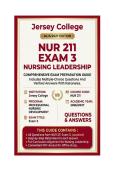
,NUR 211 Exam 3 Nursing Leadership Exam Questions And Answers
2026/2027 Jersey College
TABLE OF CONTENTS
CHAPTER 1 — Organizational Performance and Quality Improvement
CHAPTER 2 — Evidence-Based Practice
CHAPTER 3 — Outcomes, Data, and Performance Measurement
CHAPTER 4 — Medication Safety and Error Prevention
CHAPTER 5 — Transition to Professional RN Practice
CHAPTER 6 — Employment, Licensure, NCLEX, and Continuing Competence
CHAPTER 7 — Integrated Leadership and NCLEX-Style Prioritization
CHAPTER 1 — ORGANIZATIONAL PERFORMANCE AND QUALITY IMPROVEMENT
Q1. A nursing unit has experienced an increase in patient falls
during the past three months. What should the nurse leader do
first?
A) Identify the scope of the problem and analyze available fall data
B) Discipline all staff members working when falls occurred
C) Purchase additional equipment immediately
D) Change every fall-prevention policy at once
Correct Answer: A) Identify the scope of the problem and analyze available
fall data
Rationale: Quality improvement begins by clearly defining the problem and
examining relevant data before selecting interventions.
Q2. Which statement best describes quality improvement in
healthcare?
A) It focuses primarily on identifying one individual responsible for an error
B) It uses systematic methods to improve processes and patient outcomes
C) It eliminates the need for outcome measurement
D) It is performed only after serious patient harm
Correct Answer: B) It uses systematic methods to improve processes and
patient outcomes
Rationale: Quality improvement examines systems and processes and uses
data-driven changes to improve care.
Q3. A unit implements hourly rounding to reduce falls. Which finding
provides the strongest evidence that the intervention is effective?
,A) Staff report that rounding feels useful
B) More rounding forms are completed
C) The patient-fall rate decreases over time
D) The manager receives fewer complaints
Correct Answer: C) The patient-fall rate decreases over time
Rationale: The desired patient outcome provides stronger evidence of
effectiveness than completion of the intervention alone.
Q4. Which activity is characteristic of root cause analysis?
A) Assigning blame before gathering facts
B) Reviewing only the final action before an event
C) Identifying which employee should be punished
D) Examining underlying system factors that contributed to an adverse event
Correct Answer: D) Examining underlying system factors that contributed to
an adverse event
Rationale: Root cause analysis investigates contributing processes and
system weaknesses to reduce recurrence.
Q5. A medication error occurred after two medications with similar
packaging were stored beside each other. Which intervention best
addresses the system contributor?
A) Redesign medication storage to separate and clearly distinguish the
products
B) Tell nurses to be more careful without changing the environment
C) Stop reporting medication errors
D) Require patients to identify medications themselves
Correct Answer: A) Redesign medication storage to separate and clearly
distinguish the products
Rationale: Changing the system to reduce opportunities for error is more
reliable than depending solely on individual vigilance.
Q6. What is the primary purpose of a sentinel-event investigation?
A) Determine which employee should automatically be terminated
B) Understand contributing factors and implement strategies to prevent
similar serious events
C) Protect the event from organizational review
D) Eliminate documentation of the occurrence
, Correct Answer: B) Understand contributing factors and implement strategies
to prevent similar serious events
Rationale: Serious adverse events require systematic investigation focused
on learning and prevention.
Q7. Which action best demonstrates the Plan-Do-Study-Act
approach?
A) Implement a change throughout the entire organization without
evaluation
B) Select a solution based only on opinion
C) Test a change on a small scale, evaluate results, and refine the
intervention
D) Delay all changes until perfect evidence exists
Correct Answer: C) Test a change on a small scale, evaluate results, and
refine the intervention
Rationale: PDSA cycles support rapid testing, evaluation, and adjustment of
process changes.
Q8. A nurse leader compares the unit's infection rate with rates
from high-performing similar organizations. Which quality strategy
is being used?
A) Delegation
B) Credentialing
C) Case management
D) Benchmarking
Correct Answer: D) Benchmarking
Rationale: Benchmarking compares performance with established
standards or high-performing organizations to identify improvement
opportunities.
Q9. Which outcome best reflects a culture of safety?
A) Staff openly report hazards and near misses so the organization can learn
from them
B) Employees conceal minor errors to protect the unit's reputation
C) Only managers are allowed to discuss safety concerns
D) Staff avoid questioning unsafe decisions
2026/2027 Jersey College
TABLE OF CONTENTS
CHAPTER 1 — Organizational Performance and Quality Improvement
CHAPTER 2 — Evidence-Based Practice
CHAPTER 3 — Outcomes, Data, and Performance Measurement
CHAPTER 4 — Medication Safety and Error Prevention
CHAPTER 5 — Transition to Professional RN Practice
CHAPTER 6 — Employment, Licensure, NCLEX, and Continuing Competence
CHAPTER 7 — Integrated Leadership and NCLEX-Style Prioritization
CHAPTER 1 — ORGANIZATIONAL PERFORMANCE AND QUALITY IMPROVEMENT
Q1. A nursing unit has experienced an increase in patient falls
during the past three months. What should the nurse leader do
first?
A) Identify the scope of the problem and analyze available fall data
B) Discipline all staff members working when falls occurred
C) Purchase additional equipment immediately
D) Change every fall-prevention policy at once
Correct Answer: A) Identify the scope of the problem and analyze available
fall data
Rationale: Quality improvement begins by clearly defining the problem and
examining relevant data before selecting interventions.
Q2. Which statement best describes quality improvement in
healthcare?
A) It focuses primarily on identifying one individual responsible for an error
B) It uses systematic methods to improve processes and patient outcomes
C) It eliminates the need for outcome measurement
D) It is performed only after serious patient harm
Correct Answer: B) It uses systematic methods to improve processes and
patient outcomes
Rationale: Quality improvement examines systems and processes and uses
data-driven changes to improve care.
Q3. A unit implements hourly rounding to reduce falls. Which finding
provides the strongest evidence that the intervention is effective?
,A) Staff report that rounding feels useful
B) More rounding forms are completed
C) The patient-fall rate decreases over time
D) The manager receives fewer complaints
Correct Answer: C) The patient-fall rate decreases over time
Rationale: The desired patient outcome provides stronger evidence of
effectiveness than completion of the intervention alone.
Q4. Which activity is characteristic of root cause analysis?
A) Assigning blame before gathering facts
B) Reviewing only the final action before an event
C) Identifying which employee should be punished
D) Examining underlying system factors that contributed to an adverse event
Correct Answer: D) Examining underlying system factors that contributed to
an adverse event
Rationale: Root cause analysis investigates contributing processes and
system weaknesses to reduce recurrence.
Q5. A medication error occurred after two medications with similar
packaging were stored beside each other. Which intervention best
addresses the system contributor?
A) Redesign medication storage to separate and clearly distinguish the
products
B) Tell nurses to be more careful without changing the environment
C) Stop reporting medication errors
D) Require patients to identify medications themselves
Correct Answer: A) Redesign medication storage to separate and clearly
distinguish the products
Rationale: Changing the system to reduce opportunities for error is more
reliable than depending solely on individual vigilance.
Q6. What is the primary purpose of a sentinel-event investigation?
A) Determine which employee should automatically be terminated
B) Understand contributing factors and implement strategies to prevent
similar serious events
C) Protect the event from organizational review
D) Eliminate documentation of the occurrence
, Correct Answer: B) Understand contributing factors and implement strategies
to prevent similar serious events
Rationale: Serious adverse events require systematic investigation focused
on learning and prevention.
Q7. Which action best demonstrates the Plan-Do-Study-Act
approach?
A) Implement a change throughout the entire organization without
evaluation
B) Select a solution based only on opinion
C) Test a change on a small scale, evaluate results, and refine the
intervention
D) Delay all changes until perfect evidence exists
Correct Answer: C) Test a change on a small scale, evaluate results, and
refine the intervention
Rationale: PDSA cycles support rapid testing, evaluation, and adjustment of
process changes.
Q8. A nurse leader compares the unit's infection rate with rates
from high-performing similar organizations. Which quality strategy
is being used?
A) Delegation
B) Credentialing
C) Case management
D) Benchmarking
Correct Answer: D) Benchmarking
Rationale: Benchmarking compares performance with established
standards or high-performing organizations to identify improvement
opportunities.
Q9. Which outcome best reflects a culture of safety?
A) Staff openly report hazards and near misses so the organization can learn
from them
B) Employees conceal minor errors to protect the unit's reputation
C) Only managers are allowed to discuss safety concerns
D) Staff avoid questioning unsafe decisions