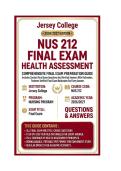
,NUS 212 Final Exam Health Assessment Questions And Answers
2026/2027 Jersey College
Q1. Which organ is located primarily in the right upper quadrant of
the abdomen?
A) Sigmoid colon
B) Gallbladder
C) Left ovary
D) Descending colon
Correct Answer: B) Gallbladder
Rationale: The right upper quadrant contains the liver, gallbladder, portions
of the duodenum and colon, and portions of the right kidney and pancreas.
Q2. Why should bowel sounds be auscultated before percussion and
palpation?
A) Auscultation makes palpation painless
B) Percussion permanently eliminates bowel sounds
C) Inspection cannot be performed after palpation
D) Manipulation of the abdomen can alter intestinal activity and change
bowel sounds
Correct Answer: D) Manipulation of the abdomen can alter intestinal activity
and change bowel sounds
Rationale: Percussion and palpation can stimulate bowel activity, so bowel
sounds should be assessed before the abdomen is manipulated.
Q3. Which abdominal finding requires the most urgent evaluation?
A) Severe pain with involuntary board-like rigidity
B) Tympany over the stomach
C) Soft abdomen without tenderness
D) Visible symmetric respiratory movement
Correct Answer: A) Severe pain with involuntary board-like rigidity
Rationale: Severe pain accompanied by involuntary rigidity can indicate
significant peritoneal irritation and an acute abdominal process.
Q4. A patient reports severe tenderness in the right lower quadrant.
How should palpation generally be performed?
,A) Begin with deep palpation directly over the painful area
B) Repeatedly press the painful area first
C) Examine nonpainful areas first and assess the tender region last
D) Omit the entire abdominal examination
Correct Answer: C) Examine nonpainful areas first and assess the tender
region last
Rationale: Tender areas are typically examined last to reduce guarding and
preserve the quality of the remainder of the assessment.
Q5. Costovertebral angle tenderness most directly suggests the
need for further assessment of which system?
A) Respiratory
B) Renal or urinary
C) Endocrine
D) Visual
Correct Answer: B) Renal or urinary
Rationale: Tenderness at the costovertebral angle may occur with
inflammation involving the kidneys or upper urinary tract.
Q6. Which percussion note is normally predominant over gas-filled
portions of the abdomen?
A) Tympany
B) Flatness
C) Hyperresonance
D) Resonance
Correct Answer: A) Tympany
Rationale: Gas within the stomach and intestines commonly produces a
tympanic percussion sound.
Q7. A patient has increasing abdominal girth and suspected ascites.
Which assessment finding can support the presence of free
abdominal fluid?
A) Hyperactive pupillary response
B) Increased tactile fremitus
C) Positive Phalen test
D) Shifting areas of percussion dullness with position change
, Correct Answer: D) Shifting areas of percussion dullness with position change
Rationale: Free intraperitoneal fluid can move when the patient changes
position, altering the distribution of tympany and dullness.
Q8. A patient has right upper-quadrant pain and abruptly stops
inhaling because of pain when the examiner palpates beneath the
right costal margin. Which finding is present?
A) McBurney sign
B) Tinel sign
C) Positive Murphy sign
D) Positive Romberg sign
Correct Answer: C) Positive Murphy sign
Rationale: Inspiratory arrest caused by tenderness during right upper-
quadrant palpation is a positive Murphy sign and may occur with gallbladder
inflammation.
Q9. A pulsatile abdominal mass is observed in an older patient.
Which action is most appropriate?
A) Avoid deep palpation of the mass and obtain prompt further evaluation
B) Press firmly to determine its exact size
C) Massage the area to assess tenderness
D) Ask the patient to perform abdominal exercises
Correct Answer: A) Avoid deep palpation of the mass and obtain prompt
further evaluation
Rationale: A pulsatile abdominal mass may represent vascular
enlargement, and unnecessary deep palpation should be avoided.
Q10. Which symptom pattern requires focused gastrointestinal
assessment for possible upper gastrointestinal bleeding?
A) Clear urine and normal appetite
B) Black tarry stool with weakness and dizziness
C) Mild hunger before meals
D) Normal brown formed stool
Correct Answer: B) Black tarry stool with weakness and dizziness
Rationale: Black tarry stool can result from digested blood originating
higher in the gastrointestinal tract and warrants further evaluation.
2026/2027 Jersey College
Q1. Which organ is located primarily in the right upper quadrant of
the abdomen?
A) Sigmoid colon
B) Gallbladder
C) Left ovary
D) Descending colon
Correct Answer: B) Gallbladder
Rationale: The right upper quadrant contains the liver, gallbladder, portions
of the duodenum and colon, and portions of the right kidney and pancreas.
Q2. Why should bowel sounds be auscultated before percussion and
palpation?
A) Auscultation makes palpation painless
B) Percussion permanently eliminates bowel sounds
C) Inspection cannot be performed after palpation
D) Manipulation of the abdomen can alter intestinal activity and change
bowel sounds
Correct Answer: D) Manipulation of the abdomen can alter intestinal activity
and change bowel sounds
Rationale: Percussion and palpation can stimulate bowel activity, so bowel
sounds should be assessed before the abdomen is manipulated.
Q3. Which abdominal finding requires the most urgent evaluation?
A) Severe pain with involuntary board-like rigidity
B) Tympany over the stomach
C) Soft abdomen without tenderness
D) Visible symmetric respiratory movement
Correct Answer: A) Severe pain with involuntary board-like rigidity
Rationale: Severe pain accompanied by involuntary rigidity can indicate
significant peritoneal irritation and an acute abdominal process.
Q4. A patient reports severe tenderness in the right lower quadrant.
How should palpation generally be performed?
,A) Begin with deep palpation directly over the painful area
B) Repeatedly press the painful area first
C) Examine nonpainful areas first and assess the tender region last
D) Omit the entire abdominal examination
Correct Answer: C) Examine nonpainful areas first and assess the tender
region last
Rationale: Tender areas are typically examined last to reduce guarding and
preserve the quality of the remainder of the assessment.
Q5. Costovertebral angle tenderness most directly suggests the
need for further assessment of which system?
A) Respiratory
B) Renal or urinary
C) Endocrine
D) Visual
Correct Answer: B) Renal or urinary
Rationale: Tenderness at the costovertebral angle may occur with
inflammation involving the kidneys or upper urinary tract.
Q6. Which percussion note is normally predominant over gas-filled
portions of the abdomen?
A) Tympany
B) Flatness
C) Hyperresonance
D) Resonance
Correct Answer: A) Tympany
Rationale: Gas within the stomach and intestines commonly produces a
tympanic percussion sound.
Q7. A patient has increasing abdominal girth and suspected ascites.
Which assessment finding can support the presence of free
abdominal fluid?
A) Hyperactive pupillary response
B) Increased tactile fremitus
C) Positive Phalen test
D) Shifting areas of percussion dullness with position change
, Correct Answer: D) Shifting areas of percussion dullness with position change
Rationale: Free intraperitoneal fluid can move when the patient changes
position, altering the distribution of tympany and dullness.
Q8. A patient has right upper-quadrant pain and abruptly stops
inhaling because of pain when the examiner palpates beneath the
right costal margin. Which finding is present?
A) McBurney sign
B) Tinel sign
C) Positive Murphy sign
D) Positive Romberg sign
Correct Answer: C) Positive Murphy sign
Rationale: Inspiratory arrest caused by tenderness during right upper-
quadrant palpation is a positive Murphy sign and may occur with gallbladder
inflammation.
Q9. A pulsatile abdominal mass is observed in an older patient.
Which action is most appropriate?
A) Avoid deep palpation of the mass and obtain prompt further evaluation
B) Press firmly to determine its exact size
C) Massage the area to assess tenderness
D) Ask the patient to perform abdominal exercises
Correct Answer: A) Avoid deep palpation of the mass and obtain prompt
further evaluation
Rationale: A pulsatile abdominal mass may represent vascular
enlargement, and unnecessary deep palpation should be avoided.
Q10. Which symptom pattern requires focused gastrointestinal
assessment for possible upper gastrointestinal bleeding?
A) Clear urine and normal appetite
B) Black tarry stool with weakness and dizziness
C) Mild hunger before meals
D) Normal brown formed stool
Correct Answer: B) Black tarry stool with weakness and dizziness
Rationale: Black tarry stool can result from digested blood originating
higher in the gastrointestinal tract and warrants further evaluation.