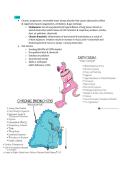
COPD
• Chronic, progressive, irreversible lower airway disorder that causes obstructive airflow
& negatively impacts oxygenation, ventilation, & gas exchange
o Emphysema: loss of lung elasticity & hyperinflation of lung tissue. Results in
alveoli destruction which leaves to CO2 retention & respiratory acidosis. (smoke,
dust, air pollution, chemicals)
o Chronic Bronchitis: inflammation of the bronchi & bronchioles as a result of
irritant exposure. Irritation results in increase in mucus cells = bronchiole wall
thickening & thick mucus in airway = airway obstruction
• Risk Factors
o Smoking (80-90% of COPD deaths)
o Occupational dust & chemicals
o Outdoor air pollution
o Second-hand smoke
o Alpha-1 antitrypsin
(AAT) deficiency (<5%)
, Pathophysiology of Emphysema
• Injury to alveoli over time by inhaled pollutants
• Loss of lung elasticity
• Hyperinflation of alveoli
• Small airways collapse prematurely
• Air trapping
• Ineffective O2/CO2 exchange
• Non-oxygenated blood enters circulation
Pathophysiology of Chronic Bronchitis
• Exposure to inhaled pollutants
• Inflammation of bronchi & bronchioles
• Bronchiole wall thickens, causing obstruction
• Increased production of mucus, causing obstruction
Diagnosis of COPD
• Pulmonary Function Tests: Spirometry to measure lung volume & airflow
o Comparisons of FEV (forced expiratory volume) & FVC (forced vital capacity) are
used to classify COPD as mild to severe
o As disease progresses, FEV to FVC ratio decreases (100% is healthy lungs)
o <30% is life threatening
• Labs
o Elevated HCT due to low O2
o Resp Infection? Sputum culture & WBC
o ABGs: hypoxemia & hypercarbia
o Electrolytes
• Chronic, progressive, irreversible lower airway disorder that causes obstructive airflow
& negatively impacts oxygenation, ventilation, & gas exchange
o Emphysema: loss of lung elasticity & hyperinflation of lung tissue. Results in
alveoli destruction which leaves to CO2 retention & respiratory acidosis. (smoke,
dust, air pollution, chemicals)
o Chronic Bronchitis: inflammation of the bronchi & bronchioles as a result of
irritant exposure. Irritation results in increase in mucus cells = bronchiole wall
thickening & thick mucus in airway = airway obstruction
• Risk Factors
o Smoking (80-90% of COPD deaths)
o Occupational dust & chemicals
o Outdoor air pollution
o Second-hand smoke
o Alpha-1 antitrypsin
(AAT) deficiency (<5%)
, Pathophysiology of Emphysema
• Injury to alveoli over time by inhaled pollutants
• Loss of lung elasticity
• Hyperinflation of alveoli
• Small airways collapse prematurely
• Air trapping
• Ineffective O2/CO2 exchange
• Non-oxygenated blood enters circulation
Pathophysiology of Chronic Bronchitis
• Exposure to inhaled pollutants
• Inflammation of bronchi & bronchioles
• Bronchiole wall thickens, causing obstruction
• Increased production of mucus, causing obstruction
Diagnosis of COPD
• Pulmonary Function Tests: Spirometry to measure lung volume & airflow
o Comparisons of FEV (forced expiratory volume) & FVC (forced vital capacity) are
used to classify COPD as mild to severe
o As disease progresses, FEV to FVC ratio decreases (100% is healthy lungs)
o <30% is life threatening
• Labs
o Elevated HCT due to low O2
o Resp Infection? Sputum culture & WBC
o ABGs: hypoxemia & hypercarbia
o Electrolytes