
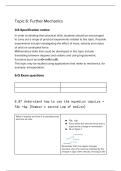
Topic 6: Further Mechanics
0.6 Specification notice:
In order to develop their practical skills, students should be encouraged
to carry out a range of practical experiments related to this topic. Possible
experiments include investigating the effect of mass, velocity and radius
of orbit on centripetal force.
Mathematical skills that could be developed in this topic include
translating between degrees and radians and using trigonometric
functions (such as tan𝚹=sin𝚹/cos𝚹).
This topic may be studied using applications that relate to mechanics, for
example, transportation.
6.Q Exam questions
6.97 Understand how to use the equation impulse =
F∆t =∆p (Newton’s second law of motion)
What is impulse and how is it calculated and
what are its units
● F∆t =∆p
● Force times the time the force acts is
equal to the change in momentum
● Ns or Kgms-1
Remember that if an object changes
direction, then this must be reflected by the
change in sign of the velocity. As long as the
, magnitude is correct, the final sign for the
impulse doesn’t matter as long as it is
consistent with which way you have
considered positive and negative
E.g if left is taken as positive and therefore
right as negative, an impulse of 20Ns to the
right equals to -20Ns
6.98 CORE PRACTICAL 9: Investigate the relationship
between the force exerted on an object and its change of
momentum.
6.99 Understand how to apply conservation of linear momentum
to problems in two dimensions
What is the principle of conservation of Total momentum before collision equals the
momentum? total momentum after the collision unless an
external force acts
External forces include friction. They affect
the total momentum as they can reduce the
velocity of an object
6.100 CORE PRACTICAL 10: Use ICT to analyse collisions
between small spheres, e.g. ball bearings on a table top.
6.101 understand how to determine whether a collision is
elastic or inelastic
What happens in elastic, inelastic, and ● Elastic is when both momentum and
0.6 Specification notice:
In order to develop their practical skills, students should be encouraged
to carry out a range of practical experiments related to this topic. Possible
experiments include investigating the effect of mass, velocity and radius
of orbit on centripetal force.
Mathematical skills that could be developed in this topic include
translating between degrees and radians and using trigonometric
functions (such as tan𝚹=sin𝚹/cos𝚹).
This topic may be studied using applications that relate to mechanics, for
example, transportation.
6.Q Exam questions
6.97 Understand how to use the equation impulse =
F∆t =∆p (Newton’s second law of motion)
What is impulse and how is it calculated and
what are its units
● F∆t =∆p
● Force times the time the force acts is
equal to the change in momentum
● Ns or Kgms-1
Remember that if an object changes
direction, then this must be reflected by the
change in sign of the velocity. As long as the
, magnitude is correct, the final sign for the
impulse doesn’t matter as long as it is
consistent with which way you have
considered positive and negative
E.g if left is taken as positive and therefore
right as negative, an impulse of 20Ns to the
right equals to -20Ns
6.98 CORE PRACTICAL 9: Investigate the relationship
between the force exerted on an object and its change of
momentum.
6.99 Understand how to apply conservation of linear momentum
to problems in two dimensions
What is the principle of conservation of Total momentum before collision equals the
momentum? total momentum after the collision unless an
external force acts
External forces include friction. They affect
the total momentum as they can reduce the
velocity of an object
6.100 CORE PRACTICAL 10: Use ICT to analyse collisions
between small spheres, e.g. ball bearings on a table top.
6.101 understand how to determine whether a collision is
elastic or inelastic
What happens in elastic, inelastic, and ● Elastic is when both momentum and


