
ES.a-q - Elements from the sea | ES1-7
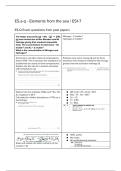
ES.Q Exam questions from past papers
The Haber process N2 (g) + 3H2 (g) ⇌ 2NH3 Nitrogen - 2 moldm-3
(g) was formed due to Mrs Marsden and Mr Hydrogen 2 moldm-3
Harbage giving their students impossible
tests. The concentration for Ammonia = 32
moldm-3 and Kc = 2 moldm-3
What is the concentration of Nitrogen and
Hydrogen?
Ammonia is not often made at temperatures Particles have more energy (1) and so there
below 473K. This is because the equilibrium is would be more frequent collisions with energy
established too slowly at lower temperatures. greater than the activation enthalpy (1)
Explain why the rate of a reaction increases
with temperature. (2)
Gallium has two isotopes, 69Ga and 71Ga. The ● (69 x (x)) + (71 x (1-x)) = 69.7
Ar of gallium is 69.7. ● 69x + 71 - 71x = 69.7
Calculate the relative abundance of 69Ga as a ● 2x = 1.3
percentage. ● X = 0.65
● X = 65%
● 100% useful
● No waste
● All useful/desired products
State and explain the atom economy of the
reaction ? (1)
, ● (3x2)/(12+4)+(2+16) x 100
● 6/(16 + 18) x 100
● 17.65
CH4(g) + H2O(g) 3H2(g) + CO(g) ∆rH =
+206kJmol–1 Equation 33.1 (e) The steam
reforming reaction shown in equation 33.1
makes hydrogen. Much of the hydrogen is
used in the manufacture of ammonia. (i)
Calculate the atom economy of the reaction in
equation 33.1 when making hydrogen.
ES.a - Formulae, equations and amount of substance | ES6 |
What is atom economy and how is it A measure of how efficient a reaction is
calculated? (Relative formula mass not MASS in grams
What is a hydride? A binary compound of hydrogen and a
metal
What is a peroxide? A compound containing two oxygen
atoms bonded together (O-O)
What is an -ide? A binary compound in which the
nonmetal is given an -ide suffix (e.g.,
sodium oxide)
What do -ate compounds contain? Oxygen and at least one other element
Examples include: Chlorate, nitrate and
carbonate
What is the charge of the ion Nitrite(III) and
state oxidation numbers?
What is the charge of the ion Sulfite(IV) and
state oxidation numbers?
What is the charge of the ion Sulfate (VI) and
state oxidation numbers??
ES.Q Exam questions from past papers
The Haber process N2 (g) + 3H2 (g) ⇌ 2NH3 Nitrogen - 2 moldm-3
(g) was formed due to Mrs Marsden and Mr Hydrogen 2 moldm-3
Harbage giving their students impossible
tests. The concentration for Ammonia = 32
moldm-3 and Kc = 2 moldm-3
What is the concentration of Nitrogen and
Hydrogen?
Ammonia is not often made at temperatures Particles have more energy (1) and so there
below 473K. This is because the equilibrium is would be more frequent collisions with energy
established too slowly at lower temperatures. greater than the activation enthalpy (1)
Explain why the rate of a reaction increases
with temperature. (2)
Gallium has two isotopes, 69Ga and 71Ga. The ● (69 x (x)) + (71 x (1-x)) = 69.7
Ar of gallium is 69.7. ● 69x + 71 - 71x = 69.7
Calculate the relative abundance of 69Ga as a ● 2x = 1.3
percentage. ● X = 0.65
● X = 65%
● 100% useful
● No waste
● All useful/desired products
State and explain the atom economy of the
reaction ? (1)
, ● (3x2)/(12+4)+(2+16) x 100
● 6/(16 + 18) x 100
● 17.65
CH4(g) + H2O(g) 3H2(g) + CO(g) ∆rH =
+206kJmol–1 Equation 33.1 (e) The steam
reforming reaction shown in equation 33.1
makes hydrogen. Much of the hydrogen is
used in the manufacture of ammonia. (i)
Calculate the atom economy of the reaction in
equation 33.1 when making hydrogen.
ES.a - Formulae, equations and amount of substance | ES6 |
What is atom economy and how is it A measure of how efficient a reaction is
calculated? (Relative formula mass not MASS in grams
What is a hydride? A binary compound of hydrogen and a
metal
What is a peroxide? A compound containing two oxygen
atoms bonded together (O-O)
What is an -ide? A binary compound in which the
nonmetal is given an -ide suffix (e.g.,
sodium oxide)
What do -ate compounds contain? Oxygen and at least one other element
Examples include: Chlorate, nitrate and
carbonate
What is the charge of the ion Nitrite(III) and
state oxidation numbers?
What is the charge of the ion Sulfite(IV) and
state oxidation numbers?
What is the charge of the ion Sulfate (VI) and
state oxidation numbers??


