
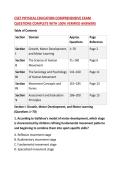
CSET PHYSICAL EDUCATION COMPREHENSIVE EXAM
QUESTIONS COMPLETE WITH 100% VERIFIED ANSWERS
Table of Contents
Section Domain Approx. Page
Questions Reference
Section Growth, Motor Development, 1–70 Page 2
I and Motor Learning
Section The Science of Human 71–140 Page 6
II Movement
Section The Sociology and Psychology 141–160 Page 11
III of Human Movement
Section Movement Concepts and 161–185 Page 13
IV Forms
Section Assessment and Evaluation 186–200 Page 15
V Principles
Section I: Growth, Motor Development, and Motor Learning
(Questions 1–70)
1. According to Gallahue's model of motor development, which stage
is characterized by children refining fundamental movement patterns
and beginning to combine them into sport-specific skills?
A. Reflexive movement stage
B. Rudimentary movement stage
C. Fundamental movement stage
D. Specialized movement stage
,Correct Answer: D
Rationale: Gallahue's model describes the specialized movement stage
as the phase where fundamental movements are refined, combined,
and applied to specific sports and activities. This stage typically begins
around age 7 and continues through adolescence.
2. A kindergartener avoids the jungle gym, a wooden climbing
structure with slides, ladders, and grab bars. The child cannot "figure
out what to hold onto" or "pull up on" to climb the structure. This
type of confusion is characteristic of an impaired or underdeveloped
ability to:
A. maintain eye fixation on an object in one's field of vision
B. distinguish pertinent objects from other stimuli in one's field of vision
C. recall the visual sequence of a set of objects
D. maintain directional awareness when following a pathway
Correct Answer: B
Rationale: The child's difficulty in identifying what to hold onto or pull
up on suggests a problem with visual discrimination—the ability to
distinguish pertinent objects from other stimuli in the visual field. This
perceptual-motor skill is essential for navigating complex physical
environments.
3. As children grow from toddlers to preschoolers, they develop
locomotor skills such as walking on a low balance beam or along a
curved line. Which of the following best describes the physical change
that typically occurs between the ages of three and five that allows
children to perform such movements?
,A. They are able to narrow the base of support on which they walk and
move
B. Their heads grow to take up more of their total body weight,
enhancing balance
C. They are able to step in marked time, bringing one foot alongside the
other while moving
D. Their center of gravity becomes higher, moving from below the navel
to above the navel
Correct Answer: A
Rationale: Between ages three and five, children develop the ability to
narrow their base of support, which enhances balance and allows for
more refined locomotor movements such as walking on a balance beam
or along a curved line.
4. Agility consists primarily of the ability to move:
A. quickly and efficiently
B. explosively
C. in repeated steps
D. rhythmically
Correct Answer: A
Rationale: Agility is defined as the ability to move quickly and efficiently
while maintaining control of the body. It involves rapid changes in
direction and position.
5. Which of the following reflects a general consensus among
researchers regarding practice and motor skill acquisition?
, A. Random practice leads to significant interference between motor
tasks, resulting in poorer acquisition performance among participants
B. Participants who use random practice or blocked practice under the
same conditions demonstrate similar levels of skill performance within
the same time
C. The blocked order leads to significant boredom in completing tasks,
resulting in poorer acquisition performance among participants
D. Approximately equal numbers of participants from both groups
demonstrate poor and superior skill performance following practice
under the same conditions
Correct Answer: A
Rationale: Research has shown that random practice creates contextual
interference, which can lead to poorer performance during the
acquisition phase but better long-term retention and transfer of skills.
6. Which of the following is a critical element in a mature motor
pattern for kicking a soccer ball?
A. Kicking with the toe pointed downward
B. Using only the lower leg without trunk rotation
C. Opposition of the arms and trunk rotation
D. Keeping the non-kicking foot behind the ball
Correct Answer: C
Rationale: A mature kicking pattern involves opposition of the arms (the
arm opposite the kicking leg swings forward) and trunk rotation, which
generates force and maintains balance.
QUESTIONS COMPLETE WITH 100% VERIFIED ANSWERS
Table of Contents
Section Domain Approx. Page
Questions Reference
Section Growth, Motor Development, 1–70 Page 2
I and Motor Learning
Section The Science of Human 71–140 Page 6
II Movement
Section The Sociology and Psychology 141–160 Page 11
III of Human Movement
Section Movement Concepts and 161–185 Page 13
IV Forms
Section Assessment and Evaluation 186–200 Page 15
V Principles
Section I: Growth, Motor Development, and Motor Learning
(Questions 1–70)
1. According to Gallahue's model of motor development, which stage
is characterized by children refining fundamental movement patterns
and beginning to combine them into sport-specific skills?
A. Reflexive movement stage
B. Rudimentary movement stage
C. Fundamental movement stage
D. Specialized movement stage
,Correct Answer: D
Rationale: Gallahue's model describes the specialized movement stage
as the phase where fundamental movements are refined, combined,
and applied to specific sports and activities. This stage typically begins
around age 7 and continues through adolescence.
2. A kindergartener avoids the jungle gym, a wooden climbing
structure with slides, ladders, and grab bars. The child cannot "figure
out what to hold onto" or "pull up on" to climb the structure. This
type of confusion is characteristic of an impaired or underdeveloped
ability to:
A. maintain eye fixation on an object in one's field of vision
B. distinguish pertinent objects from other stimuli in one's field of vision
C. recall the visual sequence of a set of objects
D. maintain directional awareness when following a pathway
Correct Answer: B
Rationale: The child's difficulty in identifying what to hold onto or pull
up on suggests a problem with visual discrimination—the ability to
distinguish pertinent objects from other stimuli in the visual field. This
perceptual-motor skill is essential for navigating complex physical
environments.
3. As children grow from toddlers to preschoolers, they develop
locomotor skills such as walking on a low balance beam or along a
curved line. Which of the following best describes the physical change
that typically occurs between the ages of three and five that allows
children to perform such movements?
,A. They are able to narrow the base of support on which they walk and
move
B. Their heads grow to take up more of their total body weight,
enhancing balance
C. They are able to step in marked time, bringing one foot alongside the
other while moving
D. Their center of gravity becomes higher, moving from below the navel
to above the navel
Correct Answer: A
Rationale: Between ages three and five, children develop the ability to
narrow their base of support, which enhances balance and allows for
more refined locomotor movements such as walking on a balance beam
or along a curved line.
4. Agility consists primarily of the ability to move:
A. quickly and efficiently
B. explosively
C. in repeated steps
D. rhythmically
Correct Answer: A
Rationale: Agility is defined as the ability to move quickly and efficiently
while maintaining control of the body. It involves rapid changes in
direction and position.
5. Which of the following reflects a general consensus among
researchers regarding practice and motor skill acquisition?
, A. Random practice leads to significant interference between motor
tasks, resulting in poorer acquisition performance among participants
B. Participants who use random practice or blocked practice under the
same conditions demonstrate similar levels of skill performance within
the same time
C. The blocked order leads to significant boredom in completing tasks,
resulting in poorer acquisition performance among participants
D. Approximately equal numbers of participants from both groups
demonstrate poor and superior skill performance following practice
under the same conditions
Correct Answer: A
Rationale: Research has shown that random practice creates contextual
interference, which can lead to poorer performance during the
acquisition phase but better long-term retention and transfer of skills.
6. Which of the following is a critical element in a mature motor
pattern for kicking a soccer ball?
A. Kicking with the toe pointed downward
B. Using only the lower leg without trunk rotation
C. Opposition of the arms and trunk rotation
D. Keeping the non-kicking foot behind the ball
Correct Answer: C
Rationale: A mature kicking pattern involves opposition of the arms (the
arm opposite the kicking leg swings forward) and trunk rotation, which
generates force and maintains balance.


