
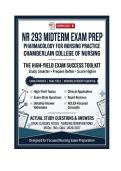
,NR 293 Pharmacology for Nursing Practice
Midterm Exam Prep Drug Classes chamberlain
collage of nursing + 150 Q&A Nursing
Interventions + MCQs 2026/2027
1. A nurse is preparing to administer an oral medication. Which statement by the nurse
indicates an understanding of the first-pass effect?
A. "The drug is absorbed directly into the systemic circulation without any changes."
B. "A portion of the drug is metabolized in the liver before it reaches systemic circulation."
C. "The drug bypasses the stomach and is absorbed in the small intestine."
D. "The kidneys excrete a large amount of the drug before it reaches the target site."
Correct Answer: B
Rationale: The first-pass effect refers to the hepatic metabolism of an orally administered drug
before it enters the systemic circulation, reducing the amount of active drug available. Drugs
absorbed from the GI tract travel via the portal vein to the liver, where they may be extensively
metabolized before reaching the general circulation.
2. A client asks why a medication is given sublingually rather than orally. The nurse's best
response is that sublingual administration:
A. Avoids first-pass metabolism
B. Requires a larger dose
,C. Causes more gastrointestinal upset
D. Is less expensive
Correct Answer: A
Rationale: Sublingual administration allows the drug to dissolve under the tongue and be
absorbed directly into the bloodstream, bypassing the liver and first-pass metabolism.
3. A nurse is reviewing a drug that has a half-life of 6 hours. Approximately how long will it take
for 97% of the drug to be eliminated from the body?
A. 6 hours
B. 12 hours
C. 24–30 hours
D. 48 hours
Correct Answer: C
Rationale: It takes approximately 4–5 half-lives for a drug to be eliminated. For a half-life of 6
hours, 4–5 half-lives equals 24–30 hours.
4. A nurse is teaching a client about a drug that is an antagonist. The nurse explains that this
drug will:
A. Bind to a receptor and produce a response
B. Bind to a receptor and block a response
C. Increase the effect of endogenous hormones
D. Act as a replacement for a missing substance
, Correct Answer: B
Rationale: An antagonist binds to a receptor but does not activate it, thereby blocking the action
of agonists or endogenous substances.
5. A client with malnutrition has low albumin levels. The nurse should monitor for increased
effects of drugs that are:
A. Highly protein-bound
B. Weakly acidic
C. Water-soluble
D. Metabolized by the liver
Correct Answer: A
Rationale: Low albumin reduces protein binding, leading to a higher free (active) drug
concentration and increased risk of toxicity for highly protein-bound drugs.
6. A nurse is caring for a client with end-stage renal disease. The nurse should anticipate that
drugs excreted by the kidneys will require:
A. An increased dose
B. A decreased dose or longer dosing interval
C. No change in dosing
D. Administration via intramuscular injection only
Correct Answer: B
Rationale: Impaired renal function decreases drug excretion, potentially causing accumulation
and toxicity; doses are often reduced or intervals extended.
Midterm Exam Prep Drug Classes chamberlain
collage of nursing + 150 Q&A Nursing
Interventions + MCQs 2026/2027
1. A nurse is preparing to administer an oral medication. Which statement by the nurse
indicates an understanding of the first-pass effect?
A. "The drug is absorbed directly into the systemic circulation without any changes."
B. "A portion of the drug is metabolized in the liver before it reaches systemic circulation."
C. "The drug bypasses the stomach and is absorbed in the small intestine."
D. "The kidneys excrete a large amount of the drug before it reaches the target site."
Correct Answer: B
Rationale: The first-pass effect refers to the hepatic metabolism of an orally administered drug
before it enters the systemic circulation, reducing the amount of active drug available. Drugs
absorbed from the GI tract travel via the portal vein to the liver, where they may be extensively
metabolized before reaching the general circulation.
2. A client asks why a medication is given sublingually rather than orally. The nurse's best
response is that sublingual administration:
A. Avoids first-pass metabolism
B. Requires a larger dose
,C. Causes more gastrointestinal upset
D. Is less expensive
Correct Answer: A
Rationale: Sublingual administration allows the drug to dissolve under the tongue and be
absorbed directly into the bloodstream, bypassing the liver and first-pass metabolism.
3. A nurse is reviewing a drug that has a half-life of 6 hours. Approximately how long will it take
for 97% of the drug to be eliminated from the body?
A. 6 hours
B. 12 hours
C. 24–30 hours
D. 48 hours
Correct Answer: C
Rationale: It takes approximately 4–5 half-lives for a drug to be eliminated. For a half-life of 6
hours, 4–5 half-lives equals 24–30 hours.
4. A nurse is teaching a client about a drug that is an antagonist. The nurse explains that this
drug will:
A. Bind to a receptor and produce a response
B. Bind to a receptor and block a response
C. Increase the effect of endogenous hormones
D. Act as a replacement for a missing substance
, Correct Answer: B
Rationale: An antagonist binds to a receptor but does not activate it, thereby blocking the action
of agonists or endogenous substances.
5. A client with malnutrition has low albumin levels. The nurse should monitor for increased
effects of drugs that are:
A. Highly protein-bound
B. Weakly acidic
C. Water-soluble
D. Metabolized by the liver
Correct Answer: A
Rationale: Low albumin reduces protein binding, leading to a higher free (active) drug
concentration and increased risk of toxicity for highly protein-bound drugs.
6. A nurse is caring for a client with end-stage renal disease. The nurse should anticipate that
drugs excreted by the kidneys will require:
A. An increased dose
B. A decreased dose or longer dosing interval
C. No change in dosing
D. Administration via intramuscular injection only
Correct Answer: B
Rationale: Impaired renal function decreases drug excretion, potentially causing accumulation
and toxicity; doses are often reduced or intervals extended.


