
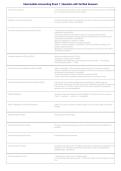
Intermediate Accounting Exam 1 | Question with Verified Answers
Financial Accounting *The process that culminates in the preparation of financial reports on the enterprise
for use by both internal and external parties.
Objective of Financial Reporting Provide information about the reporting entity that is useful to present and potential
to equity investors, lenders, and others.
Securities and Exchange Commission (SEC) -Federal agency developed to help develop and standardize financial information
presented to stockholders
-Companies that issue securities to public are required to file with SEC
-Have powers to prescribe auditing practices and standards to be employed by
companies that fall within its jurisdiction
-Requires registrants to adhere to GAAP
-Relies on FASB to develop accounting standards
-Mission to protect investors, maintain fair, orderly, and efficient markets, and
facilitate capital formation
-Regulations require filing of annual (10-K) & quarterly (10-Q) reports and others
-Enforcement authority
American Institute of CPAs (AICPA) -National professional org of CPAs
-Important to development of GAAP
-Established the Committee on Accounting Procedure (CAP) → Accounting
Principles Board (APB) → FASB
Financial Accounting Standards Board (FASB) -Major organization of the standard-setting structure for financial accounting
-Wants to establish and improve standards of financial accounting and reporting for
the guidance and education of the public
-Accounting guidance issued by FASB is considered GAAP
-Issues: Accounting standards updates & financial accounting concepts
Generally Accepted Accounting Principles (GAAP) common set of accounting standards and procedures for which either an
authoritative accounting rule making body has established a principle of reporting in
a given area, or over time, a given practice has been accepted as appropriate
because of its universal application
FASB Codification -Provides all the authoritative literature related to a particular topic in one place
-Topic → subtopics → sections → paragraphs
Major Challenges in Financial Reporting GAAP is as much a product of political action as it is of careful logic or empirical
findings
Measurement Principle Historical cost and fair value
Revenue Recognition Principle Requires companies recognize revenue in the period performance obligation is
satisfied.
Expense Recognition Principle Expenses follows the revenues.
Full Disclosure Principle Providing information that is of sufficient importance to influence the judgement and
decisions of an informed user (financial statements, notes to the statements,
supplementary information).
Two Perspectives of Time 1. Date (point in time): "as of"; balance sheet
2. Time between two dates (period): "for the year ended"; income statement, cash
flow
, Intermediate Accounting Exam 1 | Question with Verified Answers
DEAD CRLS Debits
Expenses
Assets
Dividends declared
Credits
Revenues
Liabilities
Stockholders Equity
Owners Equity is made up of ... -Net contributed capital: accumulated capital contributed to the firm by owners to
repurchase shares since inception
-Retained earnings: accumulated earnings of the firm less accumulated dividend
payments since inception
Steps in the Accounting Cycle 1. Record and post basic "transactions"
2. Prepare an Unadjusted Trial Balance
3. Record and post adjusting entries
4. Prepare an Adjusted Trial Balance
5. Prepare Income Statement
6. Record and post closing entries
7. Prepare a Closed Trial Balance
8. Prepare Balance Sheet
Recording and Posting Adjusting Entries -Deferrals: Cash is paid or received before a related expense or revenue is
recognized
-Accruals: Cash is paid or received after a related expense or revenue is recognized
-Estimates: Accountants must often make estimates in order to comply with the
accrual accounting model
Recording and Posting Closing Entries -Move balances of temporary "income statement" accounts to Retained Earnings.
-Close Revenue Accounts:
DR Revenues
CR Income Summary
-Close Expense Accounts:
DR Income Summary
CR Expenses
-Close Income Summary to Retained Earnings:
DR Income Summary
CR Retained Earnings
-Close Dividends to Retained Earnings:
DR Retained Earnings
CR Dividends
Usefulness of Income Statement -Evaluate past performance and predict future performance
-Assess uncertainty of achieving future cash flows
Limitations of Income Statement -Items that cannot be reliably measured are omitted
-Choice of accounting methods affects reporting
-Subjective judgments affect reporting
Single-step Income Statement
Multiple-step Income Statement
Financial Accounting *The process that culminates in the preparation of financial reports on the enterprise
for use by both internal and external parties.
Objective of Financial Reporting Provide information about the reporting entity that is useful to present and potential
to equity investors, lenders, and others.
Securities and Exchange Commission (SEC) -Federal agency developed to help develop and standardize financial information
presented to stockholders
-Companies that issue securities to public are required to file with SEC
-Have powers to prescribe auditing practices and standards to be employed by
companies that fall within its jurisdiction
-Requires registrants to adhere to GAAP
-Relies on FASB to develop accounting standards
-Mission to protect investors, maintain fair, orderly, and efficient markets, and
facilitate capital formation
-Regulations require filing of annual (10-K) & quarterly (10-Q) reports and others
-Enforcement authority
American Institute of CPAs (AICPA) -National professional org of CPAs
-Important to development of GAAP
-Established the Committee on Accounting Procedure (CAP) → Accounting
Principles Board (APB) → FASB
Financial Accounting Standards Board (FASB) -Major organization of the standard-setting structure for financial accounting
-Wants to establish and improve standards of financial accounting and reporting for
the guidance and education of the public
-Accounting guidance issued by FASB is considered GAAP
-Issues: Accounting standards updates & financial accounting concepts
Generally Accepted Accounting Principles (GAAP) common set of accounting standards and procedures for which either an
authoritative accounting rule making body has established a principle of reporting in
a given area, or over time, a given practice has been accepted as appropriate
because of its universal application
FASB Codification -Provides all the authoritative literature related to a particular topic in one place
-Topic → subtopics → sections → paragraphs
Major Challenges in Financial Reporting GAAP is as much a product of political action as it is of careful logic or empirical
findings
Measurement Principle Historical cost and fair value
Revenue Recognition Principle Requires companies recognize revenue in the period performance obligation is
satisfied.
Expense Recognition Principle Expenses follows the revenues.
Full Disclosure Principle Providing information that is of sufficient importance to influence the judgement and
decisions of an informed user (financial statements, notes to the statements,
supplementary information).
Two Perspectives of Time 1. Date (point in time): "as of"; balance sheet
2. Time between two dates (period): "for the year ended"; income statement, cash
flow
, Intermediate Accounting Exam 1 | Question with Verified Answers
DEAD CRLS Debits
Expenses
Assets
Dividends declared
Credits
Revenues
Liabilities
Stockholders Equity
Owners Equity is made up of ... -Net contributed capital: accumulated capital contributed to the firm by owners to
repurchase shares since inception
-Retained earnings: accumulated earnings of the firm less accumulated dividend
payments since inception
Steps in the Accounting Cycle 1. Record and post basic "transactions"
2. Prepare an Unadjusted Trial Balance
3. Record and post adjusting entries
4. Prepare an Adjusted Trial Balance
5. Prepare Income Statement
6. Record and post closing entries
7. Prepare a Closed Trial Balance
8. Prepare Balance Sheet
Recording and Posting Adjusting Entries -Deferrals: Cash is paid or received before a related expense or revenue is
recognized
-Accruals: Cash is paid or received after a related expense or revenue is recognized
-Estimates: Accountants must often make estimates in order to comply with the
accrual accounting model
Recording and Posting Closing Entries -Move balances of temporary "income statement" accounts to Retained Earnings.
-Close Revenue Accounts:
DR Revenues
CR Income Summary
-Close Expense Accounts:
DR Income Summary
CR Expenses
-Close Income Summary to Retained Earnings:
DR Income Summary
CR Retained Earnings
-Close Dividends to Retained Earnings:
DR Retained Earnings
CR Dividends
Usefulness of Income Statement -Evaluate past performance and predict future performance
-Assess uncertainty of achieving future cash flows
Limitations of Income Statement -Items that cannot be reliably measured are omitted
-Choice of accounting methods affects reporting
-Subjective judgments affect reporting
Single-step Income Statement
Multiple-step Income Statement


