
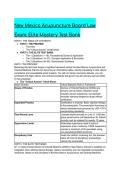
New Mexico Acupuncture Board Law
Exam: Elite Mastery Test Bank
PART 0: THE TABLE OF CONTENTS
● PART I: THE PREVIEW
○ The Intro
○ The "Critical Axioms" Cheat Sheet
● PART II: THE ELITE TEST BANK
○ Tier 1 (Questions 1–18): Foundational Syntax & Application
○ Tier 2 (Questions 19–37): Complex Application & Simulation
○ Tier 3 (Questions 38–55): Grandmaster Synthesis
PART I: THE PREVIEW
Mastering this test bank forges a cognitive framework where the New Mexico Acupuncture and
Oriental Medicine Practice Act becomes an internalized reflex, directly translating to elite clinical
compliance and unassailable board mastery. You will not merely memorize statutes; you will
synthesize the legal, ethical, and clinical boundaries that govern top-tier primary care providers
in this jurisdiction.
● The "Critical Axioms" Cheat Sheet:
Axiom Domain Critical Statutory Rule or Framework
Scope of Practice Doctors of Oriental Medicine (DOMs) are
primary care providers. Baseline scope
includes natural substances, but explicitly
excludes injecting dangerous drugs without
certification.
Expanded Practice Certification is modular. Basic injection therapy
is the prerequisite. The prescriptive formulary is
strictly delineated and governed by USP <797>
compounding standards.
Time-Bound Laws Licenses expire annually on July 31. A 60-day
grace period exists until September 30. Patient
records must be retained for exactly 10 years.
Supervision Limits Externship supervisors need 5 years of
experience (max 2 externs). CADS supervisors
oversee a maximum of 30 specialists using
non-penetrating NADA protocols.
Disciplinary Cost Under the Uniform Licensing Act, the licensee
bears all costs of disciplinary proceedings
unless fully exonerated.
PART II: THE ELITE TEST BANK
Q1: A newly licensed Doctor of Oriental Medicine (DOM) in New Mexico intends to establish an
integrative clinic utilizing manual therapy, dietary counseling, and non-injectable homeopathic
medicines. Based on the principles of the New Mexico Acupuncture and Oriental Medicine
,Practice Act, which conclusion regarding this clinical model is the MOST ACCURATE? A) The
DOM must obtain an Expanded Practice certification before dispensing homeopathic medicines.
B) The DOM is operating outside the scope of practice because cosmetics and homeopathics
require Pharmacy Board oversight. C) The DOM is operating fully within the foundational scope
of practice as a primary care provider. D) The DOM may provide dietary counseling but must
refer patients to a licensed dietician for prescriptions.
● Answer: C (The DOM is operating fully within the foundational scope of practice as a
primary care provider.)
● Distractor Analysis:
○ A is incorrect: Expanded Practice certification is required for injectable therapies
and dangerous drugs, not for non-injectable homeopathics.
○ B is incorrect: The foundational scope explicitly includes cosmetics and natural
substances.
○ D is incorrect: DOMs hold explicit statutory authority to prescribe and administer
dietary supplements therapeutically without referral.
The Mentor's Analysis: The New Mexico DOM license grants a uniquely broad foundational
scope, classifying the practitioner as an independent primary care provider. By utilizing
non-injectable natural substances, you bypass the common trap of assuming a DOM is limited
solely to traditional needling. Professional Intuition: Baseline scope covers all non-injectable
natural substances; Expanded Practice is the exclusive gateway for injectables.
Q2: A DOM plans to retire and close their clinic, possessing comprehensive patient records
spanning 15 years. Based on the principles of Licensee Business Offices and Administrative
Requirements, which action regarding these records is the MOST APPROPRIATE? A) Destroy
all records immediately to protect patient confidentiality. B) Retain all records generated within
the last 10 years for board inspection. C) Retain only the records from the last 7 years, aligning
with federal tax guidelines. D) Transfer all records to the New Mexico Board of Acupuncture and
Oriental Medicine.
● Answer: B (Retain all records generated within the last 10 years for board inspection.)
● Distractor Analysis:
○ A is incorrect: Immediate destruction violates the mandatory minimum retention
period, risking disciplinary action.
○ C is incorrect: The Board mandates a 10-year retention period for patient records,
superseding the 7-year financial baseline.
○ D is incorrect: The Board does not archive private patient records; retention is the
sole responsibility of the provider.
The Mentor's Analysis: Accurate record-keeping is a cornerstone of professional accountability.
The state mandates a minimum 10-year retention period for all patient records. By utilizing
secure, long-term archiving, you bypass the common trap of premature record destruction which
compromises legal defense. Professional Intuition: The lifespan of a patient record in New
Mexico is precisely 10 years.
Q3: A patient formally requests a complete copy of their medical records from a DOM. Based on
the principles of Unprofessional Conduct, which timeline is the MAXIMUM allowable period for
the DOM to provide these documents? A) Within 72 hours of the request. B) Within 10 days of
the request. C) Within 30 days of the request. D) Within 60 days of the request.
● Answer: C (Within 30 days of the request.)
● Distractor Analysis:
○ A is incorrect: 72 hours is not a statutory requirement for standard record
production in NM.
, ○ B is incorrect: 10 days is the timeline for notifying the Board of an address change,
not for records.
○ D is incorrect: Exceeding 30 days renders the DOM guilty of unprofessional
conduct.
The Mentor's Analysis: Patient autonomy includes timely access to health information. Failure to
provide patient records within 30 days of a request is explicitly defined as unprofessional
conduct. By utilizing administrative efficiency, you bypass the common trap of incurring
disciplinary action over clerical negligence. Professional Intuition: Patient record requests
must be fulfilled within a strict 30-day window.
Q4: A DOM is treating an animal (a dog) with acupuncture for arthritis. Based on the principles
of Unprofessional Conduct, which conclusion is the PIVOT WORD regarding this treatment? A)
The DOM is operating legally because AOM encompasses all mammals. B) The DOM is guilty
of unprofessional conduct for practicing acupuncture on an animal. C) The DOM is operating
legally provided they do not charge a fee. D) The DOM may only treat animals using
non-penetrating devices.
● Answer: B (The DOM is guilty of unprofessional conduct for practicing acupuncture on an
animal.)
● Distractor Analysis:
○ A is incorrect: The NM DOM scope is strictly limited to human patients.
○ C is incorrect: Compensation does not dictate scope; piercing an animal's skin is
veterinary medicine.
○ D is incorrect: The treatment of animals in any capacity falls outside the DOM
scope unless explicitly co-licensed in veterinary medicine.
The Mentor's Analysis: Cross-species practice is a hard boundary. The NM Board designates
practicing acupuncture on an animal as unprofessional conduct. By utilizing strictly human
clinical boundaries, you bypass the common trap of violating both the AOM Practice Act and the
Veterinary Practice Act. Professional Intuition: DOMs treat humans; treating animals is
practicing veterinary medicine without a license.
Q5: A licensed DOM fails to submit their annual license renewal application by July 31. Based
on the principles of License Renewal Rules, which action is FIRST required if they renew on
August 15? A) Cease practice immediately, as the license expired on August 1. B) Submit the
standard renewal application and standard fee only. C) Submit the renewal application,
continuing education verification, standard fee, and a late penalty fee. D) Apply for an entirely
new license.
● Answer: C (Submit the renewal application, continuing education verification, standard
fee, and a late penalty fee.)
● Distractor Analysis:
○ A is incorrect: The license does not expire and bar practice until the end of the
60-day grace period on September 30.
○ B is incorrect: Any renewal application received during the 60-day grace period
mandates a late penalty fee.
○ D is incorrect: Reapplication as a new applicant is only required if the DOM fails to
renew by the subsequent July 31.
The Mentor's Analysis: New Mexico law provides a 60-day grace period (August 1 to September
30) during which practice may continue, provided the late fee is paid. By utilizing this statutory
grace period correctly, you bypass the common trap of abandoning the practice prematurely.
Professional Intuition: July 31 is the deadline; August 1 to September 30 is the penalty grace
period.
Exam: Elite Mastery Test Bank
PART 0: THE TABLE OF CONTENTS
● PART I: THE PREVIEW
○ The Intro
○ The "Critical Axioms" Cheat Sheet
● PART II: THE ELITE TEST BANK
○ Tier 1 (Questions 1–18): Foundational Syntax & Application
○ Tier 2 (Questions 19–37): Complex Application & Simulation
○ Tier 3 (Questions 38–55): Grandmaster Synthesis
PART I: THE PREVIEW
Mastering this test bank forges a cognitive framework where the New Mexico Acupuncture and
Oriental Medicine Practice Act becomes an internalized reflex, directly translating to elite clinical
compliance and unassailable board mastery. You will not merely memorize statutes; you will
synthesize the legal, ethical, and clinical boundaries that govern top-tier primary care providers
in this jurisdiction.
● The "Critical Axioms" Cheat Sheet:
Axiom Domain Critical Statutory Rule or Framework
Scope of Practice Doctors of Oriental Medicine (DOMs) are
primary care providers. Baseline scope
includes natural substances, but explicitly
excludes injecting dangerous drugs without
certification.
Expanded Practice Certification is modular. Basic injection therapy
is the prerequisite. The prescriptive formulary is
strictly delineated and governed by USP <797>
compounding standards.
Time-Bound Laws Licenses expire annually on July 31. A 60-day
grace period exists until September 30. Patient
records must be retained for exactly 10 years.
Supervision Limits Externship supervisors need 5 years of
experience (max 2 externs). CADS supervisors
oversee a maximum of 30 specialists using
non-penetrating NADA protocols.
Disciplinary Cost Under the Uniform Licensing Act, the licensee
bears all costs of disciplinary proceedings
unless fully exonerated.
PART II: THE ELITE TEST BANK
Q1: A newly licensed Doctor of Oriental Medicine (DOM) in New Mexico intends to establish an
integrative clinic utilizing manual therapy, dietary counseling, and non-injectable homeopathic
medicines. Based on the principles of the New Mexico Acupuncture and Oriental Medicine
,Practice Act, which conclusion regarding this clinical model is the MOST ACCURATE? A) The
DOM must obtain an Expanded Practice certification before dispensing homeopathic medicines.
B) The DOM is operating outside the scope of practice because cosmetics and homeopathics
require Pharmacy Board oversight. C) The DOM is operating fully within the foundational scope
of practice as a primary care provider. D) The DOM may provide dietary counseling but must
refer patients to a licensed dietician for prescriptions.
● Answer: C (The DOM is operating fully within the foundational scope of practice as a
primary care provider.)
● Distractor Analysis:
○ A is incorrect: Expanded Practice certification is required for injectable therapies
and dangerous drugs, not for non-injectable homeopathics.
○ B is incorrect: The foundational scope explicitly includes cosmetics and natural
substances.
○ D is incorrect: DOMs hold explicit statutory authority to prescribe and administer
dietary supplements therapeutically without referral.
The Mentor's Analysis: The New Mexico DOM license grants a uniquely broad foundational
scope, classifying the practitioner as an independent primary care provider. By utilizing
non-injectable natural substances, you bypass the common trap of assuming a DOM is limited
solely to traditional needling. Professional Intuition: Baseline scope covers all non-injectable
natural substances; Expanded Practice is the exclusive gateway for injectables.
Q2: A DOM plans to retire and close their clinic, possessing comprehensive patient records
spanning 15 years. Based on the principles of Licensee Business Offices and Administrative
Requirements, which action regarding these records is the MOST APPROPRIATE? A) Destroy
all records immediately to protect patient confidentiality. B) Retain all records generated within
the last 10 years for board inspection. C) Retain only the records from the last 7 years, aligning
with federal tax guidelines. D) Transfer all records to the New Mexico Board of Acupuncture and
Oriental Medicine.
● Answer: B (Retain all records generated within the last 10 years for board inspection.)
● Distractor Analysis:
○ A is incorrect: Immediate destruction violates the mandatory minimum retention
period, risking disciplinary action.
○ C is incorrect: The Board mandates a 10-year retention period for patient records,
superseding the 7-year financial baseline.
○ D is incorrect: The Board does not archive private patient records; retention is the
sole responsibility of the provider.
The Mentor's Analysis: Accurate record-keeping is a cornerstone of professional accountability.
The state mandates a minimum 10-year retention period for all patient records. By utilizing
secure, long-term archiving, you bypass the common trap of premature record destruction which
compromises legal defense. Professional Intuition: The lifespan of a patient record in New
Mexico is precisely 10 years.
Q3: A patient formally requests a complete copy of their medical records from a DOM. Based on
the principles of Unprofessional Conduct, which timeline is the MAXIMUM allowable period for
the DOM to provide these documents? A) Within 72 hours of the request. B) Within 10 days of
the request. C) Within 30 days of the request. D) Within 60 days of the request.
● Answer: C (Within 30 days of the request.)
● Distractor Analysis:
○ A is incorrect: 72 hours is not a statutory requirement for standard record
production in NM.
, ○ B is incorrect: 10 days is the timeline for notifying the Board of an address change,
not for records.
○ D is incorrect: Exceeding 30 days renders the DOM guilty of unprofessional
conduct.
The Mentor's Analysis: Patient autonomy includes timely access to health information. Failure to
provide patient records within 30 days of a request is explicitly defined as unprofessional
conduct. By utilizing administrative efficiency, you bypass the common trap of incurring
disciplinary action over clerical negligence. Professional Intuition: Patient record requests
must be fulfilled within a strict 30-day window.
Q4: A DOM is treating an animal (a dog) with acupuncture for arthritis. Based on the principles
of Unprofessional Conduct, which conclusion is the PIVOT WORD regarding this treatment? A)
The DOM is operating legally because AOM encompasses all mammals. B) The DOM is guilty
of unprofessional conduct for practicing acupuncture on an animal. C) The DOM is operating
legally provided they do not charge a fee. D) The DOM may only treat animals using
non-penetrating devices.
● Answer: B (The DOM is guilty of unprofessional conduct for practicing acupuncture on an
animal.)
● Distractor Analysis:
○ A is incorrect: The NM DOM scope is strictly limited to human patients.
○ C is incorrect: Compensation does not dictate scope; piercing an animal's skin is
veterinary medicine.
○ D is incorrect: The treatment of animals in any capacity falls outside the DOM
scope unless explicitly co-licensed in veterinary medicine.
The Mentor's Analysis: Cross-species practice is a hard boundary. The NM Board designates
practicing acupuncture on an animal as unprofessional conduct. By utilizing strictly human
clinical boundaries, you bypass the common trap of violating both the AOM Practice Act and the
Veterinary Practice Act. Professional Intuition: DOMs treat humans; treating animals is
practicing veterinary medicine without a license.
Q5: A licensed DOM fails to submit their annual license renewal application by July 31. Based
on the principles of License Renewal Rules, which action is FIRST required if they renew on
August 15? A) Cease practice immediately, as the license expired on August 1. B) Submit the
standard renewal application and standard fee only. C) Submit the renewal application,
continuing education verification, standard fee, and a late penalty fee. D) Apply for an entirely
new license.
● Answer: C (Submit the renewal application, continuing education verification, standard
fee, and a late penalty fee.)
● Distractor Analysis:
○ A is incorrect: The license does not expire and bar practice until the end of the
60-day grace period on September 30.
○ B is incorrect: Any renewal application received during the 60-day grace period
mandates a late penalty fee.
○ D is incorrect: Reapplication as a new applicant is only required if the DOM fails to
renew by the subsequent July 31.
The Mentor's Analysis: New Mexico law provides a 60-day grace period (August 1 to September
30) during which practice may continue, provided the late fee is paid. By utilizing this statutory
grace period correctly, you bypass the common trap of abandoning the practice prematurely.
Professional Intuition: July 31 is the deadline; August 1 to September 30 is the penalty grace
period.


