
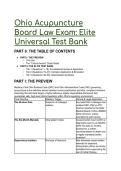
Ohio Acupuncture
Board Law Exam: Elite
Universal Test Bank
PART 0: THE TABLE OF CONTENTS
● PART I: THE PREVIEW
○ The Intro
○ The "Critical Axioms" Cheat Sheet
● PART II: THE ELITE TEST BANK
○ Tier 1 (Questions 1–18): Foundational Syntax & Application
○ Tier 2 (Questions 19–37): Complex Application & Simulation
○ Tier 3 (Questions 38–55): Grandmaster Synthesis
PART I: THE PREVIEW
Mastery of the Ohio Revised Code (ORC) and Ohio Administrative Code (OAC) governing
acupuncture is the definitive barrier between novice practitioners and elite, compliant clinicians.
Executing this test bank forges a highly defensive, legally impenetrable framework that
guarantees safe, high-level clinical operation within Ohio's regulatory environment.
Core Directive Statutory Trigger Clinical & Legal Application
The 48-Hour Rule Suspicion of colleague Any belief that a colleague has
violation. violated ORC 4762 or 4731
must be reported to the State
Medical Board of Ohio (SMBO)
within 48 hours, unless
exempted by peer-review.
The Six-Month Mandate Initial patient intake. Acupuncturists must confirm a
diagnostic exam by an MD/DC
within the past six months;
lacking this, a written
recommendation to obtain one
is legally mandated before
treatment.
Supervisory Isolation First year of licensure. New licensees require written
referrals for treatment;
chiropractors (DCs) are strictly
prohibited from supervising the
use of herbal therapy.
,Core Directive Statutory Trigger Clinical & Legal Application
Confidential Monitoring Substance use disorder Licensees may avoid public
diagnosis. discipline via the Confidential
Monitoring Program only if they
have no prior disciplinary action
and suspend practice
immediately.
Chiropractic Limits DC advertising and scope. Chiropractors with an
acupuncture certificate may
perform dry needling but are
strictly prohibited from
advertising or practicing
Oriental Medicine.
PART II: THE ELITE TEST BANK
Tier 1: Foundational Syntax & Application
Q1: An acupuncturist prepares to treat a new patient for migraines. The patient states they have
not seen a physician in over a year. Based on the principles of Ohio Revised Code 4762.10,
which action is the FIRST legal requirement? A) Refuse treatment until the patient obtains a
written referral from a physician. B) Perform a standard diagnostic examination to establish a
traditional Chinese medicine diagnosis. C) Provide the patient with a written recommendation to
undergo a medical diagnostic examination. D) Proceed with treatment but document the lack of
a recent examination in the patient's chart.
● Answer: C (Provide the patient with a written recommendation to undergo a medical
diagnostic examination.)
● Distractor Analysis:
○ A is incorrect: A referral is only required during the initial supervisory period;
independent practitioners only need to provide the recommendation.
○ B is incorrect: Acupuncturists are strictly forbidden from making a conventional
medical diagnosis under Ohio law.
○ D is incorrect: Proceeding without first providing the written recommendation
violates the statutory protocol for diagnostic confirmations.
The Mentor's Analysis: When facing a patient lacking a recent 6-month diagnostic exam, the
immediate priority is providing a written recommendation to see a physician. By utilizing this
required disclosure, you bypass the common trap of practicing medicine without authorization.
Professional Intuition: Always provide the written recommendation for a medical exam
before inserting a single needle if the 6-month confirmation is missing.
Q2: An acupuncturist observes a colleague treating patients while visibly intoxicated. Based on
the principles of OAC 4731-15-01, which action is the MOST APPROPRIATE? A) Confront the
colleague and document the incident internally. B) Report the colleague to the State Medical
Board of Ohio within 48 hours. C) Notify the local police department immediately to handle the
intoxication. D) Report the violation to the board within 30 days of the incident.
● Answer: B (Report the colleague to the State Medical Board of Ohio within 48 hours.)
● Distractor Analysis:
○ A is incorrect: Internal documentation does not discharge the legal duty to report to
the board.
, ○ C is incorrect: While law enforcement handles crimes, the statutory duty dictates
reporting misconduct specifically to the SMBO.
○ D is incorrect: Waiting 30 days is a fatal error; the mandate strictly requires
reporting within 48 hours.
The Mentor's Analysis: When facing an impaired colleague, the immediate priority is regulatory
notification. By utilizing the 48-hour reporting mandate, you bypass the common trap of
assuming internal handling relieves you of statutory liability. Professional Intuition: The Duty to
Report is absolute, non-delegable, and triggers a strict 48-hour countdown.
Q3: An applicant seeks an Ohio license as an oriental medicine practitioner. Based on the
principles of ORC 4762.03, which qualification is EXCEPTED from the standard requirements?
A) A current designation as a diplomate in oriental medicine from the NCCAOM. B) Completion
of an FDA dispensary and compounding guidelines course. C) A current designation as a
diplomate in chiropractic acupuncture. D) Evidence that the applicant is at least eighteen years
of age.
● Answer: C (A current designation as a diplomate in chiropractic acupuncture.)
● Distractor Analysis:
○ A is incorrect: This is a mandatory requirement for oriental medicine practitioners.
○ B is incorrect: This course is specifically mandated by statute for oriental medicine
licensure.
○ D is incorrect: Being eighteen years of age is a universal baseline requirement.
The Mentor's Analysis: When facing licensure requirements, the immediate priority is aligning
NCCAOM credentials with the specific Ohio license type. By utilizing proper board jurisdictions,
you bypass the common trap of conflating chiropractic certificates with oriental medicine
licenses. Professional Intuition: Oriental Medicine licenses require NCCAOM Oriental
Medicine or Chinese Herbology diplomas; Chiropractic certificates are wholly separate.
Q4: A licensed acupuncturist wishes to utilize herbal therapy. Based on the principles of ORC
4762.02, which condition is the PRIMARY legal prerequisite? A) The acupuncturist must have a
written referral from a physician for herbal therapy. B) The acupuncturist must hold an NCCAOM
designation as a diplomate in oriental medicine or Chinese herbology. C) The acupuncturist
must be under the direct supervision of a licensed pharmacist. D) The acupuncturist must obtain
a compounding license from the Pharmacy Board.
● Answer: B (The acupuncturist must hold an NCCAOM designation as a diplomate in
oriental medicine or Chinese herbology.)
● Distractor Analysis:
○ A is incorrect: Physicians cannot prescribe or supervise herbal therapy for
acupuncturists.
○ C is incorrect: Pharmacist supervision is not required; the acupuncturist acts under
their own certification.
○ D is incorrect: The law requires the specific NCCAOM designations, not a
pharmacy license.
The Mentor's Analysis: When facing the integration of herbs into practice, the immediate priority
is possessing the correct NCCAOM credential. By utilizing the proper diplomate status, you
bypass the common trap of practicing beyond the scope of a standard acupuncture license.
Professional Intuition: Herbal therapy strictly requires NCCAOM credentials in Oriental
Medicine or Chinese Herbology.
Q5: A chiropractor with an acupuncture certificate advertises their clinic as an "Oriental
Medicine Center." Based on the principles of ORC 4734.142, which conclusion is the MOST
LOGICAL? A) This is permissible if they possess an NCCAOM diploma. B) This is a direct
Board Law Exam: Elite
Universal Test Bank
PART 0: THE TABLE OF CONTENTS
● PART I: THE PREVIEW
○ The Intro
○ The "Critical Axioms" Cheat Sheet
● PART II: THE ELITE TEST BANK
○ Tier 1 (Questions 1–18): Foundational Syntax & Application
○ Tier 2 (Questions 19–37): Complex Application & Simulation
○ Tier 3 (Questions 38–55): Grandmaster Synthesis
PART I: THE PREVIEW
Mastery of the Ohio Revised Code (ORC) and Ohio Administrative Code (OAC) governing
acupuncture is the definitive barrier between novice practitioners and elite, compliant clinicians.
Executing this test bank forges a highly defensive, legally impenetrable framework that
guarantees safe, high-level clinical operation within Ohio's regulatory environment.
Core Directive Statutory Trigger Clinical & Legal Application
The 48-Hour Rule Suspicion of colleague Any belief that a colleague has
violation. violated ORC 4762 or 4731
must be reported to the State
Medical Board of Ohio (SMBO)
within 48 hours, unless
exempted by peer-review.
The Six-Month Mandate Initial patient intake. Acupuncturists must confirm a
diagnostic exam by an MD/DC
within the past six months;
lacking this, a written
recommendation to obtain one
is legally mandated before
treatment.
Supervisory Isolation First year of licensure. New licensees require written
referrals for treatment;
chiropractors (DCs) are strictly
prohibited from supervising the
use of herbal therapy.
,Core Directive Statutory Trigger Clinical & Legal Application
Confidential Monitoring Substance use disorder Licensees may avoid public
diagnosis. discipline via the Confidential
Monitoring Program only if they
have no prior disciplinary action
and suspend practice
immediately.
Chiropractic Limits DC advertising and scope. Chiropractors with an
acupuncture certificate may
perform dry needling but are
strictly prohibited from
advertising or practicing
Oriental Medicine.
PART II: THE ELITE TEST BANK
Tier 1: Foundational Syntax & Application
Q1: An acupuncturist prepares to treat a new patient for migraines. The patient states they have
not seen a physician in over a year. Based on the principles of Ohio Revised Code 4762.10,
which action is the FIRST legal requirement? A) Refuse treatment until the patient obtains a
written referral from a physician. B) Perform a standard diagnostic examination to establish a
traditional Chinese medicine diagnosis. C) Provide the patient with a written recommendation to
undergo a medical diagnostic examination. D) Proceed with treatment but document the lack of
a recent examination in the patient's chart.
● Answer: C (Provide the patient with a written recommendation to undergo a medical
diagnostic examination.)
● Distractor Analysis:
○ A is incorrect: A referral is only required during the initial supervisory period;
independent practitioners only need to provide the recommendation.
○ B is incorrect: Acupuncturists are strictly forbidden from making a conventional
medical diagnosis under Ohio law.
○ D is incorrect: Proceeding without first providing the written recommendation
violates the statutory protocol for diagnostic confirmations.
The Mentor's Analysis: When facing a patient lacking a recent 6-month diagnostic exam, the
immediate priority is providing a written recommendation to see a physician. By utilizing this
required disclosure, you bypass the common trap of practicing medicine without authorization.
Professional Intuition: Always provide the written recommendation for a medical exam
before inserting a single needle if the 6-month confirmation is missing.
Q2: An acupuncturist observes a colleague treating patients while visibly intoxicated. Based on
the principles of OAC 4731-15-01, which action is the MOST APPROPRIATE? A) Confront the
colleague and document the incident internally. B) Report the colleague to the State Medical
Board of Ohio within 48 hours. C) Notify the local police department immediately to handle the
intoxication. D) Report the violation to the board within 30 days of the incident.
● Answer: B (Report the colleague to the State Medical Board of Ohio within 48 hours.)
● Distractor Analysis:
○ A is incorrect: Internal documentation does not discharge the legal duty to report to
the board.
, ○ C is incorrect: While law enforcement handles crimes, the statutory duty dictates
reporting misconduct specifically to the SMBO.
○ D is incorrect: Waiting 30 days is a fatal error; the mandate strictly requires
reporting within 48 hours.
The Mentor's Analysis: When facing an impaired colleague, the immediate priority is regulatory
notification. By utilizing the 48-hour reporting mandate, you bypass the common trap of
assuming internal handling relieves you of statutory liability. Professional Intuition: The Duty to
Report is absolute, non-delegable, and triggers a strict 48-hour countdown.
Q3: An applicant seeks an Ohio license as an oriental medicine practitioner. Based on the
principles of ORC 4762.03, which qualification is EXCEPTED from the standard requirements?
A) A current designation as a diplomate in oriental medicine from the NCCAOM. B) Completion
of an FDA dispensary and compounding guidelines course. C) A current designation as a
diplomate in chiropractic acupuncture. D) Evidence that the applicant is at least eighteen years
of age.
● Answer: C (A current designation as a diplomate in chiropractic acupuncture.)
● Distractor Analysis:
○ A is incorrect: This is a mandatory requirement for oriental medicine practitioners.
○ B is incorrect: This course is specifically mandated by statute for oriental medicine
licensure.
○ D is incorrect: Being eighteen years of age is a universal baseline requirement.
The Mentor's Analysis: When facing licensure requirements, the immediate priority is aligning
NCCAOM credentials with the specific Ohio license type. By utilizing proper board jurisdictions,
you bypass the common trap of conflating chiropractic certificates with oriental medicine
licenses. Professional Intuition: Oriental Medicine licenses require NCCAOM Oriental
Medicine or Chinese Herbology diplomas; Chiropractic certificates are wholly separate.
Q4: A licensed acupuncturist wishes to utilize herbal therapy. Based on the principles of ORC
4762.02, which condition is the PRIMARY legal prerequisite? A) The acupuncturist must have a
written referral from a physician for herbal therapy. B) The acupuncturist must hold an NCCAOM
designation as a diplomate in oriental medicine or Chinese herbology. C) The acupuncturist
must be under the direct supervision of a licensed pharmacist. D) The acupuncturist must obtain
a compounding license from the Pharmacy Board.
● Answer: B (The acupuncturist must hold an NCCAOM designation as a diplomate in
oriental medicine or Chinese herbology.)
● Distractor Analysis:
○ A is incorrect: Physicians cannot prescribe or supervise herbal therapy for
acupuncturists.
○ C is incorrect: Pharmacist supervision is not required; the acupuncturist acts under
their own certification.
○ D is incorrect: The law requires the specific NCCAOM designations, not a
pharmacy license.
The Mentor's Analysis: When facing the integration of herbs into practice, the immediate priority
is possessing the correct NCCAOM credential. By utilizing the proper diplomate status, you
bypass the common trap of practicing beyond the scope of a standard acupuncture license.
Professional Intuition: Herbal therapy strictly requires NCCAOM credentials in Oriental
Medicine or Chinese Herbology.
Q5: A chiropractor with an acupuncture certificate advertises their clinic as an "Oriental
Medicine Center." Based on the principles of ORC 4734.142, which conclusion is the MOST
LOGICAL? A) This is permissible if they possess an NCCAOM diploma. B) This is a direct


