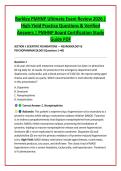
Barkley PMHNP Ultimate Exam Review 2026 |
High-Yield Practice Questions & Verified
Answers | PMHNP Board Certification Study
Guide PDF
SECTION I: SCIENTIFIC FOUNDATIONS — NEUROBIOLOGY &
PSYCHOPHARMACOLOGY (Questions 1–40)
Question 1
A 42-year-old male with treatment-resistant depression has been on phenelzine
60 mg daily for 12 weeks. He presents to the emergency department with
diaphoresis, tachycardia, and a blood pressure of 210/110. He reports eating aged
cheese and salami at a party. Which neurotransmitter is most directly implicated
in this presentation?
A. Dopamine
B. Serotonin
C. Norepinephrine
D. Acetylcholine
Correct Answer: C. Norepinephrine
Rationale: This patient is experiencing a hypertensive crisis secondary to a
tyramine reaction while taking a monoamine oxidase inhibitor (MAOI). Tyramine
is an indirect sympathomimetic that displaces norepinephrine from presynaptic
vesicles. MAOIs inhibit monoamine oxidase, preventing the breakdown of
tyramine, leading to massive norepinephrine release and severe hypertension.
Serotonin (B) is more implicated in serotonin syndrome. Dopamine (A) and
acetylcholine (D) are not the primary mediators of tyramine-induced hypertensive
crisis. High-Yield: MAOI dietary restrictions include aged cheeses, cured meats,
fermented products, soy sauce, and draft beer. The classic triad of MAOI
hypertensive crisis is severe headache, tachycardia, and hypertension. Treatment
is IV phentolamine.
,Question 2
Which of the following statements regarding the mechanism of action of
clozapine is most accurate?
A. It is a selective D2 antagonist with minimal serotonergic activity
B. It binds loosely to D2 receptors and has high affinity for 5-HT2A, D4, and α1
receptors
C. It primarily acts as a dopamine partial agonist
D. It inhibits serotonin reuptake at the presynaptic terminal
Correct Answer: B. It binds loosely to D2 receptors and has high affinity
for 5-HT2A, D4, and α1 receptors
Rationale: Clozapine is the prototype atypical antipsychotic. Its unique
efficacy in treatment-resistant schizophrenia and its low risk of extrapyramidal
symptoms (EPS) are attributed to its loose binding to D2 receptors (fast
dissociation) and its broad receptor profile, including high affinity for 5-HT2A, D4,
α1-adrenergic, H1-histaminergic, and muscarinic receptors. It is not a selective D2
antagonist (A), not a partial agonist (C) — that describes aripiprazole — and not a
serotonin reuptake inhibitor (D). High-Yield: Clozapine requires mandatory ANC
monitoring due to agranulocytosis risk. Other serious adverse effects include
myocarditis, seizures, and severe constipation (which can progress to ileus).
Question 3
A 28-year-old female with generalized anxiety disorder is started on buspirone.
Which statement by the patient indicates a need for further education?
A. "I should take this medication consistently every day, even when I feel fine."
B. "I can expect this to work within a few days, just like Xanax."
C. "I should avoid drinking grapefruit juice while on this medication."
D. "It may take 2 to 4 weeks before I notice the full effect."
Correct Answer: B. "I can expect this to work within a few days, just like
Xanax."
, Rationale: Buspirone is a 5-HT1A partial agonist that requires 2–4 weeks
for full therapeutic effect. It is not a benzodiazepine and does not provide
immediate anxiolysis. Patients expecting rapid relief similar to alprazolam (Xanax)
need correction. Consistent daily dosing (A) is correct. Grapefruit juice (C) inhibits
CYP3A4, which metabolizes buspirone, potentially increasing levels. The delayed
onset (D) is accurate. High-Yield: Buspirone is particularly useful in patients with
comorbid substance use disorders because it lacks abuse potential and does not
potentiate CNS depression with alcohol. It is not effective for panic disorder or
PRN anxiety.
Question 4
Which of the following cytochrome P450 enzymes is most responsible for the
metabolism of aripiprazole?
A. CYP1A2
B. CYP2D6
C. CYP3A4
D. CYP2C19
Correct Answer: B. CYP2D6
Rationale: Aripiprazole is primarily metabolized by CYP2D6 and CYP3A4,
with CYP2D6 being the major pathway. Poor metabolizers of CYP2D6 may have
significantly elevated aripiprazole levels and should receive a reduced dose
(typically half the usual dose). Strong CYP2D6 inhibitors (e.g., fluoxetine,
paroxetine, bupropion) also increase aripiprazole levels. CYP1A2 (A) is primarily
involved in olanzapine and clozapine metabolism. CYP3A4 (C) plays a secondary
role for aripiprazole. CYP2C19 (D) is not a major pathway. High-Yield: When
combining aripiprazole with fluoxetine or paroxetine, reduce the aripiprazole
dose by 50%.
Question 5 (SATA)
A 65-year-old male with a history of bipolar I disorder on long-term lithium
, therapy presents with coarse tremor, ataxia, vomiting, and confusion. Which of
the following findings are consistent with lithium toxicity? Select all that apply.
A. Lithium level of 2.1 mEq/L
B. Serum creatinine elevated from baseline
C. Fine tremor
D. Hyperreflexia and clonus
E. Slurred speech
Correct Answers: A, B, E
Rationale: Lithium toxicity presents with gastrointestinal symptoms
(nausea, vomiting, diarrhea), neurologic symptoms (coarse tremor, ataxia, slurred
speech, confusion, seizures), and renal impairment (elevated creatinine). A
lithium level >1.5 mEq/L is generally considered toxic, and >2.0 mEq/L is severe.
Fine tremor (C) is a common side effect at therapeutic levels, not a sign of toxicity.
Hyperreflexia and clonus (D) are hallmark features of serotonin syndrome, not
lithium toxicity. High-Yield: Risk factors for lithium toxicity include dehydration,
NSAID use, ACE inhibitors, thiazide diuretics, and renal impairment. Treatment
includes IV fluids and, in severe cases, hemodialysis.
Question 6
A patient on haloperidol develops acute dystonia with sustained neck muscle
contractions and difficulty swallowing. Which medication is the most appropriate
immediate treatment?
A. Benztropine
B. Propranolol
C. Lorazepam
D. Diphenhydramine
Correct Answer: A. Benztropine
Rationale: Acute dystonia is a painful, sustained muscle contraction that
typically occurs within hours to days of starting or increasing an antipsychotic. It is
treated emergently with anticholinergic agents such as benztropine (Cogentin) or
trihexyphenidyl. Diphenhydramine (D) is an alternative but is generally considered
High-Yield Practice Questions & Verified
Answers | PMHNP Board Certification Study
Guide PDF
SECTION I: SCIENTIFIC FOUNDATIONS — NEUROBIOLOGY &
PSYCHOPHARMACOLOGY (Questions 1–40)
Question 1
A 42-year-old male with treatment-resistant depression has been on phenelzine
60 mg daily for 12 weeks. He presents to the emergency department with
diaphoresis, tachycardia, and a blood pressure of 210/110. He reports eating aged
cheese and salami at a party. Which neurotransmitter is most directly implicated
in this presentation?
A. Dopamine
B. Serotonin
C. Norepinephrine
D. Acetylcholine
Correct Answer: C. Norepinephrine
Rationale: This patient is experiencing a hypertensive crisis secondary to a
tyramine reaction while taking a monoamine oxidase inhibitor (MAOI). Tyramine
is an indirect sympathomimetic that displaces norepinephrine from presynaptic
vesicles. MAOIs inhibit monoamine oxidase, preventing the breakdown of
tyramine, leading to massive norepinephrine release and severe hypertension.
Serotonin (B) is more implicated in serotonin syndrome. Dopamine (A) and
acetylcholine (D) are not the primary mediators of tyramine-induced hypertensive
crisis. High-Yield: MAOI dietary restrictions include aged cheeses, cured meats,
fermented products, soy sauce, and draft beer. The classic triad of MAOI
hypertensive crisis is severe headache, tachycardia, and hypertension. Treatment
is IV phentolamine.
,Question 2
Which of the following statements regarding the mechanism of action of
clozapine is most accurate?
A. It is a selective D2 antagonist with minimal serotonergic activity
B. It binds loosely to D2 receptors and has high affinity for 5-HT2A, D4, and α1
receptors
C. It primarily acts as a dopamine partial agonist
D. It inhibits serotonin reuptake at the presynaptic terminal
Correct Answer: B. It binds loosely to D2 receptors and has high affinity
for 5-HT2A, D4, and α1 receptors
Rationale: Clozapine is the prototype atypical antipsychotic. Its unique
efficacy in treatment-resistant schizophrenia and its low risk of extrapyramidal
symptoms (EPS) are attributed to its loose binding to D2 receptors (fast
dissociation) and its broad receptor profile, including high affinity for 5-HT2A, D4,
α1-adrenergic, H1-histaminergic, and muscarinic receptors. It is not a selective D2
antagonist (A), not a partial agonist (C) — that describes aripiprazole — and not a
serotonin reuptake inhibitor (D). High-Yield: Clozapine requires mandatory ANC
monitoring due to agranulocytosis risk. Other serious adverse effects include
myocarditis, seizures, and severe constipation (which can progress to ileus).
Question 3
A 28-year-old female with generalized anxiety disorder is started on buspirone.
Which statement by the patient indicates a need for further education?
A. "I should take this medication consistently every day, even when I feel fine."
B. "I can expect this to work within a few days, just like Xanax."
C. "I should avoid drinking grapefruit juice while on this medication."
D. "It may take 2 to 4 weeks before I notice the full effect."
Correct Answer: B. "I can expect this to work within a few days, just like
Xanax."
, Rationale: Buspirone is a 5-HT1A partial agonist that requires 2–4 weeks
for full therapeutic effect. It is not a benzodiazepine and does not provide
immediate anxiolysis. Patients expecting rapid relief similar to alprazolam (Xanax)
need correction. Consistent daily dosing (A) is correct. Grapefruit juice (C) inhibits
CYP3A4, which metabolizes buspirone, potentially increasing levels. The delayed
onset (D) is accurate. High-Yield: Buspirone is particularly useful in patients with
comorbid substance use disorders because it lacks abuse potential and does not
potentiate CNS depression with alcohol. It is not effective for panic disorder or
PRN anxiety.
Question 4
Which of the following cytochrome P450 enzymes is most responsible for the
metabolism of aripiprazole?
A. CYP1A2
B. CYP2D6
C. CYP3A4
D. CYP2C19
Correct Answer: B. CYP2D6
Rationale: Aripiprazole is primarily metabolized by CYP2D6 and CYP3A4,
with CYP2D6 being the major pathway. Poor metabolizers of CYP2D6 may have
significantly elevated aripiprazole levels and should receive a reduced dose
(typically half the usual dose). Strong CYP2D6 inhibitors (e.g., fluoxetine,
paroxetine, bupropion) also increase aripiprazole levels. CYP1A2 (A) is primarily
involved in olanzapine and clozapine metabolism. CYP3A4 (C) plays a secondary
role for aripiprazole. CYP2C19 (D) is not a major pathway. High-Yield: When
combining aripiprazole with fluoxetine or paroxetine, reduce the aripiprazole
dose by 50%.
Question 5 (SATA)
A 65-year-old male with a history of bipolar I disorder on long-term lithium
, therapy presents with coarse tremor, ataxia, vomiting, and confusion. Which of
the following findings are consistent with lithium toxicity? Select all that apply.
A. Lithium level of 2.1 mEq/L
B. Serum creatinine elevated from baseline
C. Fine tremor
D. Hyperreflexia and clonus
E. Slurred speech
Correct Answers: A, B, E
Rationale: Lithium toxicity presents with gastrointestinal symptoms
(nausea, vomiting, diarrhea), neurologic symptoms (coarse tremor, ataxia, slurred
speech, confusion, seizures), and renal impairment (elevated creatinine). A
lithium level >1.5 mEq/L is generally considered toxic, and >2.0 mEq/L is severe.
Fine tremor (C) is a common side effect at therapeutic levels, not a sign of toxicity.
Hyperreflexia and clonus (D) are hallmark features of serotonin syndrome, not
lithium toxicity. High-Yield: Risk factors for lithium toxicity include dehydration,
NSAID use, ACE inhibitors, thiazide diuretics, and renal impairment. Treatment
includes IV fluids and, in severe cases, hemodialysis.
Question 6
A patient on haloperidol develops acute dystonia with sustained neck muscle
contractions and difficulty swallowing. Which medication is the most appropriate
immediate treatment?
A. Benztropine
B. Propranolol
C. Lorazepam
D. Diphenhydramine
Correct Answer: A. Benztropine
Rationale: Acute dystonia is a painful, sustained muscle contraction that
typically occurs within hours to days of starting or increasing an antipsychotic. It is
treated emergently with anticholinergic agents such as benztropine (Cogentin) or
trihexyphenidyl. Diphenhydramine (D) is an alternative but is generally considered