
MATHEMATICS / LOGARITHMS / INDEPENDENT SUPPLEMENT
METHOD SUMMARY + ORIGINAL PRACTICE
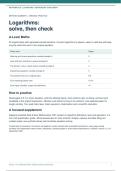
Logarithms:
solve, then check
A-Level Maths
24 original tasks with separated worked solutions. Connect logarithms to powers, select a valid law and keep
only the roots that work in the original equation.
Study route Pages
Meaning and inverse operations; worked example A 2
Laws and their restrictions; worked example B 3
The domain / solve / check routine; worked example C 4
Exponential equations; worked example D 5
Four practice sets of six original tasks 6-9
Four matching solution sets 10-13
Error-repair checklist, scope and references 14
How to practise
Read pages 2-5. For every equation, write the allowed inputs, solve without early rounding, and test each
candidate in the original expression. Attempt a set before turning to its solutions. Use separate paper for
longer working. You need index laws, linear equations, factorisation and a scientific calculator.
A focused supplement
Supports selected AQA A-level Mathematics 7357 content on logarithm definitions, laws and equations. It is
not a full specification guide, official assessment or mark scheme. Graphs, calculus and data fitting are
outside scope; one synthetic decay task illustrates equation solving.
Created with AI assistance. Numerical and algebraic results checked with executable calculations; every page visually
reviewed. No independent expert review, attendance, achieved grade or exam-board endorsement is claimed. Version 1.0, 23
September 2026.
Version 1.0 | September 2026 | Original methods and practice 1
, MATHEMATICS / LOGARITHMS / INDEPENDENT SUPPLEMENT
01 / MEANING FIRST
A logarithm asks for a power
logb(A) = k means bk = A. The base b is positive and is not 1. The argument A must be strictly positive. The
answer k can be negative, zero or positive.
Notation Read it as
log5(125) = 3 What power of 5 produces 125?
log5(1/25) = -2 A negative power produces a positive fraction.
log5(1) = 0 The zero power gives 1, not 0.
ln(A) The logarithm to base e.
log10(A) The common logarithm; often the calculator log key.
Worked example A: undo the operation
Solve log4(3x + 1) = 2. First require 3x + 1 > 0, so x > -1/3. The definition gives 3x + 1 = 42 = 16. Then 3x = 15
and x = 5. Check the original argument: 3(5) + 1 = 16, and log4(16) = 2. The solution is valid.
A negative answer is not a negative argument
log5(1/25) = -2 is defined because 1/25 is positive. log5(-2) is not a real number. Keep the location of the
negative sign clear. A logarithm of 0 is also undefined in the real numbers.
Inverse operations
ln(ex) = x for every real x. In the other direction, eln(x) = x requires x > 0. "Cancel the log" is useful shorthand
only after you have checked the base and the domain.
Quick self-check
Before rearranging, point to the base, the argument and the value. If you cannot identify those three pieces,
rewrite the statement as a power equation first.
Version 1.0 | September 2026 | Original methods and practice 2


