
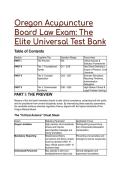
Oregon Acupuncture
Board Law Exam: The
Elite Universal Test Bank
Table of Contents
Section Cognitive Tier Question Range Focus Area
PART I The Preview N/A Critical Axioms &
Statutory Frameworks
PART II Tier 1: Foundational Q1 – Q18 Hard Deck Definitions,
Syntax Scope of Practice, Core
Licensure
PART II Tier 2: Complex Q19 – Q37 Scenario Simulation,
Application Reporting Timelines,
Administrative
Delegation
PART II Tier 3: Grandmaster Q38 – Q55 High-Stakes Clinical &
Synthesis Legal Problem Solving
PART I: THE PREVIEW
Mastery of this test bank translates directly to elite clinical compliance, protecting both the public
and the practitioner from severe disciplinary action. By internalizing these statutory parameters,
the candidate achieves absolute regulatory fluency aligned with the highest standards of the
Oregon Medical Board.
The "Critical Axioms" Cheat Sheet
Axiom Statutory Parameter Application Focus
Scope Limitation High-velocity, short-amplitude Distinguishing acupuncture
thrusts and internal from chiropractic/osteopathic
pelvic/genital massages are manipulation.
strictly prohibited.
Mandatory Reporting Misdemeanor/felony Preventing civil penalties and
convictions and felony arrests emergency license suspension.
must be reported within 10
days; official actions within 10
business days.
Unlicensed Personnel May operate e-stim (turn Clinical delegation and
on/adjust/remove clips) only supervision boundaries.
,Axiom Statutory Parameter Application Focus
after needles are placed by the
acupuncturist. Cannot
diagnose, insert, or remove
needles.
Clinical Supervision Supervisors must have 5 years Academic and clinical training
of active practice experience protocols.
and may supervise a maximum
of two students in a private
clinic setting.
Lapsed Licensure Practicing without an active Strict adherence to the June 30
license constitutes a Class C biennial renewal deadline.
felony for unauthorized
practice.
PART II: THE ELITE TEST BANK
Tier 1: Foundational Syntax & Application
Q1: Under Oregon Administrative Rules, an acupuncturist incorporates traditional manual
therapy into a treatment plan for a patient with severe lumbar radiculopathy. Based on the
principles of the Oregon Medical Board Scope of Practice, which action is STRICTLY
PROHIBITED? A) Application of manual traction to the lumbar spine. B) Deep tissue kneading
and percussion of the surrounding fascia. C) High-velocity, short-amplitude manipulative
thrusting to the spinal articulations. D) The use of thermal and magnetic devices to stimulate
local meridians.
● Answer: C (High-velocity, short-amplitude manipulative thrusting to the spinal
articulations.)
● Distractor Analysis:
○ A is incorrect: Manual traction is explicitly authorized under the definition of
traditional Eastern medicine manual therapy.
○ B is incorrect: Kneading and percussion are recognized and authorized therapeutic
methods.
○ D is incorrect: The use of thermal or magnetic devices, with or without needles, is a
foundational component of the defined acupuncture scope.
The Mentor's Analysis: Scope of practice defines the absolute boundaries of clinical
intervention. Traditional Eastern medicine manual therapy expressly excludes high-velocity,
short-amplitude thrusting, a limitation designed historically to separate acupuncture from
chiropractic or osteopathic structural manipulation. As manual therapies evolve, this hard line
preserves inter-professional boundaries and shields patients from unauthorized orthopedic
adjustments. Professional Intuition: Always differentiate traditional manual mobilization
from high-velocity structural manipulation.
Q2: An applicant trained in a foreign jurisdiction seeks an Oregon acupuncture license but does
not possess an ACAHM-accredited degree. Based on the principles of Oregon Licensure
Qualifications, what is the FIRST alternative requirement the applicant must demonstrate? A)
Three years of supervised clinical residency in the United States. B) Five years of licensed
clinical acupuncture practice in the U.S., comprising at least 500 patient visits per year. C) A
waiver from the Acupuncture Advisory Committee validating their foreign credentials. D)
, Completion of an intensive 300-hour board-approved biomedical ethics course.
● Answer: B (Five years of licensed clinical acupuncture practice in the U.S., comprising at
least 500 patient visits per year.)
● Distractor Analysis:
○ A is incorrect: Oregon law does not provide a three-year supervised residency
alternative for licensure.
○ C is incorrect: The Committee does not issue ad-hoc waivers for foreign credentials
without standardized credential equivalency reviews.
○ D is incorrect: This is a legacy requirement seen in other states for MDs practicing
acupuncture, not a standalone pathway for primary L.Ac licensure in Oregon.
The Mentor's Analysis: When standard educational accreditation pathways are unavailable, the
board demands rigorous proof of clinical safety and volume. The alternative pathway mandates
five years of active U.S. practice with a verified minimum of 500 visits annually. This mechanism
historically accommodates competent legacy practitioners while strictly gatekeeping against
inexperienced candidates lacking formal ACAHM oversight. Professional Intuition: Clinical
volume serves as the legal proxy for educational accreditation.
Q3: A newly licensed acupuncturist wishes to market their practice. The practitioner holds a
standard master's degree in acupuncture. Based on the principles of Oregon Medical Board
Advertising Rules, which title designation is the MOST APPROPRIATE? A) Doctor of
Acupuncture and Oriental Medicine B) Licensed Acupuncturist (L.Ac.) C) Acupuncture Physician
D) Medical Acupuncturist
● Answer: B (Licensed Acupuncturist (L.Ac.))
● Distractor Analysis:
○ A is incorrect: The title "Doctor" may only be used by individuals who have
completed a program leading to a federally recognized doctoral degree in
Acupuncture and Oriental Medicine.
○ C is incorrect: "Acupuncture Physician" is a specific statutory title in jurisdictions like
Florida, but is restricted in Oregon to avoid confusing the public regarding MD/DO
status.
○ D is incorrect: "Medical Acupuncturist" typically denotes an MD/DO who has
completed secondary acupuncture training.
The Mentor's Analysis: Title protection prevents public deception. Oregon law strictly limits the
"Doctor" prefix to those holding a federally recognized doctorate in the field. The mechanism of
enforcement relies on consumer transparency, ensuring patients are never misled regarding the
academic background of their provider. Professional Intuition: Never use a title that implies a
higher level of academic or medical credentialing than strictly possessed.
Q4: An acupuncturist fails to renew their biennial registration by the June 30 deadline but
continues to treat patients in July. Based on the principles of Oregon Regulatory Statutes, what
is the MOST LIKELY consequence of this action? A) A mandatory suspension of 30 days
followed by a reactivation fee. B) Reclassification to "Emeritus" status until continuing education
is validated. C) Prosecution for a Class C felony for the unauthorized practice of medicine. D) A
simple administrative warning requiring immediate payment of a late fee.
● Answer: C (Prosecution for a Class C felony for the unauthorized practice of medicine.)
● Distractor Analysis:
○ A is incorrect: The license lapses automatically; there is no mandatory 30-day
suspension period.
○ B is incorrect: Emeritus status is a voluntary classification for retired practitioners,
not a punitive downgrade.
Board Law Exam: The
Elite Universal Test Bank
Table of Contents
Section Cognitive Tier Question Range Focus Area
PART I The Preview N/A Critical Axioms &
Statutory Frameworks
PART II Tier 1: Foundational Q1 – Q18 Hard Deck Definitions,
Syntax Scope of Practice, Core
Licensure
PART II Tier 2: Complex Q19 – Q37 Scenario Simulation,
Application Reporting Timelines,
Administrative
Delegation
PART II Tier 3: Grandmaster Q38 – Q55 High-Stakes Clinical &
Synthesis Legal Problem Solving
PART I: THE PREVIEW
Mastery of this test bank translates directly to elite clinical compliance, protecting both the public
and the practitioner from severe disciplinary action. By internalizing these statutory parameters,
the candidate achieves absolute regulatory fluency aligned with the highest standards of the
Oregon Medical Board.
The "Critical Axioms" Cheat Sheet
Axiom Statutory Parameter Application Focus
Scope Limitation High-velocity, short-amplitude Distinguishing acupuncture
thrusts and internal from chiropractic/osteopathic
pelvic/genital massages are manipulation.
strictly prohibited.
Mandatory Reporting Misdemeanor/felony Preventing civil penalties and
convictions and felony arrests emergency license suspension.
must be reported within 10
days; official actions within 10
business days.
Unlicensed Personnel May operate e-stim (turn Clinical delegation and
on/adjust/remove clips) only supervision boundaries.
,Axiom Statutory Parameter Application Focus
after needles are placed by the
acupuncturist. Cannot
diagnose, insert, or remove
needles.
Clinical Supervision Supervisors must have 5 years Academic and clinical training
of active practice experience protocols.
and may supervise a maximum
of two students in a private
clinic setting.
Lapsed Licensure Practicing without an active Strict adherence to the June 30
license constitutes a Class C biennial renewal deadline.
felony for unauthorized
practice.
PART II: THE ELITE TEST BANK
Tier 1: Foundational Syntax & Application
Q1: Under Oregon Administrative Rules, an acupuncturist incorporates traditional manual
therapy into a treatment plan for a patient with severe lumbar radiculopathy. Based on the
principles of the Oregon Medical Board Scope of Practice, which action is STRICTLY
PROHIBITED? A) Application of manual traction to the lumbar spine. B) Deep tissue kneading
and percussion of the surrounding fascia. C) High-velocity, short-amplitude manipulative
thrusting to the spinal articulations. D) The use of thermal and magnetic devices to stimulate
local meridians.
● Answer: C (High-velocity, short-amplitude manipulative thrusting to the spinal
articulations.)
● Distractor Analysis:
○ A is incorrect: Manual traction is explicitly authorized under the definition of
traditional Eastern medicine manual therapy.
○ B is incorrect: Kneading and percussion are recognized and authorized therapeutic
methods.
○ D is incorrect: The use of thermal or magnetic devices, with or without needles, is a
foundational component of the defined acupuncture scope.
The Mentor's Analysis: Scope of practice defines the absolute boundaries of clinical
intervention. Traditional Eastern medicine manual therapy expressly excludes high-velocity,
short-amplitude thrusting, a limitation designed historically to separate acupuncture from
chiropractic or osteopathic structural manipulation. As manual therapies evolve, this hard line
preserves inter-professional boundaries and shields patients from unauthorized orthopedic
adjustments. Professional Intuition: Always differentiate traditional manual mobilization
from high-velocity structural manipulation.
Q2: An applicant trained in a foreign jurisdiction seeks an Oregon acupuncture license but does
not possess an ACAHM-accredited degree. Based on the principles of Oregon Licensure
Qualifications, what is the FIRST alternative requirement the applicant must demonstrate? A)
Three years of supervised clinical residency in the United States. B) Five years of licensed
clinical acupuncture practice in the U.S., comprising at least 500 patient visits per year. C) A
waiver from the Acupuncture Advisory Committee validating their foreign credentials. D)
, Completion of an intensive 300-hour board-approved biomedical ethics course.
● Answer: B (Five years of licensed clinical acupuncture practice in the U.S., comprising at
least 500 patient visits per year.)
● Distractor Analysis:
○ A is incorrect: Oregon law does not provide a three-year supervised residency
alternative for licensure.
○ C is incorrect: The Committee does not issue ad-hoc waivers for foreign credentials
without standardized credential equivalency reviews.
○ D is incorrect: This is a legacy requirement seen in other states for MDs practicing
acupuncture, not a standalone pathway for primary L.Ac licensure in Oregon.
The Mentor's Analysis: When standard educational accreditation pathways are unavailable, the
board demands rigorous proof of clinical safety and volume. The alternative pathway mandates
five years of active U.S. practice with a verified minimum of 500 visits annually. This mechanism
historically accommodates competent legacy practitioners while strictly gatekeeping against
inexperienced candidates lacking formal ACAHM oversight. Professional Intuition: Clinical
volume serves as the legal proxy for educational accreditation.
Q3: A newly licensed acupuncturist wishes to market their practice. The practitioner holds a
standard master's degree in acupuncture. Based on the principles of Oregon Medical Board
Advertising Rules, which title designation is the MOST APPROPRIATE? A) Doctor of
Acupuncture and Oriental Medicine B) Licensed Acupuncturist (L.Ac.) C) Acupuncture Physician
D) Medical Acupuncturist
● Answer: B (Licensed Acupuncturist (L.Ac.))
● Distractor Analysis:
○ A is incorrect: The title "Doctor" may only be used by individuals who have
completed a program leading to a federally recognized doctoral degree in
Acupuncture and Oriental Medicine.
○ C is incorrect: "Acupuncture Physician" is a specific statutory title in jurisdictions like
Florida, but is restricted in Oregon to avoid confusing the public regarding MD/DO
status.
○ D is incorrect: "Medical Acupuncturist" typically denotes an MD/DO who has
completed secondary acupuncture training.
The Mentor's Analysis: Title protection prevents public deception. Oregon law strictly limits the
"Doctor" prefix to those holding a federally recognized doctorate in the field. The mechanism of
enforcement relies on consumer transparency, ensuring patients are never misled regarding the
academic background of their provider. Professional Intuition: Never use a title that implies a
higher level of academic or medical credentialing than strictly possessed.
Q4: An acupuncturist fails to renew their biennial registration by the June 30 deadline but
continues to treat patients in July. Based on the principles of Oregon Regulatory Statutes, what
is the MOST LIKELY consequence of this action? A) A mandatory suspension of 30 days
followed by a reactivation fee. B) Reclassification to "Emeritus" status until continuing education
is validated. C) Prosecution for a Class C felony for the unauthorized practice of medicine. D) A
simple administrative warning requiring immediate payment of a late fee.
● Answer: C (Prosecution for a Class C felony for the unauthorized practice of medicine.)
● Distractor Analysis:
○ A is incorrect: The license lapses automatically; there is no mandatory 30-day
suspension period.
○ B is incorrect: Emeritus status is a voluntary classification for retired practitioners,
not a punitive downgrade.


