
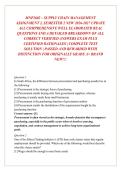
MNP2602 – SUPPLY CHAIN MANAGEMENT
ASSIGNMENT 2, SEMESTER 2 NEW 2026-2027 UPDATE
ALL COMPREHENSIVE WELL ELABORATED REAL
QUESTIONS AND A DETAILED BREAKDOWN OF ALL
CORRECT VERIFIED ANSWERS EXAM PLUS
CERTIFIED RATIONALES | COMPLETE TEST
SOLUTION | PASSED AND REWARDED WITH
DISTINCTION FOR ORIGINALLY GRADE A+ BRAND
NEW!!!
Question 1
In South Africa, the difference between procurement and purchasing usually lies in
the following:
[1] Procurement is the strategic focus of purchasing
[2] Procurement entails buying only from government suppliers, whereas
purchasing is mainly made from small businesses
[3] Procurement is the purchasing function of government entities
[4] Procurement entails the distribution of the requirements bought by the
purchasing function
Correct answer: [1]
Procurement is often viewed as the strategic, broader function that encompasses
purchasing, especially in the public sector where it involves sourcing,
negotiation, and contract management to achieve long-term organisational
goals.
Question 2
One of the Ethical Trading Initiative’s (ETI) base code clauses states that regular
employment should be provided. Which one of the following would best describe
what this clause entails?
[1] Wages should be enough to meet basic needs
,[2] Work performed must be on the basis of recognised employment relationships
established through national law and practice
[3] Overtime should be voluntary and should not exceed 12 hours per week
[4] There is no discrimination in hiring, compensation, access to training,
termination of employment or retirement based on the demographics of an
employee
Correct answer: [2]
The ETI base code clause on regular employment requires that work be
performed on the basis of recognised employment relationships established
through national law and practice, ensuring legal and social protection for
workers.
Question 3
Ethical sourcing policies should include:
[1] A report provided to the stakeholders which indicates the degree to which
suppliers adhere to performance standards
[2] The supplier’s rating of their level of vendor compliance
[3] Only ethical ratings for suppliers and no other performance criteria
[4] A draft of sourcing expectations that vendors should comply with as indicated
by all stakeholders
Correct answer: [1]
Ethical sourcing policies should include reporting to stakeholders on supplier
adherence to performance standards, ensuring transparency and accountability
in the supply chain.
Question 4
The most common formula for calculating an organisation’s inventory turnover
ratio (ITR) is:
[1] Labour, capital, energy and material costs over average inventory costs
[2] Average inventory costs over cost of storing goods
[3] Cost of goods sold over average inventory at cost
[4] Average total expenses over ratio of total income
Correct answer: [3]
The inventory turnover ratio is calculated as cost of goods sold divided by
average inventory at cost, measuring how efficiently inventory is managed.
,Question 5
______ can be defined as the part of supply chain management that plans,
implements and controls the efficient and effective forward and reverse flow and
storage of goods, services and related information between the point of origin and
the point of consumption to meet customers’ requirements.
[1] Transportation
[2] Logistics management
[3] Distribution management
[4] Distribution channels
Correct answer: [2]
Logistics management encompasses the planning, implementation, and control
of the forward and reverse flow and storage of goods, services, and related
information to meet customer requirements.
Question 6
When developing a collaborative negotiation infrastructure, designing a
negotiation launch process would refer to:
[1] Building working relationships with suppliers
[2] Brain-storming value maximising solutions and terms for both parties
[3] The process of reviewing previous negotiations
[4] The identification of objective criteria wherein both sides evaluate the fairness
of the agreement
Correct answer: [4]
Designing a negotiation launch process involves identifying objective criteria
that both parties can use to evaluate the fairness of the agreement, setting the
stage for collaborative negotiation.
Question 7
Supply management can best be defined as a:
[1] Process of planning, implementing, evaluating and controlling strategic and
operating decisions to direct all the activities of the purchasing function towards
opportunities that are consistent with the organisation’s capabilities in order to
achieve its long-term goals
[2] Process of identifying, conducting negotiations with and forming supply
agreements with vendors of goods and services
[3] Strategic process of identifying, acquiring, accessing, positioning and
, managing the resources that the organisation currently or potentially needs to
achieve its mission and strategic goals
[4] Strategic management process whereby commodities (materials and services)
and suppliers are analysed, and relationships are formed and managed according to
best practices and appropriate strategies in support of long-term organisational
goals
Correct answer: [4]
Supply management is a strategic process that involves analysing commodities
and suppliers, forming and managing relationships according to best practices
and strategies to support long-term organisational goals.
Question 8
Third-party logistics services (3PLs) are for-hire outside agents to which all or
much of an organisation’s logistics activities can be outsourced. Which one of the
following would be considered a logistics activity that a 3PL could provide?
[1] Labelling
[2] Manufacturing
[3] Technological development
[4] Purchasing
Correct answer: [1]
Labelling is a logistics activity that can be outsourced to a 3PL, as it involves the
preparation and handling of goods for distribution.
Question 9
Distribution management entails managing the outbound processes in a basic
supply chain:
[1] Downstream
[2] Upstream
[3] Focal firm's
[4] Purchasing
Correct answer: [1]
Distribution management focuses on the downstream, outbound processes of the
supply chain, delivering finished goods to customers.
Question 10
Logistic decisions are primarily concerned with a trade-off between which one of
ASSIGNMENT 2, SEMESTER 2 NEW 2026-2027 UPDATE
ALL COMPREHENSIVE WELL ELABORATED REAL
QUESTIONS AND A DETAILED BREAKDOWN OF ALL
CORRECT VERIFIED ANSWERS EXAM PLUS
CERTIFIED RATIONALES | COMPLETE TEST
SOLUTION | PASSED AND REWARDED WITH
DISTINCTION FOR ORIGINALLY GRADE A+ BRAND
NEW!!!
Question 1
In South Africa, the difference between procurement and purchasing usually lies in
the following:
[1] Procurement is the strategic focus of purchasing
[2] Procurement entails buying only from government suppliers, whereas
purchasing is mainly made from small businesses
[3] Procurement is the purchasing function of government entities
[4] Procurement entails the distribution of the requirements bought by the
purchasing function
Correct answer: [1]
Procurement is often viewed as the strategic, broader function that encompasses
purchasing, especially in the public sector where it involves sourcing,
negotiation, and contract management to achieve long-term organisational
goals.
Question 2
One of the Ethical Trading Initiative’s (ETI) base code clauses states that regular
employment should be provided. Which one of the following would best describe
what this clause entails?
[1] Wages should be enough to meet basic needs
,[2] Work performed must be on the basis of recognised employment relationships
established through national law and practice
[3] Overtime should be voluntary and should not exceed 12 hours per week
[4] There is no discrimination in hiring, compensation, access to training,
termination of employment or retirement based on the demographics of an
employee
Correct answer: [2]
The ETI base code clause on regular employment requires that work be
performed on the basis of recognised employment relationships established
through national law and practice, ensuring legal and social protection for
workers.
Question 3
Ethical sourcing policies should include:
[1] A report provided to the stakeholders which indicates the degree to which
suppliers adhere to performance standards
[2] The supplier’s rating of their level of vendor compliance
[3] Only ethical ratings for suppliers and no other performance criteria
[4] A draft of sourcing expectations that vendors should comply with as indicated
by all stakeholders
Correct answer: [1]
Ethical sourcing policies should include reporting to stakeholders on supplier
adherence to performance standards, ensuring transparency and accountability
in the supply chain.
Question 4
The most common formula for calculating an organisation’s inventory turnover
ratio (ITR) is:
[1] Labour, capital, energy and material costs over average inventory costs
[2] Average inventory costs over cost of storing goods
[3] Cost of goods sold over average inventory at cost
[4] Average total expenses over ratio of total income
Correct answer: [3]
The inventory turnover ratio is calculated as cost of goods sold divided by
average inventory at cost, measuring how efficiently inventory is managed.
,Question 5
______ can be defined as the part of supply chain management that plans,
implements and controls the efficient and effective forward and reverse flow and
storage of goods, services and related information between the point of origin and
the point of consumption to meet customers’ requirements.
[1] Transportation
[2] Logistics management
[3] Distribution management
[4] Distribution channels
Correct answer: [2]
Logistics management encompasses the planning, implementation, and control
of the forward and reverse flow and storage of goods, services, and related
information to meet customer requirements.
Question 6
When developing a collaborative negotiation infrastructure, designing a
negotiation launch process would refer to:
[1] Building working relationships with suppliers
[2] Brain-storming value maximising solutions and terms for both parties
[3] The process of reviewing previous negotiations
[4] The identification of objective criteria wherein both sides evaluate the fairness
of the agreement
Correct answer: [4]
Designing a negotiation launch process involves identifying objective criteria
that both parties can use to evaluate the fairness of the agreement, setting the
stage for collaborative negotiation.
Question 7
Supply management can best be defined as a:
[1] Process of planning, implementing, evaluating and controlling strategic and
operating decisions to direct all the activities of the purchasing function towards
opportunities that are consistent with the organisation’s capabilities in order to
achieve its long-term goals
[2] Process of identifying, conducting negotiations with and forming supply
agreements with vendors of goods and services
[3] Strategic process of identifying, acquiring, accessing, positioning and
, managing the resources that the organisation currently or potentially needs to
achieve its mission and strategic goals
[4] Strategic management process whereby commodities (materials and services)
and suppliers are analysed, and relationships are formed and managed according to
best practices and appropriate strategies in support of long-term organisational
goals
Correct answer: [4]
Supply management is a strategic process that involves analysing commodities
and suppliers, forming and managing relationships according to best practices
and strategies to support long-term organisational goals.
Question 8
Third-party logistics services (3PLs) are for-hire outside agents to which all or
much of an organisation’s logistics activities can be outsourced. Which one of the
following would be considered a logistics activity that a 3PL could provide?
[1] Labelling
[2] Manufacturing
[3] Technological development
[4] Purchasing
Correct answer: [1]
Labelling is a logistics activity that can be outsourced to a 3PL, as it involves the
preparation and handling of goods for distribution.
Question 9
Distribution management entails managing the outbound processes in a basic
supply chain:
[1] Downstream
[2] Upstream
[3] Focal firm's
[4] Purchasing
Correct answer: [1]
Distribution management focuses on the downstream, outbound processes of the
supply chain, delivering finished goods to customers.
Question 10
Logistic decisions are primarily concerned with a trade-off between which one of


