
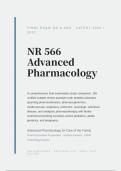
F I N A L E X A M Q S & A N S · L AT E S T 2 0 2 6 /
2027
NR 566
Advanced
Pharmacology
A comprehensive final examination study companion: 165
verified multiple-choice questions with detailed rationales
spanning pharmacokinetics, pharmacogenomics,
cardiovascular, respiratory, endocrine, neurologic, infectious
disease, and analgesic pharmacotherapy, with family-
centered prescribing scenarios across pediatrics, adults,
geriatrics, and pregnancy.
Advanced Pharmacology for Care of the Family
Final Examination Preparation · Verified Answers · APRN
Prescribing Practice
165 QUESTIONS · SECTIONS 1-10 ·
EDITION
,NR 566 Advanced Pharmacology for Care of the Family | Final Exam Qs & Ans 2026-2027
NR 566 / NR566 Final Exam Qs & Ans (Latest
)
Advanced Pharmacology for Care of the Family (Verified Answers)
165 Questions with Verified Answers and Detailed Rationales | Sections 1-10 | Family-Centered Prescribing Across the
Lifespan | Aligned with 2026-2027 Course Standards and Current Clinical Practice Guidelines
SECTION 1 (QUESTIONS 1-17)
Pharmacokinetics and Pharmacodynamics Across the Lifespan
Absorption, Distribution, Metabolism, Excretion, & Age-Related Considerations
Q1: A 3-day-old term neonate requires intramuscular antibiotic therapy for suspected early-onset sepsis.
When selecting the route and anticipating drug absorption, the APRN understands that in neonates,
intramuscular drug absorption is:
A. Faster and more complete than oral absorption because of rich neonatal muscle perfusion
B. Erratic and unpredictable because of low skeletal muscle blood flow and reduced muscle
mass [CORRECT]
C. Identical to adult IM absorption because muscle blood flow is fully mature at birth
D. Unaffected by hemodynamic status because diffusion through neonatal muscle is passive
Correct Answer: B
Rationale: Neonatal skeletal muscle has reduced blood flow, limited muscle mass, and unpredictable
perfusion, making IM absorption erratic and dependent on hemodynamic status. Option A is wrong because
neonatal muscle perfusion is not rich; option C is wrong because absorption sites mature over the first
months of life; option D is wrong because absorption is directly perfusion-dependent. For this reason, IV
therapy is preferred in neonates when possible.
Q2: A 5-day-old infant is prescribed a highly water-soluble antibiotic. Compared with adults, the APRN
anticipates which pharmacokinetic difference that most directly affects dosing?
A. A larger volume of distribution, requiring higher milligram-per-kilogram doses [CORRECT]
B. A smaller volume of distribution, requiring lower milligram-per-kilogram doses
C. Enhanced protein binding that reduces the volume of distribution
D. Faster hepatic clearance that mandates shorter dosing intervals
Correct Answer: A
Rationale: Neonates and infants have total body water of 75% to 85%, so water-soluble (hydrophilic) drugs
distribute into a larger volume of distribution, lowering peak concentrations and requiring higher mg/kg
doses than adults. Protein binding is reduced, not enhanced, in neonates (ruling out C), and hepatic clearance
is slower, not faster (ruling out D). This principle is why many pediatric doses are expressed in mg/kg.
Verified Answers | Edition 1
,NR 566 Advanced Pharmacology for Care of the Family | Final Exam Qs & Ans 2026-2027
Q3: A 6-day-old jaundiced neonate with an elevated unconjugated bilirubin level requires treatment for a
confirmed infection. Which medication should the APRN avoid because it can displace bilirubin from
albumin binding sites and precipitate kernicterus?
A. Ampicillin
B. Gentamicin
C. Sulfamethoxazole-trimethoprim [CORRECT]
D. Acyclovir
Correct Answer: C
Rationale: Highly protein-bound sulfonamides compete with bilirubin for albumin binding sites in the
neonate, freeing unconjugated bilirubin to cross the immature blood-brain barrier and cause bilirubin
encephalopathy (kernicterus). Ampicillin and gentamicin are standard neonatal sepsis agents with minimal
bilirubin displacement, and acyclovir is used for suspected HSV. Reduced neonatal albumin and immature
binding capacity make this interaction especially dangerous.
Q4: A 4-month-old infant is scheduled for a procedure and will receive an opioid analgesic. The APRN
recognizes that infants are at increased risk of respiratory depression from opioids primarily because:
A. Infant opioid receptors are structurally different from adult receptors
B. The blood-brain barrier is immature, permitting greater central drug penetration
[CORRECT]
C. Infants metabolize opioids faster than adults, producing toxic metabolites
D. Infant plasma protein binding is higher, increasing free drug fraction
Correct Answer: B
Rationale: The neonatal and infant blood-brain barrier is incompletely developed, allowing lipid-soluble
CNS-active drugs such as opioids and sedatives to reach the brain at higher concentrations than in adults,
producing exaggerated sedation and respiratory depression. Receptors are not structurally different (A);
most infants metabolize opioids more slowly, not faster (C); and protein binding is lower rather than higher
in infancy (D). This is a key reason opioid and sedative doses in infants are conservative and titrated.
Q5: A 2-week-old neonate is begun on a medication that is eliminated primarily by hepatic glucuronidation.
Compared with an adult receiving the same weight-adjusted dose, the APRN expects:
A. A shorter half-life because of brisk neonatal hepatic blood flow
B. An identical half-life because glucuronidation is mature at birth
C. A shorter half-life because of compensatory renal elimination
D. A prolonged half-life because UGT enzyme activity is markedly immature [CORRECT]
Correct Answer: D
Rationale: Glucuronidation (UGT phase II metabolism) is severely underdeveloped in the first weeks of
life; the classic consequence is chloramphenicol accumulation and gray baby syndrome. Neonatal half-lives
of glucuronidated drugs are therefore markedly prolonged, requiring longer intervals or avoidance. Hepatic
blood flow is reduced early in life (A), glucuronidation matures over months (B), and renal elimination
cannot compensate for immature phase II metabolism (C).
Verified Answers | Edition 2
, NR 566 Advanced Pharmacology for Care of the Family | Final Exam Qs & Ans 2026-2027
Q6: A 6-month-old infant with normal renal development for age requires a renally eliminated antibiotic.
Which statement best describes neonatal and infant renal function relevant to dosing?
A. Glomerular filtration is only about 30% to 40% of adult values at birth and matures toward
adult rates over the first year [CORRECT]
B. Glomerular filtration equals adult values at birth and drug doses require no adjustment
C. Tubular secretion is fully mature at birth, so actively secreted drugs need no adjustment
D. Renal function in infants cannot be estimated, so all drugs must be avoided
Correct Answer: A
Rationale: GFR at term is roughly 30% to 40% of the adult value, doubling in the first 2 weeks and
reaching adult-capacity rates around 8 to 12 months; tubular secretion and reabsorption mature more slowly
than filtration. Renally eliminated drugs therefore need reduced doses or extended intervals in early infancy.
Option B and C contradict established developmental renal physiology, and option D is false because many
renally cleared drugs are safely used with proper adjustment.
Q7: An adult patient begins an oral medication with a half-life of 6 hours taken every 6 hours. The APRN
teaches that steady-state serum concentrations, where accumulation is complete and peaks and troughs are
stable, will be reached in approximately:
A. 6 hours
B. 12 hours
C. 24 to 30 hours [CORRECT]
D. 72 to 96 hours
Correct Answer: C
Rationale: Steady state is reached after about 4 to 5 half-lives regardless of the dosing interval; with a
6-hour half-life this equals 24 to 30 hours. Six and 12 hours represent only 1 to 2 half-lives (A, B), when
roughly 50% to 75% of the eventual level is present. If dosing were withdrawn, 5 half-lives is also the time
for about 97% of drug to be eliminated, a paired concept frequently tested.
Q8: A 70-year-old male patient (weight 70 kg, serum creatinine 1.0 mg/dL) is about to start a renally cleared
medication. Using the Cockcroft-Gault equation, the APRN calculates his creatinine clearance as
approximately:
A. 35 mL/min
B. 50 mL/min
C. 68 mL/min [CORRECT]
D. 100 mL/min
Correct Answer: C
Rationale: Cockcroft-Gault for males is [(140 - age) x weight (kg)] / (72 x SCr) = (140 - 70) x 70 / (72 x
1.0) = = approximately 68 mL/min. This value, though 'normal appearing' for total CrCl, still
reflects age-related decline and may warrant dose adjustment for narrow-margin renally cleared drugs. The
female calculation multiplies by 0.85; failing to apply the age term (D) or misapplying the equation produces
the incorrect distractors (A, B).
Verified Answers | Edition 3
2027
NR 566
Advanced
Pharmacology
A comprehensive final examination study companion: 165
verified multiple-choice questions with detailed rationales
spanning pharmacokinetics, pharmacogenomics,
cardiovascular, respiratory, endocrine, neurologic, infectious
disease, and analgesic pharmacotherapy, with family-
centered prescribing scenarios across pediatrics, adults,
geriatrics, and pregnancy.
Advanced Pharmacology for Care of the Family
Final Examination Preparation · Verified Answers · APRN
Prescribing Practice
165 QUESTIONS · SECTIONS 1-10 ·
EDITION
,NR 566 Advanced Pharmacology for Care of the Family | Final Exam Qs & Ans 2026-2027
NR 566 / NR566 Final Exam Qs & Ans (Latest
)
Advanced Pharmacology for Care of the Family (Verified Answers)
165 Questions with Verified Answers and Detailed Rationales | Sections 1-10 | Family-Centered Prescribing Across the
Lifespan | Aligned with 2026-2027 Course Standards and Current Clinical Practice Guidelines
SECTION 1 (QUESTIONS 1-17)
Pharmacokinetics and Pharmacodynamics Across the Lifespan
Absorption, Distribution, Metabolism, Excretion, & Age-Related Considerations
Q1: A 3-day-old term neonate requires intramuscular antibiotic therapy for suspected early-onset sepsis.
When selecting the route and anticipating drug absorption, the APRN understands that in neonates,
intramuscular drug absorption is:
A. Faster and more complete than oral absorption because of rich neonatal muscle perfusion
B. Erratic and unpredictable because of low skeletal muscle blood flow and reduced muscle
mass [CORRECT]
C. Identical to adult IM absorption because muscle blood flow is fully mature at birth
D. Unaffected by hemodynamic status because diffusion through neonatal muscle is passive
Correct Answer: B
Rationale: Neonatal skeletal muscle has reduced blood flow, limited muscle mass, and unpredictable
perfusion, making IM absorption erratic and dependent on hemodynamic status. Option A is wrong because
neonatal muscle perfusion is not rich; option C is wrong because absorption sites mature over the first
months of life; option D is wrong because absorption is directly perfusion-dependent. For this reason, IV
therapy is preferred in neonates when possible.
Q2: A 5-day-old infant is prescribed a highly water-soluble antibiotic. Compared with adults, the APRN
anticipates which pharmacokinetic difference that most directly affects dosing?
A. A larger volume of distribution, requiring higher milligram-per-kilogram doses [CORRECT]
B. A smaller volume of distribution, requiring lower milligram-per-kilogram doses
C. Enhanced protein binding that reduces the volume of distribution
D. Faster hepatic clearance that mandates shorter dosing intervals
Correct Answer: A
Rationale: Neonates and infants have total body water of 75% to 85%, so water-soluble (hydrophilic) drugs
distribute into a larger volume of distribution, lowering peak concentrations and requiring higher mg/kg
doses than adults. Protein binding is reduced, not enhanced, in neonates (ruling out C), and hepatic clearance
is slower, not faster (ruling out D). This principle is why many pediatric doses are expressed in mg/kg.
Verified Answers | Edition 1
,NR 566 Advanced Pharmacology for Care of the Family | Final Exam Qs & Ans 2026-2027
Q3: A 6-day-old jaundiced neonate with an elevated unconjugated bilirubin level requires treatment for a
confirmed infection. Which medication should the APRN avoid because it can displace bilirubin from
albumin binding sites and precipitate kernicterus?
A. Ampicillin
B. Gentamicin
C. Sulfamethoxazole-trimethoprim [CORRECT]
D. Acyclovir
Correct Answer: C
Rationale: Highly protein-bound sulfonamides compete with bilirubin for albumin binding sites in the
neonate, freeing unconjugated bilirubin to cross the immature blood-brain barrier and cause bilirubin
encephalopathy (kernicterus). Ampicillin and gentamicin are standard neonatal sepsis agents with minimal
bilirubin displacement, and acyclovir is used for suspected HSV. Reduced neonatal albumin and immature
binding capacity make this interaction especially dangerous.
Q4: A 4-month-old infant is scheduled for a procedure and will receive an opioid analgesic. The APRN
recognizes that infants are at increased risk of respiratory depression from opioids primarily because:
A. Infant opioid receptors are structurally different from adult receptors
B. The blood-brain barrier is immature, permitting greater central drug penetration
[CORRECT]
C. Infants metabolize opioids faster than adults, producing toxic metabolites
D. Infant plasma protein binding is higher, increasing free drug fraction
Correct Answer: B
Rationale: The neonatal and infant blood-brain barrier is incompletely developed, allowing lipid-soluble
CNS-active drugs such as opioids and sedatives to reach the brain at higher concentrations than in adults,
producing exaggerated sedation and respiratory depression. Receptors are not structurally different (A);
most infants metabolize opioids more slowly, not faster (C); and protein binding is lower rather than higher
in infancy (D). This is a key reason opioid and sedative doses in infants are conservative and titrated.
Q5: A 2-week-old neonate is begun on a medication that is eliminated primarily by hepatic glucuronidation.
Compared with an adult receiving the same weight-adjusted dose, the APRN expects:
A. A shorter half-life because of brisk neonatal hepatic blood flow
B. An identical half-life because glucuronidation is mature at birth
C. A shorter half-life because of compensatory renal elimination
D. A prolonged half-life because UGT enzyme activity is markedly immature [CORRECT]
Correct Answer: D
Rationale: Glucuronidation (UGT phase II metabolism) is severely underdeveloped in the first weeks of
life; the classic consequence is chloramphenicol accumulation and gray baby syndrome. Neonatal half-lives
of glucuronidated drugs are therefore markedly prolonged, requiring longer intervals or avoidance. Hepatic
blood flow is reduced early in life (A), glucuronidation matures over months (B), and renal elimination
cannot compensate for immature phase II metabolism (C).
Verified Answers | Edition 2
, NR 566 Advanced Pharmacology for Care of the Family | Final Exam Qs & Ans 2026-2027
Q6: A 6-month-old infant with normal renal development for age requires a renally eliminated antibiotic.
Which statement best describes neonatal and infant renal function relevant to dosing?
A. Glomerular filtration is only about 30% to 40% of adult values at birth and matures toward
adult rates over the first year [CORRECT]
B. Glomerular filtration equals adult values at birth and drug doses require no adjustment
C. Tubular secretion is fully mature at birth, so actively secreted drugs need no adjustment
D. Renal function in infants cannot be estimated, so all drugs must be avoided
Correct Answer: A
Rationale: GFR at term is roughly 30% to 40% of the adult value, doubling in the first 2 weeks and
reaching adult-capacity rates around 8 to 12 months; tubular secretion and reabsorption mature more slowly
than filtration. Renally eliminated drugs therefore need reduced doses or extended intervals in early infancy.
Option B and C contradict established developmental renal physiology, and option D is false because many
renally cleared drugs are safely used with proper adjustment.
Q7: An adult patient begins an oral medication with a half-life of 6 hours taken every 6 hours. The APRN
teaches that steady-state serum concentrations, where accumulation is complete and peaks and troughs are
stable, will be reached in approximately:
A. 6 hours
B. 12 hours
C. 24 to 30 hours [CORRECT]
D. 72 to 96 hours
Correct Answer: C
Rationale: Steady state is reached after about 4 to 5 half-lives regardless of the dosing interval; with a
6-hour half-life this equals 24 to 30 hours. Six and 12 hours represent only 1 to 2 half-lives (A, B), when
roughly 50% to 75% of the eventual level is present. If dosing were withdrawn, 5 half-lives is also the time
for about 97% of drug to be eliminated, a paired concept frequently tested.
Q8: A 70-year-old male patient (weight 70 kg, serum creatinine 1.0 mg/dL) is about to start a renally cleared
medication. Using the Cockcroft-Gault equation, the APRN calculates his creatinine clearance as
approximately:
A. 35 mL/min
B. 50 mL/min
C. 68 mL/min [CORRECT]
D. 100 mL/min
Correct Answer: C
Rationale: Cockcroft-Gault for males is [(140 - age) x weight (kg)] / (72 x SCr) = (140 - 70) x 70 / (72 x
1.0) = = approximately 68 mL/min. This value, though 'normal appearing' for total CrCl, still
reflects age-related decline and may warrant dose adjustment for narrow-margin renally cleared drugs. The
female calculation multiplies by 0.85; failing to apply the age term (D) or misapplying the equation produces
the incorrect distractors (A, B).
Verified Answers | Edition 3


