
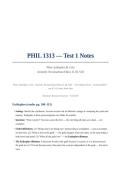
PHIL 1313 — Test 1 Notes
Plato: Euthyphro & Crito
Aristotle: Nicomachean Ethics II, III, VIII
Plato: Euthyphro, Crito · Aristotle: Nicomachean Ethics II, III, VIII · ~35 multiple-choice · Scantron 882-E ·
one 8.5×11 sheet, both sides
Houston Christian University · Fall 2026
Euthyphro (reader pp. 100–113)
• Setting: Outside the courthouse. Socrates awaits trial on Meletus's charge of corrupting the youth and
impiety; Euthyphro is there prosecuting his own father for murder.
• Question: "What is piety?" Socrates wants the form — the one thing all pious acts share — not
examples.
• Failed definitions: (1) "Doing what I am doing now" (prosecuting a wrongdoer) — just an example,
not the form. (2) "What is dear to the gods" — the gods disagree with each other, so the same thing is
both loved and hated. (3) "What all the gods love" — the Euthyphro dilemma.
• The Euthyphro dilemma: Is the pious loved by the gods because it is pious, or is it pious because
the gods love it? If loved because pious, then piety has a nature independent of the gods — Socrates's
view.
Plato: Euthyphro & Crito
Aristotle: Nicomachean Ethics II, III, VIII
Plato: Euthyphro, Crito · Aristotle: Nicomachean Ethics II, III, VIII · ~35 multiple-choice · Scantron 882-E ·
one 8.5×11 sheet, both sides
Houston Christian University · Fall 2026
Euthyphro (reader pp. 100–113)
• Setting: Outside the courthouse. Socrates awaits trial on Meletus's charge of corrupting the youth and
impiety; Euthyphro is there prosecuting his own father for murder.
• Question: "What is piety?" Socrates wants the form — the one thing all pious acts share — not
examples.
• Failed definitions: (1) "Doing what I am doing now" (prosecuting a wrongdoer) — just an example,
not the form. (2) "What is dear to the gods" — the gods disagree with each other, so the same thing is
both loved and hated. (3) "What all the gods love" — the Euthyphro dilemma.
• The Euthyphro dilemma: Is the pious loved by the gods because it is pious, or is it pious because
the gods love it? If loved because pious, then piety has a nature independent of the gods — Socrates's
view.


