
P O RTA G E L E A R N I N G BIOD 102 ·
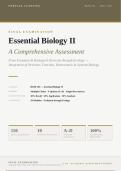
FINAL EXAMINATION
Essential Biology II
A Comprehensive Assessment
From Evolution & Biological Diversity through Ecology —
Integration of Structure, Function, Homeostasis & Systems Biology
COURSE BIOD 102 — Essential Biology II
F O R M AT Multiple Choice · 4 Options (A–D) · Single Best Answer
COGNITIVE MIX 30% Recall · 50% Application · 20% Analysis
COVERAGE 10 Modules · Evolution through Ecology
150 10 A–D 100%
T O TA L Q U E S T I O N S CONTENT SECTIONS OPTIONS / R AT I O N A L E S
QUESTION PROVIDED
F I N A L E X A M I N AT I O N Z.AI · ACADEMIC ASSESSMENT SERIES
Aligned with 2026–2027 BIOD 102 Learning Objectives
,BIOD 102 • ESSENTIAL BIOLOGY II Final Examination •
BIOD 102 — Essential Biology II
Final Examination
Comprehensive Assessment of BIOD 102 Learning Objectives — Edition
Examination Overview. This final examination comprises 150 multiple-choice questions organized into ten sections that
mirror the BIOD 102 Essential Biology II module sequence from Evolution and Biological Diversity through Ecology. Each
question presents four options (A–D) with a single best answer. Cognitive level distribution is approximately 30% recall,
50% application, and 20% analysis, matching Portage Learning assessment standards. Approximately 70% of items are
scenario-based and require integration of anatomical, physiological, and ecological principles; 30% directly assess
foundational concepts and definitions. Each item includes a rationale explaining why the correct option is right and why the
distractors are wrong, with explicit reference to biological mechanisms, evolutionary context, and homeostatic principles.
Examination Structure
Question
# Section Items Focus
Range
Darwinian Theory, Evidence, Population Genetics,
1 Evolution and Natural Selection Q1 - Q20 20
Speciation & Phylogeny
Biological Diversity and Viruses, Prokaryotes, Protists, Fungi & Kingdom
2 Q21 - Q35 15
Classification Survey
Plant Structure, Transport, Nutrition, Reproduction,
3 Plant Biology Q36 - Q55 20
Growth & Hormones
Animal Form, Function, and
4 Q56 - Q70 15 Tissues, Organ Systems & Homeostatic Mechanisms
Homeostasis
Animal Nutrition, Digestion, and
5 Q71 - Q82 12 Digestive Systems, Nutrients & Metabolic Pathways
Metabolism
Circulation, Respiration, and Gas Cardiovascular Systems, Respiratory Systems &
6 Q83 - Q98 16
Exchange Transport Mechanisms
Excretion, Osmoregulation, and Kidney Function, Fluid Balance & Immune
7 Q99 - Q112 14
Immune Defense Responses
Nervous, Sensory, and Endocrine Neurons, Signal Transmission, Sensory Organs &
8 Q113 - Q128 16
Systems Hormones
Animal Reproduction and Reproductive Systems, Gametogenesis, Fertilization
9 Q129 - Q140 12
Development & Embryonic Development
Population Dynamics, Community Ecology,
10 Ecology and Population Biology Q141 - Q150 10
Ecosystems & Conservation
Portage Learning • BIOD 102 Essential Biology II 150 Questions • 10 Sections Page 1
,BIOD 102 • ESSENTIAL BIOLOGY II Final Examination •
Question
# Section Items Focus
Range
TOTAL Q1 - Q150 150 All BIOD 102 modules
Instructions to Candidates
• Format: Each question has four answer options (A–D). Select the single best answer.
• Rationale: Each question includes a rationale explaining the correct answer and why distractors are incorrect.
• Cognitive mix: 30% recall, 50% application, 20% analysis items.
• Integration: Scenario-based questions require integration of multiple organ systems, homeostatic mechanisms, and
ecological principles.
• Comparative emphasis: Several items contrast commonly confused pairs (e.g., arteries vs. veins, innate vs. adaptive
immunity, osmoconformers vs. osmoregulators).
Portage Learning • BIOD 102 Essential Biology II 150 Questions • 10 Sections Page 2
, BIOD 102 • ESSENTIAL BIOLOGY II Final Examination •
SECTION 1: Evolution and Natural Selection
Questions Q1 - Q20 • Darwinian Theory, Evidence, Population Genetics, Speciation & Phylogeny
1. A population of medium ground finches on the Galapagos island of Daphne Major experiences a severe drought in
1977. During the drought, plants producing small seeds died, leaving only large, hard seeds. Researchers observed that
average beak depth in the surviving finch population increased significantly within a single generation. Which
statement best explains this observation in the context of Darwinian natural selection?
A. The finches consciously developed deeper beaks in response to the changing environment, and this acquired trait
was passed to offspring.
B. Finches with naturally deeper beaks had higher survival and reproduction rates because they could crack
the large seeds, increasing the frequency of deep-beak alleles in the next generation. [CORRECT]
C. The drought directly mutated finch DNA to produce deeper beaks, ensuring survival of the species.
D. Beak depth increased due to use and disuse, with deeper beaks forming as finches exercised their jaw muscles.
Correct Answer: B
Rationale: Natural selection acts on heritable variation already present in a population. Finches with deeper beaks had a
selective advantage during the drought because they could exploit the only available food source, leading to differential
survival and reproduction that increased deep-beak allele frequency. Options A and D reflect Lamarckian inheritance of
acquired characteristics, which is biologically invalid. Option C incorrectly suggests that environmental pressure directly
induces beneficial mutations.
2. Paleontologists excavating a sedimentary rock sequence find a layer containing fossilized whale pelvic bones with
well-defined hind limb elements, dated to approximately 50 million years ago. Modern whales retain only tiny,
internal vestigial pelvic bones. This fossil sequence best illustrates which line of evidence for evolution?
A. Molecular homology, because DNA sequences can be directly extracted from the fossil bones.
B. Biogeographic evidence, because the fossils are found in sedimentary rock.
C. Anatomical homology and transitional fossil evidence documenting gradual reduction of hind limbs over
evolutionary time. [CORRECT]
D. Convergent evolution, because whales and land mammals independently evolved similar pelvic structures.
Correct Answer: C
Rationale: The fossil sequence documents a transitional form showing progressive reduction of hind limbs, exemplifying
anatomical homology and evolutionary descent with modification. Whales retained pelvic bones as vestigial structures from
their tetrapod ancestors. Option A is incorrect because DNA degrades over 50 million years and cannot be extracted reliably
from such ancient fossils. Option B misidentifies biogeography, which concerns species distribution. Option D is wrong
because whales inherited pelvic bones from ancestors, not from independent evolution.
3. In a population in Hardy-Weinberg equilibrium, the frequency of the recessive phenotype (aa) is 0.04 (4%). What is
the frequency of the dominant allele (A) in this population?
A. 0.20
B. 0.80 [CORRECT]
C. 0.96
D. 0.64
Correct Answer: B
Rationale: Under Hardy-Weinberg equilibrium, q^2 = frequency of recessive phenotype = 0.04, so q = sqrt(0.04) = 0.20.
Since p + q = 1, p = 1 - 0.20 = 0.80. Option A confuses q with p. Option C incorrectly uses 1 - q^2. Option D incorrectly
calculates p^2 (the frequency of AA homozygotes) instead of the allele frequency p.
Portage Learning • BIOD 102 Essential Biology II 150 Questions • 10 Sections Page 3
FINAL EXAMINATION
Essential Biology II
A Comprehensive Assessment
From Evolution & Biological Diversity through Ecology —
Integration of Structure, Function, Homeostasis & Systems Biology
COURSE BIOD 102 — Essential Biology II
F O R M AT Multiple Choice · 4 Options (A–D) · Single Best Answer
COGNITIVE MIX 30% Recall · 50% Application · 20% Analysis
COVERAGE 10 Modules · Evolution through Ecology
150 10 A–D 100%
T O TA L Q U E S T I O N S CONTENT SECTIONS OPTIONS / R AT I O N A L E S
QUESTION PROVIDED
F I N A L E X A M I N AT I O N Z.AI · ACADEMIC ASSESSMENT SERIES
Aligned with 2026–2027 BIOD 102 Learning Objectives
,BIOD 102 • ESSENTIAL BIOLOGY II Final Examination •
BIOD 102 — Essential Biology II
Final Examination
Comprehensive Assessment of BIOD 102 Learning Objectives — Edition
Examination Overview. This final examination comprises 150 multiple-choice questions organized into ten sections that
mirror the BIOD 102 Essential Biology II module sequence from Evolution and Biological Diversity through Ecology. Each
question presents four options (A–D) with a single best answer. Cognitive level distribution is approximately 30% recall,
50% application, and 20% analysis, matching Portage Learning assessment standards. Approximately 70% of items are
scenario-based and require integration of anatomical, physiological, and ecological principles; 30% directly assess
foundational concepts and definitions. Each item includes a rationale explaining why the correct option is right and why the
distractors are wrong, with explicit reference to biological mechanisms, evolutionary context, and homeostatic principles.
Examination Structure
Question
# Section Items Focus
Range
Darwinian Theory, Evidence, Population Genetics,
1 Evolution and Natural Selection Q1 - Q20 20
Speciation & Phylogeny
Biological Diversity and Viruses, Prokaryotes, Protists, Fungi & Kingdom
2 Q21 - Q35 15
Classification Survey
Plant Structure, Transport, Nutrition, Reproduction,
3 Plant Biology Q36 - Q55 20
Growth & Hormones
Animal Form, Function, and
4 Q56 - Q70 15 Tissues, Organ Systems & Homeostatic Mechanisms
Homeostasis
Animal Nutrition, Digestion, and
5 Q71 - Q82 12 Digestive Systems, Nutrients & Metabolic Pathways
Metabolism
Circulation, Respiration, and Gas Cardiovascular Systems, Respiratory Systems &
6 Q83 - Q98 16
Exchange Transport Mechanisms
Excretion, Osmoregulation, and Kidney Function, Fluid Balance & Immune
7 Q99 - Q112 14
Immune Defense Responses
Nervous, Sensory, and Endocrine Neurons, Signal Transmission, Sensory Organs &
8 Q113 - Q128 16
Systems Hormones
Animal Reproduction and Reproductive Systems, Gametogenesis, Fertilization
9 Q129 - Q140 12
Development & Embryonic Development
Population Dynamics, Community Ecology,
10 Ecology and Population Biology Q141 - Q150 10
Ecosystems & Conservation
Portage Learning • BIOD 102 Essential Biology II 150 Questions • 10 Sections Page 1
,BIOD 102 • ESSENTIAL BIOLOGY II Final Examination •
Question
# Section Items Focus
Range
TOTAL Q1 - Q150 150 All BIOD 102 modules
Instructions to Candidates
• Format: Each question has four answer options (A–D). Select the single best answer.
• Rationale: Each question includes a rationale explaining the correct answer and why distractors are incorrect.
• Cognitive mix: 30% recall, 50% application, 20% analysis items.
• Integration: Scenario-based questions require integration of multiple organ systems, homeostatic mechanisms, and
ecological principles.
• Comparative emphasis: Several items contrast commonly confused pairs (e.g., arteries vs. veins, innate vs. adaptive
immunity, osmoconformers vs. osmoregulators).
Portage Learning • BIOD 102 Essential Biology II 150 Questions • 10 Sections Page 2
, BIOD 102 • ESSENTIAL BIOLOGY II Final Examination •
SECTION 1: Evolution and Natural Selection
Questions Q1 - Q20 • Darwinian Theory, Evidence, Population Genetics, Speciation & Phylogeny
1. A population of medium ground finches on the Galapagos island of Daphne Major experiences a severe drought in
1977. During the drought, plants producing small seeds died, leaving only large, hard seeds. Researchers observed that
average beak depth in the surviving finch population increased significantly within a single generation. Which
statement best explains this observation in the context of Darwinian natural selection?
A. The finches consciously developed deeper beaks in response to the changing environment, and this acquired trait
was passed to offspring.
B. Finches with naturally deeper beaks had higher survival and reproduction rates because they could crack
the large seeds, increasing the frequency of deep-beak alleles in the next generation. [CORRECT]
C. The drought directly mutated finch DNA to produce deeper beaks, ensuring survival of the species.
D. Beak depth increased due to use and disuse, with deeper beaks forming as finches exercised their jaw muscles.
Correct Answer: B
Rationale: Natural selection acts on heritable variation already present in a population. Finches with deeper beaks had a
selective advantage during the drought because they could exploit the only available food source, leading to differential
survival and reproduction that increased deep-beak allele frequency. Options A and D reflect Lamarckian inheritance of
acquired characteristics, which is biologically invalid. Option C incorrectly suggests that environmental pressure directly
induces beneficial mutations.
2. Paleontologists excavating a sedimentary rock sequence find a layer containing fossilized whale pelvic bones with
well-defined hind limb elements, dated to approximately 50 million years ago. Modern whales retain only tiny,
internal vestigial pelvic bones. This fossil sequence best illustrates which line of evidence for evolution?
A. Molecular homology, because DNA sequences can be directly extracted from the fossil bones.
B. Biogeographic evidence, because the fossils are found in sedimentary rock.
C. Anatomical homology and transitional fossil evidence documenting gradual reduction of hind limbs over
evolutionary time. [CORRECT]
D. Convergent evolution, because whales and land mammals independently evolved similar pelvic structures.
Correct Answer: C
Rationale: The fossil sequence documents a transitional form showing progressive reduction of hind limbs, exemplifying
anatomical homology and evolutionary descent with modification. Whales retained pelvic bones as vestigial structures from
their tetrapod ancestors. Option A is incorrect because DNA degrades over 50 million years and cannot be extracted reliably
from such ancient fossils. Option B misidentifies biogeography, which concerns species distribution. Option D is wrong
because whales inherited pelvic bones from ancestors, not from independent evolution.
3. In a population in Hardy-Weinberg equilibrium, the frequency of the recessive phenotype (aa) is 0.04 (4%). What is
the frequency of the dominant allele (A) in this population?
A. 0.20
B. 0.80 [CORRECT]
C. 0.96
D. 0.64
Correct Answer: B
Rationale: Under Hardy-Weinberg equilibrium, q^2 = frequency of recessive phenotype = 0.04, so q = sqrt(0.04) = 0.20.
Since p + q = 1, p = 1 - 0.20 = 0.80. Option A confuses q with p. Option C incorrectly uses 1 - q^2. Option D incorrectly
calculates p^2 (the frequency of AA homozygotes) instead of the allele frequency p.
Portage Learning • BIOD 102 Essential Biology II 150 Questions • 10 Sections Page 3


