
NR568 / NR 568 FINAL EXAM (LATEST ):
ADVANCED PHARMACOLOGY FOR THE
ADULT-GERONTOLOGY PRIMARY CARE NURSE
PRACTITIONER
GUIDE WITH VERIFIED ANSWERS | CHAMBERLAIN UNIVERSITY
Aligned with the Chamberlain University NR 568 Course Syllabus, the AACN Essentials of Master's Education in
Nursing, and the Adult-Gerontology Primary Care Nurse Practitioner (AGPCNP) Pharmacology Competencies
(2026/2027 Edition)
Comprehensive Final Examination | 150 Multiple-Choice Questions (A-D) | Time Limit: 180 Minutes | Cognitive Mix:
20% Recall / 50% Application / 30% Analysis | Verified Answers with Detailed Rationales
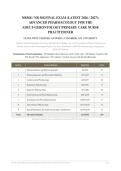
Section Content Domain Questions Items
1 Pharmacokinetics and Pharmacodynamics Q1-Q20 20
2 Pharmacogenomics and Personalized Medicine Q21-Q35 15
3 Cardiovascular Pharmacology Q36-Q55 20
4 Respiratory Pharmacology Q56-Q70 15
5 Endocrine Pharmacology Q71-Q90 20
6 Gastrointestinal and Renal Pharmacology Q91-Q105 15
7 Neurological and Psychopharmacology Q106-Q120 15
8 Anti-infective Pharmacology Q121-Q135 15
9 Special Populations and Adult-Gerontology Considerations Q136-Q150 15
Total All content domains Q1-Q150 150
Examination blueprint: question distribution across the nine NR 568 content domains.
NR 568 Advanced Pharmacology | Comprehensive Final Examination | Guide with Verified Answers Page 1
,NR568 / NR 568 FINAL EXAM (LATEST ): ADVANCED PHARMACOLOGY FOR THE AGPCNP | CHAMBERLAIN
Section 1: Pharmacokinetics & Pharmacodynamics
Questions Q1 to Q20 | 20 items
Q1: A 68-year-old man with chronic stable angina asks the nurse practitioner why his sublingual nitroglycerin
tablets work within minutes while an oral long-acting nitrate capsule takes much longer to act. Which
pharmacokinetic principle best explains the rapid onset of the sublingual formulation?
A. Sublingual administration bypasses hepatic first-pass metabolism and enters the systemic circulation
directly [CORRECT]
B. Sublingual administration increases the drug's protein binding and extends its half-life
C. Sublingual administration converts the drug to a prodrug with higher intrinsic efficacy
D. Sublingual administration reduces the drug's volume of distribution and lowers its clearance
Correct Answer: A
Rationale: Sublingual nitroglycerin is absorbed through the oral mucosa directly into the systemic venous circulation,
completely bypassing the hepatic portal system and first-pass metabolism, which produces high bioavailability and rapid
onset. NR 568 emphasizes that nitroglycerin is nearly completely degraded on first pass when swallowed, so the sublingual
route is required for acute relief. The other options misstate the mechanism because protein binding, prodrug conversion,
and volume of distribution are not favorably altered by sublingual delivery.
Q2: A patient begins taking levothyroxine 75 mcg daily for primary hypothyroidism. The medication has a half-life
of approximately 7 days. At the next visit the patient asks when the full effect of this dose will be reached. The nurse
practitioner explains that steady state is achieved after about how long?
A. 2 to 3 days
B. 4 to 5 weeks [CORRECT]
C. 12 to 16 weeks
D. Steady state is never achieved with levothyroxine
Correct Answer: B
Rationale: As a general pharmacokinetic rule taught in NR 568, steady state is reached after approximately 4 to 5
half-lives of consistent dosing regardless of the dosing interval. With a 7-day half-life, five half-lives equal about 35 days,
so 4 to 5 weeks is the appropriate interval to assess the full biochemical effect and recheck TSH. Two to three days is far
too short, and 12 to 16 weeks unnecessarily delays needed evaluation.
NR 568 Advanced Pharmacology | Comprehensive Final Examination | Guide with Verified Answers Page 2
,NR568 / NR 568 FINAL EXAM (LATEST ): ADVANCED PHARMACOLOGY FOR THE AGPCNP | CHAMBERLAIN
Q3: A 45-year-old woman is started on a loading dose of amiodarone before beginning the maintenance regimen.
Which pharmacokinetic concept best justifies administering a loading dose?
A. A loading dose compensates for the drug's poor oral bioavailability
B. A loading dose saturates renal clearance mechanisms to prolong the half-life
C. A loading dose rapidly achieves the target plasma concentration in drugs with a long half-life [CORRECT]
D. A loading dose reduces the risk of dose-dependent adverse effects during initiation
Correct Answer: C
Rationale: A loading dose is used when the time to steady state, which requires 4 to 5 half-lives, would otherwise delay
therapeutic benefit, as with amiodarone whose half-life is measured in weeks. Loading doses are calculated from the
volume of distribution and desired plasma concentration, allowing rapid achievement of therapeutic levels. The other
options are incorrect because loading doses do not alter bioavailability or clearance, and they actually increase the risk of
early dose-related toxicity rather than reducing it.
Q4: A frail 82-year-old woman with hypoalbuminemia (albumin 2.2 g/dL) has been taking phenytoin for years. Her
total serum phenytoin level is reported at 9 mcg/mL, which is below the usual therapeutic range of 10 to 20 mcg/mL,
yet she shows signs of nystagmus and ataxia. What is the most appropriate interpretation and action?
A. The total level confirms underdosing, so the dose should be increased immediately
B. The symptoms are unrelated to phenytoin, so the drug should be continued unchanged
C. The specimen should be redrawn because the level is clearly a laboratory error
D. The free phenytoin level should be measured because low albumin increases the unbound fraction and total
levels become misleading [CORRECT]
Correct Answer: D
Rationale: Phenytoin is approximately 90 percent protein bound, and in hypoalbuminemia the free, pharmacologically
active fraction rises, so total levels appear low while unbound drug concentrations are toxic. Measuring the free phenytoin
level is the standard of care in low-albumin states such as advanced age, malnutrition, and hepatic or renal disease.
Increasing the dose based on the total level would precipitate overt toxicity, and attributing cerebellar signs to another
cause or to lab error ignores a classic NR 568 protein-binding teaching point.
Q5: A 74-year-old man with atrial fibrillation takes digoxin 0.25 mg daily and reports nausea, anorexia, and seeing
yellow-green halos around lights. Which pharmacologic characteristic of digoxin most directly explains why these
findings developed?
A. Digoxin has a wide therapeutic index and symptoms reflect an allergic reaction
B. Digoxin has a narrow therapeutic index, and the patient has likely developed digoxin toxicity [CORRECT]
C. Digoxin is a partial agonist, and the symptoms represent a ceiling effect
D. Digoxin undergoes extensive first-pass metabolism, causing unpredictable absorption
Correct Answer: B
Rationale: Digoxin is the classic narrow-therapeutic-index drug in NR 568, with toxicity producing gastrointestinal
symptoms, visual disturbances, and dysrhythmias even at doses only modestly above therapeutic. Elderly patients with
declining renal function are at highest risk because digoxin is renally cleared. The symptom cluster described is
pathognomonic for toxicity rather than allergy, partial agonism, or absorption variability, and the dose should be held with
a level and renal function assessed.
NR 568 Advanced Pharmacology | Comprehensive Final Examination | Guide with Verified Answers Page 3
, NR568 / NR 568 FINAL EXAM (LATEST ): ADVANCED PHARMACOLOGY FOR THE AGPCNP | CHAMBERLAIN
Q6: A 59-year-old woman with acute bacterial sinusitis is prescribed clarithromycin while continuing simvastatin 40
mg nightly. Three days later she reports severe muscle pain and dark urine. Which mechanism best explains this
presentation?
A. Clarithromycin inhibits CYP3A4, raising simvastatin concentrations and causing myopathy or
rhabdomyolysis [CORRECT]
B. Clarithromycin induces CYP3A4 and accelerates simvastatin clearance
C. Clarithromycin displaces simvastatin from albumin, increasing its free fraction
D. Clarithromycin antagonizes the LDL-receptor effects of simvastatin
Correct Answer: A
Rationale: Clarithromycin is a potent CYP3A4 inhibitor, and simvastatin is extensively metabolized by CYP3A4, so
coadministration markedly elevates statin exposure and can produce myopathy and rhabdomyolysis with myalgias and
dark, myoglobin-rich urine. NR 568 highlights this as a high-risk inhibitory interaction best avoided by holding the statin
or choosing a non-CYP3A4 macrolide such as azithromycin. Induction would lower statin levels, and displacement or
receptor antagonism does not explain statin-induced muscle injury.
Q7: A patient with active tuberculosis is started on rifampin while taking warfarin for atrial fibrillation. What
change in the INR should the nurse practitioner anticipate?
A. A sharp rise in INR due to CYP inhibition
B. No change in INR because rifampin does not affect warfarin
C. A fall in INR due to hepatic enzyme induction that accelerates warfarin metabolism [CORRECT]
D. A biphasic INR that first rises then falls without any dose adjustment being needed
Correct Answer: C
Rationale: Rifampin is one of the most powerful hepatic enzyme inducers taught in NR 568, upregulating CYP2C9 and
CYP3A4 and markedly increasing warfarin metabolism, which lowers the INR and risks thrombosis. Warfarin doses often
must be doubled or more while rifampin continues, with close INR monitoring. Inhibition would raise the INR, and the
interaction is unidirectional and predictable enough to require proactive dose adjustment.
Q8: A 66-year-old man who drinks grapefruit juice every morning takes felodipine for hypertension and lovastatin
for dyslipidemia. Which counseling point about grapefruit juice is most accurate?
A. Grapefruit juice induces CYP3A4 in the gut wall and lowers the levels of both drugs
B. Grapefruit juice binds both drugs in the intestinal lumen and reduces their absorption
C. Grapefruit juice has no clinically significant interaction with either medication
D. Grapefruit juice irreversibly inhibits intestinal CYP3A4 and can raise the levels of both drugs, increasing
the risk of hypotension and myopathy [CORRECT]
Correct Answer: D
Rationale: Grapefruit juice components irreversibly inhibit CYP3A4 within the intestinal wall, reducing presystemic
metabolism of felodipine and lovastatin and increasing their bioavailability and peak concentrations. The effect persists
for 24 to 72 hours after ingestion, so simply separating the juice from the doses does not eliminate the interaction. NR 568
lists grapefruit juice among the highest-yield counseling topics because patients perceive it as a health food while it can
precipitate hypotension and statin myopathy.
NR 568 Advanced Pharmacology | Comprehensive Final Examination | Guide with Verified Answers Page 4
ADVANCED PHARMACOLOGY FOR THE
ADULT-GERONTOLOGY PRIMARY CARE NURSE
PRACTITIONER
GUIDE WITH VERIFIED ANSWERS | CHAMBERLAIN UNIVERSITY
Aligned with the Chamberlain University NR 568 Course Syllabus, the AACN Essentials of Master's Education in
Nursing, and the Adult-Gerontology Primary Care Nurse Practitioner (AGPCNP) Pharmacology Competencies
(2026/2027 Edition)
Comprehensive Final Examination | 150 Multiple-Choice Questions (A-D) | Time Limit: 180 Minutes | Cognitive Mix:
20% Recall / 50% Application / 30% Analysis | Verified Answers with Detailed Rationales
Section Content Domain Questions Items
1 Pharmacokinetics and Pharmacodynamics Q1-Q20 20
2 Pharmacogenomics and Personalized Medicine Q21-Q35 15
3 Cardiovascular Pharmacology Q36-Q55 20
4 Respiratory Pharmacology Q56-Q70 15
5 Endocrine Pharmacology Q71-Q90 20
6 Gastrointestinal and Renal Pharmacology Q91-Q105 15
7 Neurological and Psychopharmacology Q106-Q120 15
8 Anti-infective Pharmacology Q121-Q135 15
9 Special Populations and Adult-Gerontology Considerations Q136-Q150 15
Total All content domains Q1-Q150 150
Examination blueprint: question distribution across the nine NR 568 content domains.
NR 568 Advanced Pharmacology | Comprehensive Final Examination | Guide with Verified Answers Page 1
,NR568 / NR 568 FINAL EXAM (LATEST ): ADVANCED PHARMACOLOGY FOR THE AGPCNP | CHAMBERLAIN
Section 1: Pharmacokinetics & Pharmacodynamics
Questions Q1 to Q20 | 20 items
Q1: A 68-year-old man with chronic stable angina asks the nurse practitioner why his sublingual nitroglycerin
tablets work within minutes while an oral long-acting nitrate capsule takes much longer to act. Which
pharmacokinetic principle best explains the rapid onset of the sublingual formulation?
A. Sublingual administration bypasses hepatic first-pass metabolism and enters the systemic circulation
directly [CORRECT]
B. Sublingual administration increases the drug's protein binding and extends its half-life
C. Sublingual administration converts the drug to a prodrug with higher intrinsic efficacy
D. Sublingual administration reduces the drug's volume of distribution and lowers its clearance
Correct Answer: A
Rationale: Sublingual nitroglycerin is absorbed through the oral mucosa directly into the systemic venous circulation,
completely bypassing the hepatic portal system and first-pass metabolism, which produces high bioavailability and rapid
onset. NR 568 emphasizes that nitroglycerin is nearly completely degraded on first pass when swallowed, so the sublingual
route is required for acute relief. The other options misstate the mechanism because protein binding, prodrug conversion,
and volume of distribution are not favorably altered by sublingual delivery.
Q2: A patient begins taking levothyroxine 75 mcg daily for primary hypothyroidism. The medication has a half-life
of approximately 7 days. At the next visit the patient asks when the full effect of this dose will be reached. The nurse
practitioner explains that steady state is achieved after about how long?
A. 2 to 3 days
B. 4 to 5 weeks [CORRECT]
C. 12 to 16 weeks
D. Steady state is never achieved with levothyroxine
Correct Answer: B
Rationale: As a general pharmacokinetic rule taught in NR 568, steady state is reached after approximately 4 to 5
half-lives of consistent dosing regardless of the dosing interval. With a 7-day half-life, five half-lives equal about 35 days,
so 4 to 5 weeks is the appropriate interval to assess the full biochemical effect and recheck TSH. Two to three days is far
too short, and 12 to 16 weeks unnecessarily delays needed evaluation.
NR 568 Advanced Pharmacology | Comprehensive Final Examination | Guide with Verified Answers Page 2
,NR568 / NR 568 FINAL EXAM (LATEST ): ADVANCED PHARMACOLOGY FOR THE AGPCNP | CHAMBERLAIN
Q3: A 45-year-old woman is started on a loading dose of amiodarone before beginning the maintenance regimen.
Which pharmacokinetic concept best justifies administering a loading dose?
A. A loading dose compensates for the drug's poor oral bioavailability
B. A loading dose saturates renal clearance mechanisms to prolong the half-life
C. A loading dose rapidly achieves the target plasma concentration in drugs with a long half-life [CORRECT]
D. A loading dose reduces the risk of dose-dependent adverse effects during initiation
Correct Answer: C
Rationale: A loading dose is used when the time to steady state, which requires 4 to 5 half-lives, would otherwise delay
therapeutic benefit, as with amiodarone whose half-life is measured in weeks. Loading doses are calculated from the
volume of distribution and desired plasma concentration, allowing rapid achievement of therapeutic levels. The other
options are incorrect because loading doses do not alter bioavailability or clearance, and they actually increase the risk of
early dose-related toxicity rather than reducing it.
Q4: A frail 82-year-old woman with hypoalbuminemia (albumin 2.2 g/dL) has been taking phenytoin for years. Her
total serum phenytoin level is reported at 9 mcg/mL, which is below the usual therapeutic range of 10 to 20 mcg/mL,
yet she shows signs of nystagmus and ataxia. What is the most appropriate interpretation and action?
A. The total level confirms underdosing, so the dose should be increased immediately
B. The symptoms are unrelated to phenytoin, so the drug should be continued unchanged
C. The specimen should be redrawn because the level is clearly a laboratory error
D. The free phenytoin level should be measured because low albumin increases the unbound fraction and total
levels become misleading [CORRECT]
Correct Answer: D
Rationale: Phenytoin is approximately 90 percent protein bound, and in hypoalbuminemia the free, pharmacologically
active fraction rises, so total levels appear low while unbound drug concentrations are toxic. Measuring the free phenytoin
level is the standard of care in low-albumin states such as advanced age, malnutrition, and hepatic or renal disease.
Increasing the dose based on the total level would precipitate overt toxicity, and attributing cerebellar signs to another
cause or to lab error ignores a classic NR 568 protein-binding teaching point.
Q5: A 74-year-old man with atrial fibrillation takes digoxin 0.25 mg daily and reports nausea, anorexia, and seeing
yellow-green halos around lights. Which pharmacologic characteristic of digoxin most directly explains why these
findings developed?
A. Digoxin has a wide therapeutic index and symptoms reflect an allergic reaction
B. Digoxin has a narrow therapeutic index, and the patient has likely developed digoxin toxicity [CORRECT]
C. Digoxin is a partial agonist, and the symptoms represent a ceiling effect
D. Digoxin undergoes extensive first-pass metabolism, causing unpredictable absorption
Correct Answer: B
Rationale: Digoxin is the classic narrow-therapeutic-index drug in NR 568, with toxicity producing gastrointestinal
symptoms, visual disturbances, and dysrhythmias even at doses only modestly above therapeutic. Elderly patients with
declining renal function are at highest risk because digoxin is renally cleared. The symptom cluster described is
pathognomonic for toxicity rather than allergy, partial agonism, or absorption variability, and the dose should be held with
a level and renal function assessed.
NR 568 Advanced Pharmacology | Comprehensive Final Examination | Guide with Verified Answers Page 3
, NR568 / NR 568 FINAL EXAM (LATEST ): ADVANCED PHARMACOLOGY FOR THE AGPCNP | CHAMBERLAIN
Q6: A 59-year-old woman with acute bacterial sinusitis is prescribed clarithromycin while continuing simvastatin 40
mg nightly. Three days later she reports severe muscle pain and dark urine. Which mechanism best explains this
presentation?
A. Clarithromycin inhibits CYP3A4, raising simvastatin concentrations and causing myopathy or
rhabdomyolysis [CORRECT]
B. Clarithromycin induces CYP3A4 and accelerates simvastatin clearance
C. Clarithromycin displaces simvastatin from albumin, increasing its free fraction
D. Clarithromycin antagonizes the LDL-receptor effects of simvastatin
Correct Answer: A
Rationale: Clarithromycin is a potent CYP3A4 inhibitor, and simvastatin is extensively metabolized by CYP3A4, so
coadministration markedly elevates statin exposure and can produce myopathy and rhabdomyolysis with myalgias and
dark, myoglobin-rich urine. NR 568 highlights this as a high-risk inhibitory interaction best avoided by holding the statin
or choosing a non-CYP3A4 macrolide such as azithromycin. Induction would lower statin levels, and displacement or
receptor antagonism does not explain statin-induced muscle injury.
Q7: A patient with active tuberculosis is started on rifampin while taking warfarin for atrial fibrillation. What
change in the INR should the nurse practitioner anticipate?
A. A sharp rise in INR due to CYP inhibition
B. No change in INR because rifampin does not affect warfarin
C. A fall in INR due to hepatic enzyme induction that accelerates warfarin metabolism [CORRECT]
D. A biphasic INR that first rises then falls without any dose adjustment being needed
Correct Answer: C
Rationale: Rifampin is one of the most powerful hepatic enzyme inducers taught in NR 568, upregulating CYP2C9 and
CYP3A4 and markedly increasing warfarin metabolism, which lowers the INR and risks thrombosis. Warfarin doses often
must be doubled or more while rifampin continues, with close INR monitoring. Inhibition would raise the INR, and the
interaction is unidirectional and predictable enough to require proactive dose adjustment.
Q8: A 66-year-old man who drinks grapefruit juice every morning takes felodipine for hypertension and lovastatin
for dyslipidemia. Which counseling point about grapefruit juice is most accurate?
A. Grapefruit juice induces CYP3A4 in the gut wall and lowers the levels of both drugs
B. Grapefruit juice binds both drugs in the intestinal lumen and reduces their absorption
C. Grapefruit juice has no clinically significant interaction with either medication
D. Grapefruit juice irreversibly inhibits intestinal CYP3A4 and can raise the levels of both drugs, increasing
the risk of hypotension and myopathy [CORRECT]
Correct Answer: D
Rationale: Grapefruit juice components irreversibly inhibit CYP3A4 within the intestinal wall, reducing presystemic
metabolism of felodipine and lovastatin and increasing their bioavailability and peak concentrations. The effect persists
for 24 to 72 hours after ingestion, so simply separating the juice from the doses does not eliminate the interaction. NR 568
lists grapefruit juice among the highest-yield counseling topics because patients perceive it as a health food while it can
precipitate hypotension and statin myopathy.
NR 568 Advanced Pharmacology | Comprehensive Final Examination | Guide with Verified Answers Page 4


