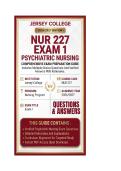
,NUR 227 Exam 1 Psychiatric Nursing Questions And Answers
2026/2027 Jersey College
Q1. A patient says, “Nobody understands how frightened I have
been since coming here.” Which response is most therapeutic?
A) “Tell me more about what has been frightening for you.”
B) “There is nothing here to be afraid of.”
C) “Everyone feels nervous during admission.”
D) “You should focus on positive thoughts.”
Correct Answer: A) “Tell me more about what has been frightening for you.”
Rationale: An open-ended invitation encourages the patient to describe
feelings and experiences without minimizing or redirecting the concern.
Q2. A patient becomes silent and tearful while discussing a
traumatic experience. Which response is most appropriate?
A) Immediately change the subject
B) Remain present and allow the patient time to respond
C) Ask several questions rapidly to maintain conversation
D) Tell the patient that crying will make things worse
Correct Answer: B) Remain present and allow the patient time to respond
Rationale: Therapeutic silence communicates acceptance and allows time
for the patient to process emotions.
Q3. Which statement is an example of reflection?
A) “Why did you become angry?”
B) “Everything will be fine.”
C) “You sound disappointed that your family did not visit.”
D) “I think you should call your family tonight.”
Correct Answer: C) “You sound disappointed that your family did not visit.”
Rationale: Reflection directs the patient's expressed feelings back to the
patient and promotes further exploration.
Q4. A patient says, “I don't know whether I should return home after
discharge.” Which response is therapeutic?
A) “You should definitely go home.”
B) “Your family probably knows what is best.”
,C) “Don't worry about that right now.”
D) “What concerns do you have about returning home?”
Correct Answer: D) “What concerns do you have about returning home?”
Rationale: Exploring the patient's concerns supports autonomy and
encourages problem-solving without giving advice.
Q5. Which question is most appropriate when beginning a
psychiatric interview?
A) “What brought you in for care today?”
B) “Why are you behaving this way?”
C) “You aren't suicidal, are you?”
D) “Do you realize your choices caused this?”
Correct Answer: A) “What brought you in for care today?”
Rationale: A broad, nonjudgmental opening allows the patient to identify
the main concern in their own words.
Q6. A patient says, “I am completely useless.” Which response best
uses the technique of exploring?
A) “That's not true.”
B) “What has been happening that makes you feel useless?”
C) “You should be grateful for what you have.”
D) “Other people have much worse problems.”
Correct Answer: B) “What has been happening that makes you feel useless?”
Rationale: Exploring invites the patient to examine the experiences and
thoughts underlying the statement.
Q7. Which behavior by the interviewer best demonstrates active
listening?
A) Completing the patient's sentences
B) Frequently checking the clock
C) Maintaining attentive posture and responding to relevant verbal and
nonverbal cues
D) Taking extensive notes without looking at the patient
Correct Answer: C) Maintaining attentive posture and responding to relevant
verbal and nonverbal cues
, Rationale: Active listening requires focused attention to both spoken
content and nonverbal communication.
Q8. Which response is nontherapeutic because it provides false
reassurance?
A) “What worries you most about the procedure?”
B) “You seem concerned about what might happen.”
C) “Let's discuss what information would help you.”
D) “Don't worry; everything will be perfectly fine.”
Correct Answer: D) “Don't worry; everything will be perfectly fine.”
Rationale: False reassurance dismisses uncertainty and can prevent
meaningful discussion of the patient's concerns.
Q9. A patient states, “Since my spouse died, evenings are the
hardest.” Which response is most therapeutic?
A) “What is it about the evenings that feels especially difficult?”
B) “You need to keep yourself busy.”
C) “At least you had many years together.”
D) “Try not to think about your spouse.”
Correct Answer: A) “What is it about the evenings that feels especially
difficult?”
Rationale: Focusing encourages the patient to explore a meaningful aspect
of the experience.
Q10. Which finding belongs to the mental status examination?
A) Serum sodium concentration
B) Appearance, behavior, mood, thought processes, cognition, and
perception
C) Chest radiograph results
D) Urine culture findings
Correct Answer: B) Appearance, behavior, mood, thought processes,
cognition, and perception
Rationale: The mental status examination systematically evaluates current
psychological and cognitive functioning.
CHAPTER 2 — THERAPEUTIC RELATIONSHIPS, BOUNDARIES, AND
MILIEU CARE
2026/2027 Jersey College
Q1. A patient says, “Nobody understands how frightened I have
been since coming here.” Which response is most therapeutic?
A) “Tell me more about what has been frightening for you.”
B) “There is nothing here to be afraid of.”
C) “Everyone feels nervous during admission.”
D) “You should focus on positive thoughts.”
Correct Answer: A) “Tell me more about what has been frightening for you.”
Rationale: An open-ended invitation encourages the patient to describe
feelings and experiences without minimizing or redirecting the concern.
Q2. A patient becomes silent and tearful while discussing a
traumatic experience. Which response is most appropriate?
A) Immediately change the subject
B) Remain present and allow the patient time to respond
C) Ask several questions rapidly to maintain conversation
D) Tell the patient that crying will make things worse
Correct Answer: B) Remain present and allow the patient time to respond
Rationale: Therapeutic silence communicates acceptance and allows time
for the patient to process emotions.
Q3. Which statement is an example of reflection?
A) “Why did you become angry?”
B) “Everything will be fine.”
C) “You sound disappointed that your family did not visit.”
D) “I think you should call your family tonight.”
Correct Answer: C) “You sound disappointed that your family did not visit.”
Rationale: Reflection directs the patient's expressed feelings back to the
patient and promotes further exploration.
Q4. A patient says, “I don't know whether I should return home after
discharge.” Which response is therapeutic?
A) “You should definitely go home.”
B) “Your family probably knows what is best.”
,C) “Don't worry about that right now.”
D) “What concerns do you have about returning home?”
Correct Answer: D) “What concerns do you have about returning home?”
Rationale: Exploring the patient's concerns supports autonomy and
encourages problem-solving without giving advice.
Q5. Which question is most appropriate when beginning a
psychiatric interview?
A) “What brought you in for care today?”
B) “Why are you behaving this way?”
C) “You aren't suicidal, are you?”
D) “Do you realize your choices caused this?”
Correct Answer: A) “What brought you in for care today?”
Rationale: A broad, nonjudgmental opening allows the patient to identify
the main concern in their own words.
Q6. A patient says, “I am completely useless.” Which response best
uses the technique of exploring?
A) “That's not true.”
B) “What has been happening that makes you feel useless?”
C) “You should be grateful for what you have.”
D) “Other people have much worse problems.”
Correct Answer: B) “What has been happening that makes you feel useless?”
Rationale: Exploring invites the patient to examine the experiences and
thoughts underlying the statement.
Q7. Which behavior by the interviewer best demonstrates active
listening?
A) Completing the patient's sentences
B) Frequently checking the clock
C) Maintaining attentive posture and responding to relevant verbal and
nonverbal cues
D) Taking extensive notes without looking at the patient
Correct Answer: C) Maintaining attentive posture and responding to relevant
verbal and nonverbal cues
, Rationale: Active listening requires focused attention to both spoken
content and nonverbal communication.
Q8. Which response is nontherapeutic because it provides false
reassurance?
A) “What worries you most about the procedure?”
B) “You seem concerned about what might happen.”
C) “Let's discuss what information would help you.”
D) “Don't worry; everything will be perfectly fine.”
Correct Answer: D) “Don't worry; everything will be perfectly fine.”
Rationale: False reassurance dismisses uncertainty and can prevent
meaningful discussion of the patient's concerns.
Q9. A patient states, “Since my spouse died, evenings are the
hardest.” Which response is most therapeutic?
A) “What is it about the evenings that feels especially difficult?”
B) “You need to keep yourself busy.”
C) “At least you had many years together.”
D) “Try not to think about your spouse.”
Correct Answer: A) “What is it about the evenings that feels especially
difficult?”
Rationale: Focusing encourages the patient to explore a meaningful aspect
of the experience.
Q10. Which finding belongs to the mental status examination?
A) Serum sodium concentration
B) Appearance, behavior, mood, thought processes, cognition, and
perception
C) Chest radiograph results
D) Urine culture findings
Correct Answer: B) Appearance, behavior, mood, thought processes,
cognition, and perception
Rationale: The mental status examination systematically evaluates current
psychological and cognitive functioning.
CHAPTER 2 — THERAPEUTIC RELATIONSHIPS, BOUNDARIES, AND
MILIEU CARE