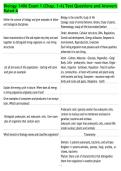
Biology 1406 Exam 1 (Chap. 1-4) Test Questions and Answers
Rated A
Biology is the scientific study of life
Define the science of biology and give examples of ditter-
Zoology: study of animal behavior, Botany: Study of plants,
ent biological disciplines.
Paleontology: study of life that existed before
Order, Movement, Cellular structure, DNA, Regulation,
Name characteristics of life and explain why they are used Growth and development, Energy utilization, Response to
together to distinguish living organisms vs. non-living environment, Reproduction, Evolution
structures Each living organism must possess each of these qualities
otherwise it is non-living.
Atom - Carbon, Molecule - Glucose, Organelles - Golgi
Body, Cells - prokaryotic, tissue - muscle tissue, Organ -
List all the levels of life organization - starting with atom Heart, Organism - Sunflower, Population - field of sunflow-
and give an example ers, communities - A forest with animals and plants along
with bacteria and fungi, Ecosystem - mountain range with
birds and rocks and goats, Biosphere - Earth
Explain the energy cycle in nature. Where does all energy
in living organisms originally come from?
Give examples of consumers and producers in an ecosys-
tem. Which are humans?
Prokaryotic cells: typically smaller than eukaryotic cells,
contain no nucleus and no membrane-enclosed or-
Distinguish prokaryotic and eukaryotic cells. Give exam-
ganelles; bacteria and archaea
ples of organisms that contain each.
Eukaryotic cells: larger than prokaryotic cells, contain DNA
inside nucleus; plants and animals
Which branch of biology names and classifies organisms? Taxonomy
Domain: 3 systems-eukaryota, bacteria, and archaea
Kingdom: 6 systems-animalia, plantae, fungi, protista, ar-
chaea, bacteria
Phylum: Share a set of characteristics that distinguishes
them from organisms in another phylum
, Biology 1406 Exam 1 (Chap. 1-4) Test Questions and Answers
Rated A
Class: common characteristics or attributes
Order: related organisms but smaller than class
Family: broken down further
List the kingdoms of organisms and briefly describe each. Genus: organisms that have similar features and are relat-
ed
Species: names after it's individual features and charac-
teristics
Individuals in a population vary in their heritable traits;
Briefly explain the main postulates of the theory of evolu- A population can produce far more ottspring than can
tion. survive to produce ottspring of their own;
Species generally are suited to their environments
Individuals with inherited traits that are better suited to the
What was Darwin's contribution to the theory of evolution? local environment are more likely to survive and reproduce
than are less well-suited individuals
Observation
Question
Hypothesis
List the steps of "the scientific method" in proper order.
(Prediction)
Experiment
Analyze results/data
Why do we need a control group in a properly designed To serve as a basis of comparison with the experimental
experiment? group
A substance that cannot be broken down any further;
Define chemical element; give examples.
Carbon, Oxygen, Gold, Zinc, Uranium
Oxygen- 60%
Carbon- 20%
Name 4 most common elements of living organisms; what
Hydrogen- 10%
percentage of the cell is composed of them?
Nitrogen- 5%
(CHON)
Rated A
Biology is the scientific study of life
Define the science of biology and give examples of ditter-
Zoology: study of animal behavior, Botany: Study of plants,
ent biological disciplines.
Paleontology: study of life that existed before
Order, Movement, Cellular structure, DNA, Regulation,
Name characteristics of life and explain why they are used Growth and development, Energy utilization, Response to
together to distinguish living organisms vs. non-living environment, Reproduction, Evolution
structures Each living organism must possess each of these qualities
otherwise it is non-living.
Atom - Carbon, Molecule - Glucose, Organelles - Golgi
Body, Cells - prokaryotic, tissue - muscle tissue, Organ -
List all the levels of life organization - starting with atom Heart, Organism - Sunflower, Population - field of sunflow-
and give an example ers, communities - A forest with animals and plants along
with bacteria and fungi, Ecosystem - mountain range with
birds and rocks and goats, Biosphere - Earth
Explain the energy cycle in nature. Where does all energy
in living organisms originally come from?
Give examples of consumers and producers in an ecosys-
tem. Which are humans?
Prokaryotic cells: typically smaller than eukaryotic cells,
contain no nucleus and no membrane-enclosed or-
Distinguish prokaryotic and eukaryotic cells. Give exam-
ganelles; bacteria and archaea
ples of organisms that contain each.
Eukaryotic cells: larger than prokaryotic cells, contain DNA
inside nucleus; plants and animals
Which branch of biology names and classifies organisms? Taxonomy
Domain: 3 systems-eukaryota, bacteria, and archaea
Kingdom: 6 systems-animalia, plantae, fungi, protista, ar-
chaea, bacteria
Phylum: Share a set of characteristics that distinguishes
them from organisms in another phylum
, Biology 1406 Exam 1 (Chap. 1-4) Test Questions and Answers
Rated A
Class: common characteristics or attributes
Order: related organisms but smaller than class
Family: broken down further
List the kingdoms of organisms and briefly describe each. Genus: organisms that have similar features and are relat-
ed
Species: names after it's individual features and charac-
teristics
Individuals in a population vary in their heritable traits;
Briefly explain the main postulates of the theory of evolu- A population can produce far more ottspring than can
tion. survive to produce ottspring of their own;
Species generally are suited to their environments
Individuals with inherited traits that are better suited to the
What was Darwin's contribution to the theory of evolution? local environment are more likely to survive and reproduce
than are less well-suited individuals
Observation
Question
Hypothesis
List the steps of "the scientific method" in proper order.
(Prediction)
Experiment
Analyze results/data
Why do we need a control group in a properly designed To serve as a basis of comparison with the experimental
experiment? group
A substance that cannot be broken down any further;
Define chemical element; give examples.
Carbon, Oxygen, Gold, Zinc, Uranium
Oxygen- 60%
Carbon- 20%
Name 4 most common elements of living organisms; what
Hydrogen- 10%
percentage of the cell is composed of them?
Nitrogen- 5%
(CHON)