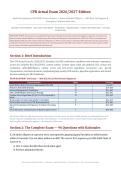
CPR Actual Exam 2026/2027-Edition
Real Exam Questions And 100% Correct Answers • Exams of Medical Physics • AHA Basic Life Support &
Emergency Cardiovascular Care
─────────────────────────────────────────────────────────────────────────────────────
AHA 2020 + 2025 Guidelines • BLS / ACLS / PALS Aligned • 96 Questions • Randomized Key • Evidence-Based Rationales • For Study
Purposes Only
IMPORTANT NOTICE: This document is an independent study aid and comprehensive practice examination designed to reflect the current American
Heart Association (AHA) Guidelines for Cardiopulmonary Resuscitation and Emergency Cardiovascular Care (2020 with 2025 focused updates) and
official BLS/ACLS/PALS provider content outlines for 2026/2027. It is NOT an actual, leaked, or reproduced AHA examination and does not guarantee
certification. All content is for educational preparation only. "Real Exam Questions And 100% Correct Answers" indicates each item includes a verified
correct answer and evidence-based rationale for self-assessment.
Section 1: Brief Introduction
This CPR Actual Exam for 2026/2027 simulates real AHA certification conditions and evaluates competency
across the complete BLS/ACLS/PALS content outline. Content spans adult and pediatric BLS, airway and
ventilation, AED/defibrillation, cardiac arrest and peri-arrest algorithms, post-arrest care, special
circumstances, and team dynamics, emphasizing high-quality CPR metrics, algorithm application, and clinical
decision-making per AHA Guidelines.
EXAM BLUEPRINT (96 Items) — AHA BLS/ACLS/PALS Domain Alignment:
Content Domain Items Coverage
Adult BLS & Chain of Survival, High-Quality CPR, AED 18 Q1–Q18
Pediatric BLS (Child & Infant) 12 Q19–Q30
Airway Management & Ventilation 11 Q31–Q41
AED / Defibrillation & Electrical Therapy 10 Q42–Q51
Cardiac Arrest Algorithms (VF/pVT vs PEA/Asystole) & 14 Q52–Q65
Meds
Bradycardia & Tachycardia (Stable vs Unstable) 10 Q66–Q75
Post-Cardiac Arrest Care (TTM, Hemodynamics) 6 Q76–Q81
Special Circumstances (Pregnancy, Overdose, Drowning, 8 Q82–Q89
etc.)
Team Dynamics, Communication & Quality Improvement 7 Q90–Q96
Instructions: Select the single best answer for each scenario. Correct answers are shown in bold cyan and are randomized across A–D.
Review rationales immediately after each item. Time allocation: ~75 seconds per item (≈ 2 hours total). Prioritize high-quality CPR
metrics, safety, and algorithm sequence — the hallmark of AHA exams.
Section 2: The Complete Exam — 96 Questions with Rationales
1. An adult collapses in a grocery store, unresponsive, gasping (agonal breaths), no definite pulse
within 10 seconds. You are alone without an AED. The correct first sequence per AHA Adult Chain of
Survival is:
A. Give 3 rescue breaths then check pulse again
B. Perform abdominal thrusts
CPR Actual Exam 2026/2027-Edition • 96 Questions • AHA BLS/ACLS/PALS • For Study Use Only — Not an Actual AHA Examination
, C. Activate emergency response (call 911/activate code), retrieve AED if available
without leaving victim if alone with phone, and immediately begin high-quality CPR
starting with 30 chest compressions
D. Wait for AED before starting compressions
Rationale: AHA Chain: Early recognition → Activate EMS/AED → Immediate high-quality CPR (CAB:
Compressions-Airway-Breathing). With agonal gasps/no pulse ≤10 sec, start compressions immediately; call
for help/AED via speakerphone, do not delay compressions for rescue breaths or AED retrieval that requires
leaving. Abdominal thrusts are for choking.
2. High-quality adult chest compressions require:
A. Compression fraction 50% is sufficient
B. Rate 100–120/min, depth 5 cm to 6 cm (2–2.4 inches), full chest recoil, minimal
interruptions (<10 sec), and compression fraction >80%
C. Rate 150/min, depth 8 cm
D. Rate 80/min, depth 3 cm, no recoil needed
Rationale: AHA BLS: 100–120/min optimizes perfusion; depth ≥5 cm but ≤6 cm (avoid >6 injury), allow full
recoil for venous return, minimize pauses (CCG <10 sec, e.g., pulse check, AED analysis), maintain >80%
compression fraction for survival.
3. Compression-to-ventilation ratio for 2-rescuer adult BLS without an advanced airway is:
A. 15:1
B. Continuous compressions without breaths for all
C. 30:2 (30 compressions to 2 breaths, each breath 1 second with visible chest rise)
D. 5:1
Rationale: AHA Adult BLS without advanced airway: 30:2 for 1- and 2-rescuer adult, 15:2 only for 2-rescuer
child/infant. Breaths 1 sec each, avoid hyperventilation (excessive rate/force reduces venous return). With
advanced airway, continuous compressions + 1 breath q6 sec (10/min) without pausing.
4. You witness an adult sudden collapse, AED arrives. The correct AED steps are:
A. Power on AED, expose chest, place pads (anterolateral: right infraclavicular, left lateral
chest), follow prompts, clear victim during analysis/shock, resume CPR immediately for 2
minutes after shock/no-shock (do not check pulse immediately)
B. Wait 1 minute after shock before resuming CPR
C. Place pads on clothing
D. Touch victim during analysis, shock regardless of rhythm
Rationale: AHA AED: Turn on, dry chest, anterolateral pads (avoid breast tissue, shave if needed), clear (loud
“all clear”), let analyze, deliver shock if advised, immediately resume CPR 30:2 ×2 min before rechecking
pulse/rhythm — minimizes no-flow time and improves defibrillation success.
CPR Actual Exam 2026/2027-Edition • 96 Questions • AHA BLS/ACLS/PALS • For Study Use Only — Not an Actual AHA Examination
, 5. Chest compression fraction (CCF) should be:
A. CCF does not affect outcome
B. Less than 50%
C. Exactly 30%
D. At least 80% — meaning compressions occupy ≥80% of arrest time, with pauses <10
seconds for ventilation, rhythm check, pulse check, and defibrillation
Rationale: High CCF >80% (ideally >80-85%) correlated with increased ROSC/survival. AHA emphasizes
minimizing interruptions: pre-charge AED, resume compressions immediately after shock, switch
compressors q2 min in <5 sec.
6. An adult has agonal gasps 30 seconds after collapse. You should:
A. Wait for gasps to stop before CPR
B. Assume normal breathing and place in recovery position
C. Give abdominal thrusts
D. Recognize agonal gasps as sign of cardiac arrest, not normal breathing — check pulse
≤10 sec and start CPR if no definite pulse
Rationale: Agonal gasps (gasping, snorting) occur in 40-60% of early arrests, ineffective. AHA: Brief (<10
sec) simultaneous breathing + pulse check; agonal with unresponsiveness = cardiac arrest → CPR. Recovery
position only if breathing normal and pulse present.
7. Two rescuers are performing adult BLS. Rescuer 1 fatigues after 4 minutes without switching.
Team should:
A. Switch only when victim recovers
B. Switch every 30 seconds
C. Continue with same compressor indefinitely
D. Switch compressors every 2 minutes (≈5 cycles of 30:2) taking ≤5 seconds, at AED
analysis or pause, to maintain quality and prevent fatigue-related shallow/slow
compressions
Rationale: AHA Team dynamics: Rotate compressor q2 min (or sooner if fatigued) to prevent quality decay
(depth/rate drop after 1-2 min). Switch during natural pauses (AED analysis) in <5 sec, hover hands ready for
high CCF.
8. Adult rescue breathing without compressions (pulse present, inadequate breathing) rate is:
A. No breaths needed if pulse present
B. 1 breath every 6 seconds (10 breaths/min), reassessing pulse/breathing q2 min, and
delivering each breath over 1 second with chest rise
CPR Actual Exam 2026/2027-Edition • 96 Questions • AHA BLS/ACLS/PALS • For Study Use Only — Not an Actual AHA Examination