
FINANCIAL ANALYSIS · OBJECTIVE ASSESSMENT
A+ VERIFIED
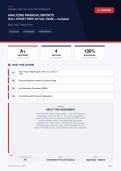
ANALYZING FINANCIAL REPORTS
WALL STREET PREP ACTUAL EXAM — Complete
Official Exam
40 Questions Full Rationales Verified Answers
A+ 4 100%
QUESTIONS SECTIONS RATIONALES
Complete coverage Core exam domains Every answer explained
WHAT THIS COVERS
SEC Filings & Report Types (10-K, 10-Q, 8-K, S-1
01
, S-4)
02 Financial Statement Analysis & Common-Sizing
03 Key Disclosures, Footnotes & MD&A
04 Financial Analysis Process & Interpretation
ABOUT THIS ASSESSMENT
Build mastery in financial report analysis — from SEC filings and
report types (10-K, 10-Q, 8-K, S-1, S-4) to financial statement
analysis, common-sizing, key disclosures, footnotes, MD&A, and the
financial analysis process. This original study bank targets
application and analysis skills for the Wall Street Prep Analyzing
Financial Reports certification exam, with full rationales for every
answer. For review use only; not an institutional proctored assessment.
PASSING SCORE LEVEL FORMAT
70% Intermediate (Financial Analysis) Application / Analysis
STUVIA ACTUAL EXAM Page 1
, SECTION 1: SEC Filings & Report Types (10-K, 10-Q, 8-K, S-1, S-4)
Q1. An equity analyst covering a large-cap U.S. issuer needs the most comprehensive annual disclosure of business, risk factors,
financial statements, and management discussion. Which SEC filing is the primary source for this information?
A. Form 10-K
B. Form 10-Q
C. Form 8-K
D. Form S-3
Correct Answer: A
Rationale:
The Form 10-K is the annual report that contains the full business description, risk factors, audited financial statements, MD&A, and other required
disclosures. The 10-Q is quarterly and less comprehensive; the 8-K reports current events; S-3 is a shelf registration statement.
Q2. A company announces a material acquisition that closed two days ago. The transaction is significant enough to require prompt
disclosure to the market. Which filing is the company most likely to use to report this event?
A. Form 10-K
B. Form 8-K
C. Form 10-Q
D. Form S-1
Correct Answer: B
Rationale:
Form 8-K is used to report material current events, including significant acquisitions, within the prescribed time frame. Annual and quarterly reports are
periodic; S-1 is for IPO registration.
Q3. An analyst is reviewing a company’s quarterly results and notes that the financial statements are reviewed but not audited.
Which SEC form typically contains these interim financial statements?
A. Form 10-K
B. Form 8-K
C. Form 10-Q
D. Form DEF 14A
Correct Answer: C
Rationale:
Form 10-Q contains unaudited (reviewed) interim financial statements for the first three quarters of the fiscal year. The 10-K contains audited annual
statements.
Q4. A private company is preparing to go public and must file a registration statement that includes a detailed prospectus for
potential investors. Which form is the standard initial registration statement for most IPOs?
A. Form 10-K
B. Form 8-K
C. Form 10-Q
D. Form S-1
Correct Answer: D
Rationale:
Form S-1 is the primary registration statement used for initial public offerings under the Securities Act. Periodic reports (10-K, 10-Q, 8-K) apply after
the company is public.
STUVIA ACTUAL EXAM · Page 2
A+ VERIFIED
ANALYZING FINANCIAL REPORTS
WALL STREET PREP ACTUAL EXAM — Complete
Official Exam
40 Questions Full Rationales Verified Answers
A+ 4 100%
QUESTIONS SECTIONS RATIONALES
Complete coverage Core exam domains Every answer explained
WHAT THIS COVERS
SEC Filings & Report Types (10-K, 10-Q, 8-K, S-1
01
, S-4)
02 Financial Statement Analysis & Common-Sizing
03 Key Disclosures, Footnotes & MD&A
04 Financial Analysis Process & Interpretation
ABOUT THIS ASSESSMENT
Build mastery in financial report analysis — from SEC filings and
report types (10-K, 10-Q, 8-K, S-1, S-4) to financial statement
analysis, common-sizing, key disclosures, footnotes, MD&A, and the
financial analysis process. This original study bank targets
application and analysis skills for the Wall Street Prep Analyzing
Financial Reports certification exam, with full rationales for every
answer. For review use only; not an institutional proctored assessment.
PASSING SCORE LEVEL FORMAT
70% Intermediate (Financial Analysis) Application / Analysis
STUVIA ACTUAL EXAM Page 1
, SECTION 1: SEC Filings & Report Types (10-K, 10-Q, 8-K, S-1, S-4)
Q1. An equity analyst covering a large-cap U.S. issuer needs the most comprehensive annual disclosure of business, risk factors,
financial statements, and management discussion. Which SEC filing is the primary source for this information?
A. Form 10-K
B. Form 10-Q
C. Form 8-K
D. Form S-3
Correct Answer: A
Rationale:
The Form 10-K is the annual report that contains the full business description, risk factors, audited financial statements, MD&A, and other required
disclosures. The 10-Q is quarterly and less comprehensive; the 8-K reports current events; S-3 is a shelf registration statement.
Q2. A company announces a material acquisition that closed two days ago. The transaction is significant enough to require prompt
disclosure to the market. Which filing is the company most likely to use to report this event?
A. Form 10-K
B. Form 8-K
C. Form 10-Q
D. Form S-1
Correct Answer: B
Rationale:
Form 8-K is used to report material current events, including significant acquisitions, within the prescribed time frame. Annual and quarterly reports are
periodic; S-1 is for IPO registration.
Q3. An analyst is reviewing a company’s quarterly results and notes that the financial statements are reviewed but not audited.
Which SEC form typically contains these interim financial statements?
A. Form 10-K
B. Form 8-K
C. Form 10-Q
D. Form DEF 14A
Correct Answer: C
Rationale:
Form 10-Q contains unaudited (reviewed) interim financial statements for the first three quarters of the fiscal year. The 10-K contains audited annual
statements.
Q4. A private company is preparing to go public and must file a registration statement that includes a detailed prospectus for
potential investors. Which form is the standard initial registration statement for most IPOs?
A. Form 10-K
B. Form 8-K
C. Form 10-Q
D. Form S-1
Correct Answer: D
Rationale:
Form S-1 is the primary registration statement used for initial public offerings under the Securities Act. Periodic reports (10-K, 10-Q, 8-K) apply after
the company is public.
STUVIA ACTUAL EXAM · Page 2


