
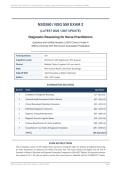
NSG 550 / NSG 550 Exam 2 (Latest 2026/2027 Update) | Diagnostic Reasoning for Nurse Practitioners | Wilkes
NSG550 / NSG 550 EXAM 2
(LATEST UPDATE)
Diagnostic Reasoning for Nurse Practitioners
Questions and Verified Answers | 100% Correct | Grade A
Wilkes University NSG 550 Course Examination Preparation
Total Questions 100
Cognitive Levels 20% Recall | 50% Application | 30% Analysis
Format Multiple Choice (4 options A-D, one correct)
Style 80% Scenario-Based | 20% Direct Knowledge
Aligned With AACN Essentials of Master's Education
Edition Update
EXAMINATION SECTIONS
Section Topic Questions
1 Foundations of Diagnostic Reasoning Q1 - Q12 (12)
2 Advanced Health Assessment & Data Collection Q13 - Q24 (12)
3 Clinical Reasoning & Hypothesis Generation Q25 - Q39 (15)
4 Differential Diagnosis Construction Q40 - Q54 (15)
5 Diagnostic Testing & Interpretation Q55 - Q69 (15)
6 Diagnostic Errors & Cognitive Biases Q70 - Q79 (10)
7 Evidence-Based Practice & Clinical Guidelines Q80 - Q89 (10)
8 Comprehensive Case Studies & Diagnostic Formulation Q90 - Q100 (11)
TOTAL 100 Questions
EXAM INSTRUCTIONS
This examination consists of 100 multiple-choice questions covering the eight core domains of Diagnostic Reasoning
for Nurse Practitioners as outlined in the Wilkes University NSG 550 course syllabus and aligned with the AACN
Essentials of Master's Education and Diagnostic Reasoning Competencies (2026/2027 Edition). Each question presents
four options (A, B, C, D); only one option is correct. The correct answer is identified with the *[CORRECT]* marker,
Wilkes University | NSG 550 | Grade A | 100% Verified Page 1
,NSG 550 / NSG 550 Exam 2 (Latest 2026/2027 Update) | Diagnostic Reasoning for Nurse Practitioners | Wilkes
and each question is accompanied by a 2-4 sentence rationale integrating NSG 550 curriculum content, AACN
standards, and evidence-based diagnostic reasoning principles.
Wilkes University | NSG 550 | Grade A | 100% Verified Page 2
,NSG 550 / NSG 550 Exam 2 (Latest 2026/2027 Update) | Diagnostic Reasoning for Nurse Practitioners | Wilkes
Section 1: Foundations of Diagnostic Reasoning
Q1: A 52-year-old male presents with new-onset chest pressure radiating to the left arm. The nurse
practitioner (NP) immediately suspects acute coronary syndrome (ACS) based on pattern recognition before
completing the full history. Which type of reasoning is the NP primarily demonstrating?
A. Hypothetico-deductive reasoning
B. Analytical reasoning
C. Intuitive (System 1) reasoning *[CORRECT]*
D. Probabilistic reasoning
Correct Answer: C
Rationale: Pattern recognition that occurs rapidly and automatically, before a deliberate analytical search, is characteristic
of System 1 (intuitive) reasoning described in dual process theory. Hypothetico-deductive (A) and analytical (B) reasoning
are deliberate System 2 processes. Probabilistic reasoning (D) requires explicit estimation of likelihoods using data such as
pretest probability.
Q2: Which statement best defines diagnostic reasoning as taught in NSG 550?
A. A linear process of matching patient symptoms to textbook disease descriptions
B. The dynamic, iterative process of gathering and interpreting clinical data to generate, test, and refine
hypotheses about a patient's condition *[CORRECT]*
C. The application of clinical practice guidelines to standardize patient care decisions
D. The use of diagnostic testing to confirm or exclude a suspected diagnosis
Correct Answer: B
Rationale: Diagnostic reasoning is defined as a dynamic, iterative process integrating data collection, hypothesis generation,
testing, and refinement - not a linear (A) or solely guideline-driven (C) process. Diagnostic testing (D) is one component, not
the definition itself. This definition aligns with AACN Essentials competencies for clinical reasoning.
Q3: An NP is evaluating a 68-year-old with acute dyspnea. After forming an initial hypothesis of heart failure,
the NP actively searches for data that would support this diagnosis while downplaying evidence suggesting
COPD. This behavior best illustrates which concept, and what is the appropriate corrective strategy?
A. Anchoring bias; correct by using a structured differential diagnosis
B. Confirmation bias; correct by deliberately searching for disconfirming evidence *[CORRECT]*
C. Premature closure; correct by broadening the differential
D. Availability bias; correct by considering base rates
Correct Answer: B
Rationale: Confirmation bias is the tendency to seek information that supports an initial hypothesis and ignore
disconfirming data. The corrective strategy is to actively search for disconfirming evidence (hypothesis falsification).
Anchoring (A) refers to fixating on initial information; premature closure (C) is accepting a diagnosis before it is fully
verified; availability (D) is overestimating what is easily recalled.
Wilkes University | NSG 550 | Grade A | 100% Verified Page 3
, NSG 550 / NSG 550 Exam 2 (Latest 2026/2027 Update) | Diagnostic Reasoning for Nurse Practitioners | Wilkes
Q4: According to dual process theory, which clinical task most appropriately requires System 2 (analytical)
thinking rather than System 1 (intuitive) thinking?
A. Recognizing that a diaphoretic, clutching-the-chest patient is having an MI
B. Identifying a familiar viral exanthem in a pediatric patient
C. Calculating a Wells score for pulmonary embolism and interpreting pretest probability *[CORRECT]*
D. Noticing that a lethargic patient with a glucose of 38 mg/dL requires dextrose
Correct Answer: C
Rationale: System 2 thinking is slow, deliberate, and analytical - required for tasks such as clinical prediction rule
calculation and Bayesian reasoning. The scenarios in A, B, and D represent pattern recognition (System 1) because they
involve rapidly recognizable clinical syndromes with severe or classic presentations.
Q5: A novice NP spends significantly longer evaluating patients compared to an expert NP. Which cognitive
structure best explains the expert's ability to rapidly narrow diagnostic possibilities?
A. Illness scripts *[CORRECT]*
B. Bayesian probability tables
C. Clinical practice guidelines
D. Decision trees
Correct Answer: A
Rationale: Illness scripts are organized mental networks of knowledge about diseases (epidemiology, time course, clinical
features, pathophysiology) that allow experts to rapidly recognize patterns and narrow differentials. Novices lack
well-developed scripts and must rely on slower analytical strategies. Bayesian tables (B), guidelines (C), and decision trees
(D) are external tools, not internal cognitive structures.
Q6: Metacognition in diagnostic reasoning is best described as:
A. The ability to recall detailed medical knowledge under pressure
B. Awareness and regulation of one's own thinking processes during clinical decision-making
*[CORRECT]*
C. The capacity to communicate diagnostic uncertainty to patients
D. The skill of integrating patient preferences into the diagnostic plan
Correct Answer: B
Rationale: Metacognition is thinking about one's own thinking - monitoring and adjusting reasoning processes, recognizing
bias, and knowing when to slow down. It is central to diagnostic safety. (A) describes knowledge recall, (C) is
communication, (D) is shared decision-making. Metacognition is specifically a self-reflective cognitive skill.
Q7: Which scenario best exemplifies shared decision-making in the diagnostic process?
A. The NP orders a complete diagnostic workup and informs the patient of the results when complete
B. The NP presents the risks, benefits, and alternatives to a CT pulmonary angiogram, explores the patient's
values, and together they decide whether to proceed *[CORRECT]*
C. The NP selects the most cost-effective diagnostic test based on institutional protocol
D. The NP defers all diagnostic decisions to the consulting physician
Correct Answer: B
Rationale: Shared decision-making integrates best evidence, clinician expertise, and patient preferences - the three pillars of
evidence-based practice. (A) is paternalistic, (C) omits patient values, (D) abdicates responsibility. The AACN Essentials
emphasize patient-centered care, which includes collaborative diagnostic decision-making.
Wilkes University | NSG 550 | Grade A | 100% Verified Page 4
NSG550 / NSG 550 EXAM 2
(LATEST UPDATE)
Diagnostic Reasoning for Nurse Practitioners
Questions and Verified Answers | 100% Correct | Grade A
Wilkes University NSG 550 Course Examination Preparation
Total Questions 100
Cognitive Levels 20% Recall | 50% Application | 30% Analysis
Format Multiple Choice (4 options A-D, one correct)
Style 80% Scenario-Based | 20% Direct Knowledge
Aligned With AACN Essentials of Master's Education
Edition Update
EXAMINATION SECTIONS
Section Topic Questions
1 Foundations of Diagnostic Reasoning Q1 - Q12 (12)
2 Advanced Health Assessment & Data Collection Q13 - Q24 (12)
3 Clinical Reasoning & Hypothesis Generation Q25 - Q39 (15)
4 Differential Diagnosis Construction Q40 - Q54 (15)
5 Diagnostic Testing & Interpretation Q55 - Q69 (15)
6 Diagnostic Errors & Cognitive Biases Q70 - Q79 (10)
7 Evidence-Based Practice & Clinical Guidelines Q80 - Q89 (10)
8 Comprehensive Case Studies & Diagnostic Formulation Q90 - Q100 (11)
TOTAL 100 Questions
EXAM INSTRUCTIONS
This examination consists of 100 multiple-choice questions covering the eight core domains of Diagnostic Reasoning
for Nurse Practitioners as outlined in the Wilkes University NSG 550 course syllabus and aligned with the AACN
Essentials of Master's Education and Diagnostic Reasoning Competencies (2026/2027 Edition). Each question presents
four options (A, B, C, D); only one option is correct. The correct answer is identified with the *[CORRECT]* marker,
Wilkes University | NSG 550 | Grade A | 100% Verified Page 1
,NSG 550 / NSG 550 Exam 2 (Latest 2026/2027 Update) | Diagnostic Reasoning for Nurse Practitioners | Wilkes
and each question is accompanied by a 2-4 sentence rationale integrating NSG 550 curriculum content, AACN
standards, and evidence-based diagnostic reasoning principles.
Wilkes University | NSG 550 | Grade A | 100% Verified Page 2
,NSG 550 / NSG 550 Exam 2 (Latest 2026/2027 Update) | Diagnostic Reasoning for Nurse Practitioners | Wilkes
Section 1: Foundations of Diagnostic Reasoning
Q1: A 52-year-old male presents with new-onset chest pressure radiating to the left arm. The nurse
practitioner (NP) immediately suspects acute coronary syndrome (ACS) based on pattern recognition before
completing the full history. Which type of reasoning is the NP primarily demonstrating?
A. Hypothetico-deductive reasoning
B. Analytical reasoning
C. Intuitive (System 1) reasoning *[CORRECT]*
D. Probabilistic reasoning
Correct Answer: C
Rationale: Pattern recognition that occurs rapidly and automatically, before a deliberate analytical search, is characteristic
of System 1 (intuitive) reasoning described in dual process theory. Hypothetico-deductive (A) and analytical (B) reasoning
are deliberate System 2 processes. Probabilistic reasoning (D) requires explicit estimation of likelihoods using data such as
pretest probability.
Q2: Which statement best defines diagnostic reasoning as taught in NSG 550?
A. A linear process of matching patient symptoms to textbook disease descriptions
B. The dynamic, iterative process of gathering and interpreting clinical data to generate, test, and refine
hypotheses about a patient's condition *[CORRECT]*
C. The application of clinical practice guidelines to standardize patient care decisions
D. The use of diagnostic testing to confirm or exclude a suspected diagnosis
Correct Answer: B
Rationale: Diagnostic reasoning is defined as a dynamic, iterative process integrating data collection, hypothesis generation,
testing, and refinement - not a linear (A) or solely guideline-driven (C) process. Diagnostic testing (D) is one component, not
the definition itself. This definition aligns with AACN Essentials competencies for clinical reasoning.
Q3: An NP is evaluating a 68-year-old with acute dyspnea. After forming an initial hypothesis of heart failure,
the NP actively searches for data that would support this diagnosis while downplaying evidence suggesting
COPD. This behavior best illustrates which concept, and what is the appropriate corrective strategy?
A. Anchoring bias; correct by using a structured differential diagnosis
B. Confirmation bias; correct by deliberately searching for disconfirming evidence *[CORRECT]*
C. Premature closure; correct by broadening the differential
D. Availability bias; correct by considering base rates
Correct Answer: B
Rationale: Confirmation bias is the tendency to seek information that supports an initial hypothesis and ignore
disconfirming data. The corrective strategy is to actively search for disconfirming evidence (hypothesis falsification).
Anchoring (A) refers to fixating on initial information; premature closure (C) is accepting a diagnosis before it is fully
verified; availability (D) is overestimating what is easily recalled.
Wilkes University | NSG 550 | Grade A | 100% Verified Page 3
, NSG 550 / NSG 550 Exam 2 (Latest 2026/2027 Update) | Diagnostic Reasoning for Nurse Practitioners | Wilkes
Q4: According to dual process theory, which clinical task most appropriately requires System 2 (analytical)
thinking rather than System 1 (intuitive) thinking?
A. Recognizing that a diaphoretic, clutching-the-chest patient is having an MI
B. Identifying a familiar viral exanthem in a pediatric patient
C. Calculating a Wells score for pulmonary embolism and interpreting pretest probability *[CORRECT]*
D. Noticing that a lethargic patient with a glucose of 38 mg/dL requires dextrose
Correct Answer: C
Rationale: System 2 thinking is slow, deliberate, and analytical - required for tasks such as clinical prediction rule
calculation and Bayesian reasoning. The scenarios in A, B, and D represent pattern recognition (System 1) because they
involve rapidly recognizable clinical syndromes with severe or classic presentations.
Q5: A novice NP spends significantly longer evaluating patients compared to an expert NP. Which cognitive
structure best explains the expert's ability to rapidly narrow diagnostic possibilities?
A. Illness scripts *[CORRECT]*
B. Bayesian probability tables
C. Clinical practice guidelines
D. Decision trees
Correct Answer: A
Rationale: Illness scripts are organized mental networks of knowledge about diseases (epidemiology, time course, clinical
features, pathophysiology) that allow experts to rapidly recognize patterns and narrow differentials. Novices lack
well-developed scripts and must rely on slower analytical strategies. Bayesian tables (B), guidelines (C), and decision trees
(D) are external tools, not internal cognitive structures.
Q6: Metacognition in diagnostic reasoning is best described as:
A. The ability to recall detailed medical knowledge under pressure
B. Awareness and regulation of one's own thinking processes during clinical decision-making
*[CORRECT]*
C. The capacity to communicate diagnostic uncertainty to patients
D. The skill of integrating patient preferences into the diagnostic plan
Correct Answer: B
Rationale: Metacognition is thinking about one's own thinking - monitoring and adjusting reasoning processes, recognizing
bias, and knowing when to slow down. It is central to diagnostic safety. (A) describes knowledge recall, (C) is
communication, (D) is shared decision-making. Metacognition is specifically a self-reflective cognitive skill.
Q7: Which scenario best exemplifies shared decision-making in the diagnostic process?
A. The NP orders a complete diagnostic workup and informs the patient of the results when complete
B. The NP presents the risks, benefits, and alternatives to a CT pulmonary angiogram, explores the patient's
values, and together they decide whether to proceed *[CORRECT]*
C. The NP selects the most cost-effective diagnostic test based on institutional protocol
D. The NP defers all diagnostic decisions to the consulting physician
Correct Answer: B
Rationale: Shared decision-making integrates best evidence, clinician expertise, and patient preferences - the three pillars of
evidence-based practice. (A) is paternalistic, (C) omits patient values, (D) abdicates responsibility. The AACN Essentials
emphasize patient-centered care, which includes collaborative diagnostic decision-making.
Wilkes University | NSG 550 | Grade A | 100% Verified Page 4


