
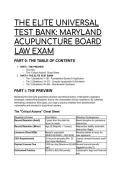
THE ELITE UNIVERSAL
TEST BANK: MARYLAND
ACUPUNCTURE BOARD
LAW EXAM
PART 0: THE TABLE OF CONTENTS
1. PART I: THE PREVIEW
○ The Intro
○ The "Critical Axioms" Cheat Sheet
2. PART II: THE ELITE TEST BANK
○ Tier 1 (Questions 1–18) - Foundational Syntax & Application
○ Tier 2 (Questions 19–37) - Complex Application & Simulation
○ Tier 3 (Questions 38–55) - Grandmaster Synthesis
PART I: THE PREVIEW
Mastering this test bank guarantees absolute operational fluency in Maryland's regulatory
landscape, transforming academic theory into unassailable clinical compliance. By ruthlessly
eliminating compliance blind spots, you forge a practice shielded from administrative
vulnerability and elevated to board-level mastery.
The "Critical Axioms" Cheat Sheet
Regulatory Domain Core Metric Statutory Consequence
Record Retention (Adult) 7 years from the date the Board discipline for premature
record is made. destruction.
Record Retention (Minor) Age 25 (Majority + 7 years). Malpractice liability extended;
destruction illegal.
Licensure (Post-2026) Master's equivalent Absolute barrier to entry for
(MHEC/ACAOM) + NCCAOM. new applicants.
CEU Requirements 30 hours bi-annually (Min. 20 License renewal blocked; audit
East Asian Medicine). failure.
Expired License Fine $100 per day (Maximum $5,000 Severe financial penalty
cap). triggered on day 31.
Unlicensed Practice $5,000 to $50,000 penalty. Catastrophic legal and financial
ruin.
,PART II: THE ELITE TEST BANK
Q1: An applicant submits their paperwork for initial Maryland licensure on August 15, 2026.
Based on the principles of the Maryland Health Occupations Article, which qualification is the
ABSOLUTE requirement? A) Evidence of 1,800 hours of training with 300 clinical hours. B) A
letter from an educational evaluation agency for foreign credentials. C) Graduation from a
master's level program and a passing NCCAOM score. D) Registration with the State Board of
Physician Quality Assurance.
● Answer: C (Graduation from a master's level program and a passing NCCAOM score.)
● Distractor Analysis:
○ A is incorrect: The 1,800-hour standard is a legacy requirement rendered obsolete
for licenses issued on or after June 1, 2026, which now mandate degree-based
metrics.
○ B is incorrect: The Board explicitly repealed the foreign credential review
requirement, opting instead to mandate NCCAOM examination for all
non-accredited foreign graduates.
○ D is incorrect: This references an obsolete legacy provision from 1994 that has
been fully repealed.
The Mentor's Analysis: Maryland legislation systematically elevated the entry threshold to align
with national academic standards. When facing post-2026 licensing, the immediate priority is
verifying master's-level equivalence and NCCAOM passage. By utilizing current statutory dates,
you bypass the common trap of relying on outdated training hour metrics that no longer carry
legal weight. Professional Intuition: Always apply the June 1, 2026 statutory threshold to
determine whether legacy hour-counting or modern degree-verification applies.
Q2: A licensed acupuncturist decides to close their clinic and destroy old patient files. For an
adult patient whose record was generated eight years ago but who was last treated four years
ago, what is the LEGAL status of the record? A) It must be retained for three more years. B) It
may be destroyed immediately because seven years have passed since creation. C) It must be
retained indefinitely. D) It must be transferred to the local health department.
● Answer: B (It may be destroyed immediately because seven years have passed since
creation.)
● Distractor Analysis:
○ A is incorrect: Retention is based on the date the record is made, not the date of the
last clinical encounter.
○ C is incorrect: Infinite retention is not a statutory requirement and creates undue
administrative burden.
○ D is incorrect: State health departments do not act as repositories for private clinical
records.
The Mentor's Analysis: Record retention laws mitigate malpractice exposure by ensuring
continuity of care over a predictable timeline. When facing file destruction, the immediate priority
is calculating the exact creation date of the document. By utilizing the seven-year statutory
minimum anchored to the creation date, you bypass the common trap of calculating timelines
based on clinical discharge dates. Professional Intuition: Adult records are anchored to the
date of document creation, not the date of clinical discharge.
Q3: A patient who began treatment at age 12 completed their final session at age 15. Based on
the principles of Maryland medical record retention, which age must the patient reach before
their records can be DESTROYED? A) Age 18 B) Age 21 C) Age 22 D) Age 25
, ● Answer: D (Age 25)
● Distractor Analysis:
○ A is incorrect: Age 18 is the age of majority, but statutory mandates require records
to be held significantly longer to protect latent malpractice claims.
○ B is incorrect: Age 21 was an older standard under general health care provider
regulations prior to the recent statutory extension.
○ C is incorrect: The "majority plus three years" standard is an obsolete legacy rule
that was subsequently expanded.
The Mentor's Analysis: Minors possess extended tort windows that delay the statute of
limitations, requiring practitioners to preserve evidence of care well into the patient's adulthood.
When facing pediatric record purges, the immediate priority is adding seven years to the age of
majority (18). By utilizing the majority-plus-seven formula, you bypass the common trap of
confusing outdated COMAR regulations with current statutes. Professional Intuition: Never
purge a minor's clinical file until they celebrate their 25th birthday.
Q4: An individual wishes to perform acupuncture on animals in Maryland. Based on the
principles of scope of practice, which professional is AUTHORIZED to do so without an
acupuncture board license? A) A licensed physician (MD) with specialty training in veterinary
science. B) A licensed acupuncturist who has taken a 100-hour animal continuing education
course. C) A veterinarian licensed under the Agriculture Article. D) An individual employed by an
animal shelter.
● Answer: C (A veterinarian licensed under the Agriculture Article.)
● Distractor Analysis:
○ A is incorrect: Physicians are authorized under Title 14 to perform acupuncture on
humans, but this exemption does not cross species lines.
○ B is incorrect: Acupuncturists licensed under Title 1A are strictly forbidden from
practicing on animals, as this constitutes the unlicensed practice of veterinary
medicine.
○ D is incorrect: Animal shelter employment grants no medical or procedural scope
exemptions.
The Mentor's Analysis: Scope of practice boundaries prevent cross-species clinical errors and
maintain distinct regulatory jurisdictions. When facing animal treatment inquiries, the immediate
priority is deferring entirely to the State Veterinary Board. By utilizing the Agriculture Article
exemption, you bypass the common trap of assuming a human acupuncture license applies
universally across biological classifications. Professional Intuition: Human acupuncture
licenses never cross the species barrier; animal treatment remains the exclusive domain
of licensed veterinarians.
Q5: An individual is hired by the United States Department of Veterans Affairs to provide
acupuncture at a federal hospital in Maryland. Based on the principles of Maryland Title 1A,
what is the LEGAL requirement for this individual regarding a Maryland state license? A) They
must obtain a Maryland license within 6 months of federal employment. B) They are exempt
from Maryland licensure while practicing within the scope of federal employment. C) They must
hold a temporary expedited military license. D) They must pay a reciprocity fee to the Maryland
Board.
● Answer: B (They are exempt from Maryland licensure while practicing within the scope of
federal employment.)
● Distractor Analysis:
○ A is incorrect: Federal supremacy overrides state licensure deadlines entirely for
federal roles, rendering state deadlines irrelevant.
TEST BANK: MARYLAND
ACUPUNCTURE BOARD
LAW EXAM
PART 0: THE TABLE OF CONTENTS
1. PART I: THE PREVIEW
○ The Intro
○ The "Critical Axioms" Cheat Sheet
2. PART II: THE ELITE TEST BANK
○ Tier 1 (Questions 1–18) - Foundational Syntax & Application
○ Tier 2 (Questions 19–37) - Complex Application & Simulation
○ Tier 3 (Questions 38–55) - Grandmaster Synthesis
PART I: THE PREVIEW
Mastering this test bank guarantees absolute operational fluency in Maryland's regulatory
landscape, transforming academic theory into unassailable clinical compliance. By ruthlessly
eliminating compliance blind spots, you forge a practice shielded from administrative
vulnerability and elevated to board-level mastery.
The "Critical Axioms" Cheat Sheet
Regulatory Domain Core Metric Statutory Consequence
Record Retention (Adult) 7 years from the date the Board discipline for premature
record is made. destruction.
Record Retention (Minor) Age 25 (Majority + 7 years). Malpractice liability extended;
destruction illegal.
Licensure (Post-2026) Master's equivalent Absolute barrier to entry for
(MHEC/ACAOM) + NCCAOM. new applicants.
CEU Requirements 30 hours bi-annually (Min. 20 License renewal blocked; audit
East Asian Medicine). failure.
Expired License Fine $100 per day (Maximum $5,000 Severe financial penalty
cap). triggered on day 31.
Unlicensed Practice $5,000 to $50,000 penalty. Catastrophic legal and financial
ruin.
,PART II: THE ELITE TEST BANK
Q1: An applicant submits their paperwork for initial Maryland licensure on August 15, 2026.
Based on the principles of the Maryland Health Occupations Article, which qualification is the
ABSOLUTE requirement? A) Evidence of 1,800 hours of training with 300 clinical hours. B) A
letter from an educational evaluation agency for foreign credentials. C) Graduation from a
master's level program and a passing NCCAOM score. D) Registration with the State Board of
Physician Quality Assurance.
● Answer: C (Graduation from a master's level program and a passing NCCAOM score.)
● Distractor Analysis:
○ A is incorrect: The 1,800-hour standard is a legacy requirement rendered obsolete
for licenses issued on or after June 1, 2026, which now mandate degree-based
metrics.
○ B is incorrect: The Board explicitly repealed the foreign credential review
requirement, opting instead to mandate NCCAOM examination for all
non-accredited foreign graduates.
○ D is incorrect: This references an obsolete legacy provision from 1994 that has
been fully repealed.
The Mentor's Analysis: Maryland legislation systematically elevated the entry threshold to align
with national academic standards. When facing post-2026 licensing, the immediate priority is
verifying master's-level equivalence and NCCAOM passage. By utilizing current statutory dates,
you bypass the common trap of relying on outdated training hour metrics that no longer carry
legal weight. Professional Intuition: Always apply the June 1, 2026 statutory threshold to
determine whether legacy hour-counting or modern degree-verification applies.
Q2: A licensed acupuncturist decides to close their clinic and destroy old patient files. For an
adult patient whose record was generated eight years ago but who was last treated four years
ago, what is the LEGAL status of the record? A) It must be retained for three more years. B) It
may be destroyed immediately because seven years have passed since creation. C) It must be
retained indefinitely. D) It must be transferred to the local health department.
● Answer: B (It may be destroyed immediately because seven years have passed since
creation.)
● Distractor Analysis:
○ A is incorrect: Retention is based on the date the record is made, not the date of the
last clinical encounter.
○ C is incorrect: Infinite retention is not a statutory requirement and creates undue
administrative burden.
○ D is incorrect: State health departments do not act as repositories for private clinical
records.
The Mentor's Analysis: Record retention laws mitigate malpractice exposure by ensuring
continuity of care over a predictable timeline. When facing file destruction, the immediate priority
is calculating the exact creation date of the document. By utilizing the seven-year statutory
minimum anchored to the creation date, you bypass the common trap of calculating timelines
based on clinical discharge dates. Professional Intuition: Adult records are anchored to the
date of document creation, not the date of clinical discharge.
Q3: A patient who began treatment at age 12 completed their final session at age 15. Based on
the principles of Maryland medical record retention, which age must the patient reach before
their records can be DESTROYED? A) Age 18 B) Age 21 C) Age 22 D) Age 25
, ● Answer: D (Age 25)
● Distractor Analysis:
○ A is incorrect: Age 18 is the age of majority, but statutory mandates require records
to be held significantly longer to protect latent malpractice claims.
○ B is incorrect: Age 21 was an older standard under general health care provider
regulations prior to the recent statutory extension.
○ C is incorrect: The "majority plus three years" standard is an obsolete legacy rule
that was subsequently expanded.
The Mentor's Analysis: Minors possess extended tort windows that delay the statute of
limitations, requiring practitioners to preserve evidence of care well into the patient's adulthood.
When facing pediatric record purges, the immediate priority is adding seven years to the age of
majority (18). By utilizing the majority-plus-seven formula, you bypass the common trap of
confusing outdated COMAR regulations with current statutes. Professional Intuition: Never
purge a minor's clinical file until they celebrate their 25th birthday.
Q4: An individual wishes to perform acupuncture on animals in Maryland. Based on the
principles of scope of practice, which professional is AUTHORIZED to do so without an
acupuncture board license? A) A licensed physician (MD) with specialty training in veterinary
science. B) A licensed acupuncturist who has taken a 100-hour animal continuing education
course. C) A veterinarian licensed under the Agriculture Article. D) An individual employed by an
animal shelter.
● Answer: C (A veterinarian licensed under the Agriculture Article.)
● Distractor Analysis:
○ A is incorrect: Physicians are authorized under Title 14 to perform acupuncture on
humans, but this exemption does not cross species lines.
○ B is incorrect: Acupuncturists licensed under Title 1A are strictly forbidden from
practicing on animals, as this constitutes the unlicensed practice of veterinary
medicine.
○ D is incorrect: Animal shelter employment grants no medical or procedural scope
exemptions.
The Mentor's Analysis: Scope of practice boundaries prevent cross-species clinical errors and
maintain distinct regulatory jurisdictions. When facing animal treatment inquiries, the immediate
priority is deferring entirely to the State Veterinary Board. By utilizing the Agriculture Article
exemption, you bypass the common trap of assuming a human acupuncture license applies
universally across biological classifications. Professional Intuition: Human acupuncture
licenses never cross the species barrier; animal treatment remains the exclusive domain
of licensed veterinarians.
Q5: An individual is hired by the United States Department of Veterans Affairs to provide
acupuncture at a federal hospital in Maryland. Based on the principles of Maryland Title 1A,
what is the LEGAL requirement for this individual regarding a Maryland state license? A) They
must obtain a Maryland license within 6 months of federal employment. B) They are exempt
from Maryland licensure while practicing within the scope of federal employment. C) They must
hold a temporary expedited military license. D) They must pay a reciprocity fee to the Maryland
Board.
● Answer: B (They are exempt from Maryland licensure while practicing within the scope of
federal employment.)
● Distractor Analysis:
○ A is incorrect: Federal supremacy overrides state licensure deadlines entirely for
federal roles, rendering state deadlines irrelevant.


