
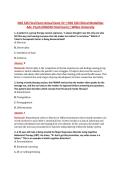
NSG 526 Final Exam Actual Exam V2 | NSG 526 Clinical Modalities
Adv. Psych (NSG526 Final Exam) | Wilkes University
1. A patient in a group therapy session expresses, “I always thought I was the only one who
felt this way, but hearing everyone else talk makes me realize I’m not alone.” Which of
Yalom’s therapeutic factors is being demonstrated?
A. Altruism
B. Universality
C. Instillation of hope
D. Catharsis
Answer: B
Rationale: Universality is the recognition of shared experiences and feelings among group
members, which validates the patient’s own struggles. It helps to decrease the sense of
isolation and shame that individuals often feel when dealing with mental health issues. This
factor is crucial in the early stages of group development to foster connection and safety.
2. During a family therapy session, the PMHNP notices that the mother often speaks for the
teenage son, and the son looks to the mother for approval before answering any questions.
This pattern best describes which concept from Structural Family Therapy?
A. Enmeshment
B. Triangulation
C. Disengagement
D. Differentiation
Answer: A
Rationale: Enmeshment refers to blurred or diffuse boundaries where family members are
overly involved in each other’s emotional lives. It often results in a lack of autonomy and
prevents individuals from developing their own identity. In this scenario, the mother and
son lack the necessary boundaries to function independently within the family system.
3. A 45-year-old male is being treated for Major Depressive Disorder using Cognitive
Behavioral Therapy (CBT). He states, “If I don’t get this promotion, my entire career is a
failure.” This is an example of which cognitive distortion?
A. Personalization
B. Emotional reasoning
C. All-or-nothing thinking
,D. Catastrophizing
Answer: C
Rationale: All-or-nothing thinking, also known as black-and-white thinking, involves
seeing things in only two categories without any middle ground. The patient’s statement
suggests that anything less than a promotion equates to total failure, ignoring partial
successes. CBT interventions focus on helping the patient recognize these patterns and find
more balanced perspectives.
4. In Dialectical Behavior Therapy (DBT), the therapist teaches the patient to observe their
breath and the sensations in their body without judgment. This skill belongs to which
module?
A. Mindfulness
B. Emotional Regulation
C. Distress Tolerance
D. Interpersonal Effectiveness
Answer: A
Rationale: Mindfulness is the foundational skill in DBT that involves focusing on the
present moment without judgment. It helps patients become aware of their thoughts and
feelings without immediately acting on them. By practicing mindfulness, patients can move
from a state of emotional reactivity to ‘Wise Mind.’
5. A PMHNP is conducting a session with a family where the parents are constantly arguing.
The father eventually turns to the daughter to seek emotional support and validation against
the mother. This is an example of:
A. A coalition
B. Triangulation
C. Differentiation
D. A nuclear family emotional process
Answer: B
Rationale: Triangulation occurs when a two-person system under stress brings in a third
person to stabilize the relationship and reduce anxiety. In this case, the father uses the
daughter to deflect the conflict with his wife, which places the child in a stressful and
inappropriate position. This concept is a hallmark of Bowenian Family Systems Theory.
6. A patient is struggling with the recent death of a spouse and is experiencing significant
functional impairment. The PMHNP chooses Interpersonal Therapy (IPT) as the modality.
Which IPT problem area is the focus of treatment?
A. Interpersonal deficits
, B. Complicated grief
C. Role dispute
D. Role transition
Answer: B
Rationale: Complicated grief is one of the four focal areas of Interpersonal Therapy,
specifically addressing the loss of a significant person. The goal is to facilitate the mourning
process and help the patient find new activities and relationships. IPT is evidence-based
and time-limited, making it highly effective for depression related to bereavement.
7. The PMHNP is utilizing Motivational Interviewing with a patient who is ambivalent about
quitting smoking. The patient says, “I know smoking is bad for my health, but it’s the only
way I can relax.” Which component of OARS is best used here?
A. Open-ended questions
B. Affirmations
C. Summarizing
D. Reflective listening
Answer: D
Rationale: Reflective listening allows the therapist to mirror the patient’s feelings and
thoughts, demonstrating empathy and understanding. By reflecting the patient’s
ambivalence, the therapist helps the patient explore their motivations for change. This
technique reduces resistance and encourages the patient to express ‘change talk.’
8. During a group session, two members begin to argue loudly, and the rest of the group
remains silent and uncomfortable. According to Tuckman’s stages of group development,
which stage is the group most likely in?
A. Storming
B. Forming
C. Norming
D. Performing
Answer: A
Rationale: The storming stage is characterized by conflict, competition for status, and
disagreements among group members. It is a necessary phase where members test
boundaries and express individual differences. The facilitator’s role is to help the group
navigate this conflict to reach the ‘norming’ stage where cohesion is built.
Adv. Psych (NSG526 Final Exam) | Wilkes University
1. A patient in a group therapy session expresses, “I always thought I was the only one who
felt this way, but hearing everyone else talk makes me realize I’m not alone.” Which of
Yalom’s therapeutic factors is being demonstrated?
A. Altruism
B. Universality
C. Instillation of hope
D. Catharsis
Answer: B
Rationale: Universality is the recognition of shared experiences and feelings among group
members, which validates the patient’s own struggles. It helps to decrease the sense of
isolation and shame that individuals often feel when dealing with mental health issues. This
factor is crucial in the early stages of group development to foster connection and safety.
2. During a family therapy session, the PMHNP notices that the mother often speaks for the
teenage son, and the son looks to the mother for approval before answering any questions.
This pattern best describes which concept from Structural Family Therapy?
A. Enmeshment
B. Triangulation
C. Disengagement
D. Differentiation
Answer: A
Rationale: Enmeshment refers to blurred or diffuse boundaries where family members are
overly involved in each other’s emotional lives. It often results in a lack of autonomy and
prevents individuals from developing their own identity. In this scenario, the mother and
son lack the necessary boundaries to function independently within the family system.
3. A 45-year-old male is being treated for Major Depressive Disorder using Cognitive
Behavioral Therapy (CBT). He states, “If I don’t get this promotion, my entire career is a
failure.” This is an example of which cognitive distortion?
A. Personalization
B. Emotional reasoning
C. All-or-nothing thinking
,D. Catastrophizing
Answer: C
Rationale: All-or-nothing thinking, also known as black-and-white thinking, involves
seeing things in only two categories without any middle ground. The patient’s statement
suggests that anything less than a promotion equates to total failure, ignoring partial
successes. CBT interventions focus on helping the patient recognize these patterns and find
more balanced perspectives.
4. In Dialectical Behavior Therapy (DBT), the therapist teaches the patient to observe their
breath and the sensations in their body without judgment. This skill belongs to which
module?
A. Mindfulness
B. Emotional Regulation
C. Distress Tolerance
D. Interpersonal Effectiveness
Answer: A
Rationale: Mindfulness is the foundational skill in DBT that involves focusing on the
present moment without judgment. It helps patients become aware of their thoughts and
feelings without immediately acting on them. By practicing mindfulness, patients can move
from a state of emotional reactivity to ‘Wise Mind.’
5. A PMHNP is conducting a session with a family where the parents are constantly arguing.
The father eventually turns to the daughter to seek emotional support and validation against
the mother. This is an example of:
A. A coalition
B. Triangulation
C. Differentiation
D. A nuclear family emotional process
Answer: B
Rationale: Triangulation occurs when a two-person system under stress brings in a third
person to stabilize the relationship and reduce anxiety. In this case, the father uses the
daughter to deflect the conflict with his wife, which places the child in a stressful and
inappropriate position. This concept is a hallmark of Bowenian Family Systems Theory.
6. A patient is struggling with the recent death of a spouse and is experiencing significant
functional impairment. The PMHNP chooses Interpersonal Therapy (IPT) as the modality.
Which IPT problem area is the focus of treatment?
A. Interpersonal deficits
, B. Complicated grief
C. Role dispute
D. Role transition
Answer: B
Rationale: Complicated grief is one of the four focal areas of Interpersonal Therapy,
specifically addressing the loss of a significant person. The goal is to facilitate the mourning
process and help the patient find new activities and relationships. IPT is evidence-based
and time-limited, making it highly effective for depression related to bereavement.
7. The PMHNP is utilizing Motivational Interviewing with a patient who is ambivalent about
quitting smoking. The patient says, “I know smoking is bad for my health, but it’s the only
way I can relax.” Which component of OARS is best used here?
A. Open-ended questions
B. Affirmations
C. Summarizing
D. Reflective listening
Answer: D
Rationale: Reflective listening allows the therapist to mirror the patient’s feelings and
thoughts, demonstrating empathy and understanding. By reflecting the patient’s
ambivalence, the therapist helps the patient explore their motivations for change. This
technique reduces resistance and encourages the patient to express ‘change talk.’
8. During a group session, two members begin to argue loudly, and the rest of the group
remains silent and uncomfortable. According to Tuckman’s stages of group development,
which stage is the group most likely in?
A. Storming
B. Forming
C. Norming
D. Performing
Answer: A
Rationale: The storming stage is characterized by conflict, competition for status, and
disagreements among group members. It is a necessary phase where members test
boundaries and express individual differences. The facilitator’s role is to help the group
navigate this conflict to reach the ‘norming’ stage where cohesion is built.


