
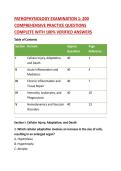
PATHOPHYSIOLOGY EXAMINATION 1: 200
COMPREHENSIVE PRACTICE QUESTIONS
COMPLETE WITH 100% VERIFIED ANSWERS
Table of Contents
Section Domain Approx. Page
Questions Reference
I Cellular Injury, Adaptation, 40 1
and Death
II Acute Inflammation and 40 4
Mediators
III Chronic Inflammation and 40 7
Tissue Repair
IV Immunity, Leukocytes, and 40 10
Phagocytosis
V Hemodynamics and Vascular 40 13
Disorders
Section I: Cellular Injury, Adaptation, and Death
1. Which cellular adaptation involves an increase in the size of cells,
resulting in an enlarged organ?
A. Hyperplasia
B. Hypertrophy
C. Atrophy
,D. Metaplasia
Correct Answer: B
Rationale: Hypertrophy is an increase in the size of cells, which
increases the size of the organ. Hyperplasia involves an increase in cell
number.
2. A patient has a decreased workload on their skeletal muscles due to
prolonged bed rest. Which cellular adaptation is most likely to occur?
A. Hypertrophy
B. Hyperplasia
C. Atrophy
D. Dysplasia
Correct Answer: C
Rationale: Atrophy is a decrease in the size of cells due to a reduced
workload, disuse, or loss of innervation.
3. Which type of cellular adaptation is characterized by a reversible
change in which one adult cell type is replaced by another adult cell
type?
A. Metaplasia
B. Dysplasia
C. Anaplasia
D. Neoplasia
Correct Answer: A
Rationale: Metaplasia is a reversible change in which one differentiated
cell type is replaced by another cell type, often in response to chronic
irritation.
4. What is the primary mechanism of cell injury caused by hypoxia?
A. Increased ATP production
,B. Decreased oxidative phosphorylation and ATP depletion
C. Activation of the complement system
D. Direct DNA damage
Correct Answer: B
Rationale: Hypoxia leads to decreased oxidative phosphorylation,
causing ATP depletion, which disrupts sodium-potassium pumps and
leads to cellular swelling.
5. Which form of cell death is characterized by cell swelling, rupture,
and an inflammatory response?
A. Apoptosis
B. Necrosis
C. Autophagy
D. Pyroptosis
Correct Answer: B
Rationale: Necrosis is an uncontrolled form of cell death characterized
by swelling, rupture of the cell membrane, and subsequent
inflammation.
6. Which of the following is a hallmark of irreversible cell injury?
A. Cellular swelling
B. Ribosomal detachment
C. Severe membrane damage and mitochondrial dysfunction
D. Fatty change
Correct Answer: C
Rationale: Severe membrane damage, mitochondrial dysfunction, and
profound ATP depletion are hallmarks of irreversible cell injury leading
to necrosis.
, 7. What is the primary purpose of apoptosis?
A. To incite an inflammatory response
B. To eliminate unwanted or damaged cells without inflammation
C. To cause tissue necrosis
D. To promote fibrosis
Correct Answer: B
Rationale: Apoptosis is a programmed cell death pathway designed to
eliminate cells safely without triggering an inflammatory response.
8. Which of the following is an example of physiological hyperplasia?
A. Endometrial hyperplasia
B. Prostatic hyperplasia
C. Breast hyperplasia during puberty
D. Hyperplasia in response to viral infection
Correct Answer: C
Rationale: Breast hyperplasia during puberty is a physiological response
to hormonal stimulation. The others are pathological.
9. Free radicals cause cellular injury primarily through:
A. Lipid peroxidation of cell membranes
B. Activation of apoptosis
C. Increased ATP synthesis
D. Inhibition of proteasomes
Correct Answer: A
Rationale: Free radicals cause injury by lipid peroxidation of
membranes, oxidative modification of proteins, and DNA damage.
10. A biopsy reveals disorganized, atypical cells with variation in size
and shape. This is most consistent with:
A. Metaplasia
COMPREHENSIVE PRACTICE QUESTIONS
COMPLETE WITH 100% VERIFIED ANSWERS
Table of Contents
Section Domain Approx. Page
Questions Reference
I Cellular Injury, Adaptation, 40 1
and Death
II Acute Inflammation and 40 4
Mediators
III Chronic Inflammation and 40 7
Tissue Repair
IV Immunity, Leukocytes, and 40 10
Phagocytosis
V Hemodynamics and Vascular 40 13
Disorders
Section I: Cellular Injury, Adaptation, and Death
1. Which cellular adaptation involves an increase in the size of cells,
resulting in an enlarged organ?
A. Hyperplasia
B. Hypertrophy
C. Atrophy
,D. Metaplasia
Correct Answer: B
Rationale: Hypertrophy is an increase in the size of cells, which
increases the size of the organ. Hyperplasia involves an increase in cell
number.
2. A patient has a decreased workload on their skeletal muscles due to
prolonged bed rest. Which cellular adaptation is most likely to occur?
A. Hypertrophy
B. Hyperplasia
C. Atrophy
D. Dysplasia
Correct Answer: C
Rationale: Atrophy is a decrease in the size of cells due to a reduced
workload, disuse, or loss of innervation.
3. Which type of cellular adaptation is characterized by a reversible
change in which one adult cell type is replaced by another adult cell
type?
A. Metaplasia
B. Dysplasia
C. Anaplasia
D. Neoplasia
Correct Answer: A
Rationale: Metaplasia is a reversible change in which one differentiated
cell type is replaced by another cell type, often in response to chronic
irritation.
4. What is the primary mechanism of cell injury caused by hypoxia?
A. Increased ATP production
,B. Decreased oxidative phosphorylation and ATP depletion
C. Activation of the complement system
D. Direct DNA damage
Correct Answer: B
Rationale: Hypoxia leads to decreased oxidative phosphorylation,
causing ATP depletion, which disrupts sodium-potassium pumps and
leads to cellular swelling.
5. Which form of cell death is characterized by cell swelling, rupture,
and an inflammatory response?
A. Apoptosis
B. Necrosis
C. Autophagy
D. Pyroptosis
Correct Answer: B
Rationale: Necrosis is an uncontrolled form of cell death characterized
by swelling, rupture of the cell membrane, and subsequent
inflammation.
6. Which of the following is a hallmark of irreversible cell injury?
A. Cellular swelling
B. Ribosomal detachment
C. Severe membrane damage and mitochondrial dysfunction
D. Fatty change
Correct Answer: C
Rationale: Severe membrane damage, mitochondrial dysfunction, and
profound ATP depletion are hallmarks of irreversible cell injury leading
to necrosis.
, 7. What is the primary purpose of apoptosis?
A. To incite an inflammatory response
B. To eliminate unwanted or damaged cells without inflammation
C. To cause tissue necrosis
D. To promote fibrosis
Correct Answer: B
Rationale: Apoptosis is a programmed cell death pathway designed to
eliminate cells safely without triggering an inflammatory response.
8. Which of the following is an example of physiological hyperplasia?
A. Endometrial hyperplasia
B. Prostatic hyperplasia
C. Breast hyperplasia during puberty
D. Hyperplasia in response to viral infection
Correct Answer: C
Rationale: Breast hyperplasia during puberty is a physiological response
to hormonal stimulation. The others are pathological.
9. Free radicals cause cellular injury primarily through:
A. Lipid peroxidation of cell membranes
B. Activation of apoptosis
C. Increased ATP synthesis
D. Inhibition of proteasomes
Correct Answer: A
Rationale: Free radicals cause injury by lipid peroxidation of
membranes, oxidative modification of proteins, and DNA damage.
10. A biopsy reveals disorganized, atypical cells with variation in size
and shape. This is most consistent with:
A. Metaplasia


