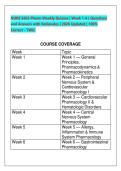
NURS 5663 Pharm Weekly Quizzes | Week 1-6 | Questions
and Answers with Rationales | 2026 Updated | 100%
Correct - TWU.
COURSE COVERAGE
Week Topic
Week 1 Week 1 — General
Principles,
Pharmacodynamics &
Pharmacokinetics
Week 2 Week 2 — Peripheral
Nervous System &
Cardiovascular
Pharmacology I
Week 3 Week 3 — Cardiovascular
Pharmacology II &
Hematologic Disorders
Week 4 Week 4 — Central
Nervous System
Pharmacology
Week 5 Week 5 — Allergy,
Inflammation & Immune
System Pharmacology
Week 6 Week 6 — Gastrointestinal
Pharmacology
,Week 1 — General Principles, Pharmacodynamics &
Pharmacokinetics
1. Which statement best describes pharmacokinetics?
A. What the body does to the drug
B. How a drug binds to a receptor
C. How a drug produces a therapeutic effect
D. What the drug does to the body
Correct Answer: A. What the body does to the drug
Rationale: Pharmacokinetics describes absorption, distribution, metabolism, and excretion—the
movement and handling of a drug by the body.
2. Which process is NOT one of the classic ADME components?
A. Distribution
B. Receptor activation
C. Metabolism
D. Absorption
Correct Answer: B. Receptor activation
Rationale: ADME stands for absorption, distribution, metabolism, and excretion. Receptor activation
is a pharmacodynamic process.
3. A drug with a large volume of distribution is most likely to be:
A. Rapidly excreted unchanged
B. Unable to cross cell membranes
C. Confined mainly to plasma
D. Widely distributed into tissues
Correct Answer: D. Widely distributed into tissues
Rationale: A large volume of distribution suggests substantial movement from the plasma into
tissues.
4. Which route most directly avoids first-pass hepatic metabolism?
A. Gastric tube
B. Sublingual
C. Oral
D. Enteric-coated oral
,Correct Answer: B. Sublingual
Rationale: Sublingual administration allows absorption through oral mucosa and largely bypasses
first-pass hepatic metabolism.
5. Which organ is the major site of drug metabolism for many medications?
A. Liver
B. Pancreas
C. Heart
D. Spleen
Correct Answer: A. Liver
Rationale: The liver contains many drug-metabolizing enzymes, especially the CYP450 system.
6. A CYP450 enzyme inducer generally causes a substrate drug to:
A. Become completely inactive at the receptor
B. Be metabolized more quickly
C. Accumulate more rapidly
D. Have slower renal filtration
Correct Answer: B. Be metabolized more quickly
Rationale: Enzyme induction increases metabolism of susceptible substrates and can lower their
plasma concentrations.
7. A CYP450 enzyme inhibitor can increase the concentration of a substrate drug because it:
A. Blocks absorption in every case
B. Slows its metabolism
C. Increases renal clearance
D. Always increases protein synthesis
Correct Answer: B. Slows its metabolism
Rationale: Enzyme inhibition decreases metabolism of susceptible substrates, potentially increasing
drug exposure.
8. Which patient factor is most likely to reduce renal drug clearance?
A. Increased visual acuity
B. Increased muscle mass
C. Reduced kidney function
D. Mild seasonal allergies
, Correct Answer: C. Reduced kidney function
Rationale: Renal impairment can reduce elimination of drugs that depend on the kidneys.
9. The therapeutic index is most useful for estimating a drug's:
A. Route of administration
B. Taste
C. Relative margin of safety
D. Color and formulation
Correct Answer: C. Relative margin of safety
Rationale: A larger therapeutic index generally indicates a wider margin between effective and toxic
concentrations.
10. A drug's half-life is the time required for its plasma concentration to:
A. Double
B. Reach its peak
C. Become completely undetectable
D. Fall by approximately 50%
Correct Answer: D. Fall by approximately 50%
Rationale: Half-life is the time required for the plasma concentration of a drug to decrease by about
50%.
11. A loading dose is primarily used to:
A. Prevent all adverse effects
B. Replace a maintenance dose permanently
C. Maintain a sterile IV line
D. Rapidly achieve a target concentration
Correct Answer: D. Rapidly achieve a target concentration
Rationale: A loading dose can quickly achieve a desired therapeutic concentration, especially for
drugs with long half-lives.
12. A maintenance dose is primarily intended to:
A. Replace metabolism
B. Eliminate first-pass metabolism
C. Keep drug exposure within the therapeutic range
D. Achieve the first measurable level
and Answers with Rationales | 2026 Updated | 100%
Correct - TWU.
COURSE COVERAGE
Week Topic
Week 1 Week 1 — General
Principles,
Pharmacodynamics &
Pharmacokinetics
Week 2 Week 2 — Peripheral
Nervous System &
Cardiovascular
Pharmacology I
Week 3 Week 3 — Cardiovascular
Pharmacology II &
Hematologic Disorders
Week 4 Week 4 — Central
Nervous System
Pharmacology
Week 5 Week 5 — Allergy,
Inflammation & Immune
System Pharmacology
Week 6 Week 6 — Gastrointestinal
Pharmacology
,Week 1 — General Principles, Pharmacodynamics &
Pharmacokinetics
1. Which statement best describes pharmacokinetics?
A. What the body does to the drug
B. How a drug binds to a receptor
C. How a drug produces a therapeutic effect
D. What the drug does to the body
Correct Answer: A. What the body does to the drug
Rationale: Pharmacokinetics describes absorption, distribution, metabolism, and excretion—the
movement and handling of a drug by the body.
2. Which process is NOT one of the classic ADME components?
A. Distribution
B. Receptor activation
C. Metabolism
D. Absorption
Correct Answer: B. Receptor activation
Rationale: ADME stands for absorption, distribution, metabolism, and excretion. Receptor activation
is a pharmacodynamic process.
3. A drug with a large volume of distribution is most likely to be:
A. Rapidly excreted unchanged
B. Unable to cross cell membranes
C. Confined mainly to plasma
D. Widely distributed into tissues
Correct Answer: D. Widely distributed into tissues
Rationale: A large volume of distribution suggests substantial movement from the plasma into
tissues.
4. Which route most directly avoids first-pass hepatic metabolism?
A. Gastric tube
B. Sublingual
C. Oral
D. Enteric-coated oral
,Correct Answer: B. Sublingual
Rationale: Sublingual administration allows absorption through oral mucosa and largely bypasses
first-pass hepatic metabolism.
5. Which organ is the major site of drug metabolism for many medications?
A. Liver
B. Pancreas
C. Heart
D. Spleen
Correct Answer: A. Liver
Rationale: The liver contains many drug-metabolizing enzymes, especially the CYP450 system.
6. A CYP450 enzyme inducer generally causes a substrate drug to:
A. Become completely inactive at the receptor
B. Be metabolized more quickly
C. Accumulate more rapidly
D. Have slower renal filtration
Correct Answer: B. Be metabolized more quickly
Rationale: Enzyme induction increases metabolism of susceptible substrates and can lower their
plasma concentrations.
7. A CYP450 enzyme inhibitor can increase the concentration of a substrate drug because it:
A. Blocks absorption in every case
B. Slows its metabolism
C. Increases renal clearance
D. Always increases protein synthesis
Correct Answer: B. Slows its metabolism
Rationale: Enzyme inhibition decreases metabolism of susceptible substrates, potentially increasing
drug exposure.
8. Which patient factor is most likely to reduce renal drug clearance?
A. Increased visual acuity
B. Increased muscle mass
C. Reduced kidney function
D. Mild seasonal allergies
, Correct Answer: C. Reduced kidney function
Rationale: Renal impairment can reduce elimination of drugs that depend on the kidneys.
9. The therapeutic index is most useful for estimating a drug's:
A. Route of administration
B. Taste
C. Relative margin of safety
D. Color and formulation
Correct Answer: C. Relative margin of safety
Rationale: A larger therapeutic index generally indicates a wider margin between effective and toxic
concentrations.
10. A drug's half-life is the time required for its plasma concentration to:
A. Double
B. Reach its peak
C. Become completely undetectable
D. Fall by approximately 50%
Correct Answer: D. Fall by approximately 50%
Rationale: Half-life is the time required for the plasma concentration of a drug to decrease by about
50%.
11. A loading dose is primarily used to:
A. Prevent all adverse effects
B. Replace a maintenance dose permanently
C. Maintain a sterile IV line
D. Rapidly achieve a target concentration
Correct Answer: D. Rapidly achieve a target concentration
Rationale: A loading dose can quickly achieve a desired therapeutic concentration, especially for
drugs with long half-lives.
12. A maintenance dose is primarily intended to:
A. Replace metabolism
B. Eliminate first-pass metabolism
C. Keep drug exposure within the therapeutic range
D. Achieve the first measurable level