

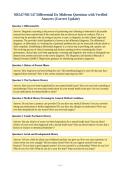
NR547/NR 547 Differential Dx Midterm Questions with Verified
Answers (Correct Update)
Question 1: Differential Dx
Answer: Diagnostic reasoning is the process of questioning one's thinking to determine if all possible
avenues have been explored and if the conclusions that are drawn are based on evidence. This is a
critical step for providers who are trying to uncover a cause, or diagnosis, for their clients' signs and
symptoms. The provider's initial hypothesis is known as the differential diagnosis. The differential
diagnosis, or differential, is a working list of potential problems that can be associated with the initial or
chief complaint. Establishing a differential diagnosis is a critical step in providing safe, quality care.
This evolving process of clinical reasoning and decision making involves examining the client's
presentation, clinical data, and when appropriate, screening and diagnostic test results to distinguish one
disease from another and arrive at the correct diagnosis. The Diagnostic and Statistical Manual of
Mental Disorders (DSM-5-TR)provides guidance for identifying psychiatric diagnosest
Question 2: History of Present Illness
Answer: How long have you been feeling this way? Did something happen in your life that may have
triggered these emotions? How is this current situation impacting your life?
Question 3: The Psychiatric History
Answer: Have you ever been hospitalized for any mental health issues? Have you ever had counseling or
psychotherapy? Have you ever taken medications for your mental health in the past? Are you currently
on any medications for mental health or sleep?
Question 4: Medical History/Screening for General Medical Conditions
Answer: Do you have a primary care provider? Do you have any medical illnesses? Are you currently
taking any medications or herbal supplements? Do you have any allergies to medications? Have you
ever been hospitalized for any reason? Have you ever had surgery?
Question 5: Family Psychiatric History
Answer: Has any relative of yours ever been hospitalized for a mental health issue? Has any blood
relative of yours ever been diagnosed with a mental health issue? Has any blood relative of yours had a
history of seizures or dementia/Alzheimer's?
Question 6: Social and Developmental History
Answer: Tell me a little bit about your childhood and how you grew up. How was your experience in
school when you were younger? Did you enjoy school? How do you support yourself with your
finances? Do you have a good support system? Are you currently in a relationship? Where do you live?
Who do you live with? What do you do in your free time? What activities do you enjoy?
Page 1
,Question 7: Which of the following should be included when providing client education about
medication regimens? Select all that apply.
Answer: A)Explain how the medication targets the symptoms, specific benefits, and expected time
course. (Correct answer)
B)Identify potential side effects, duration of side effects, and adverse effects. (Correct answer)
C)Explain the instructions, dosing, and special requirements. (Correct answer)
D)Use teach-back methods to ensure client understanding. (Correct answer)
Question 8: Apply the Ask Suicide-Screening Questions (ASQ) Suicide Risk Screening Tool
(Links to an external site.) to the scenario below. A 52-year-old client presents to the emergency
department following a car accident. The emergency department (ED) physician is concerned
that the client may have intentionally crashed her car and requests a stat PMHNP consult. In
speaking with the PMHNP, the client describes persistent feelings of sadness and hopelessness.
She states that she often wonders if her husband would be happier if she wasn't around anymore
since she's never happy and sometimes thinks about what it would be like to just take a handful
of sleeping pills and go to sleep forever. The client reports a previous suicide attempt when she
was 16 but denies that she is considering killing herself right now. Based on the client's ASQ
score, what is the most appropriate response?
A) No action is necessary as the client is not
Answer: B)Provide a brief suicide safety assessment. Rationale: While the client's responses do not
indicate a need for a stat full safety and mental health evaluation, the client requires a brief suicide safety
assessment to determine whether a full mental health evaluation in necessary. It is also important to
notify the client's physician or the clinician responsible for the client's care.
Question 9: Complete Blood Count
Answer: The CBC is a serum diagnostic test that measures red blood cells, white blood cells,
hemoglobin, hematocrit, and platelets. The CBC includes a differential of the white blood cells. A CBC
is often included as part of routine health screening or to obtain information related to specific
conditions. In mental health, the CBC is used to rule out medical conditions that may present with
symptoms that can be attributed to both medical and psychiatric diagnoses. For example, the CBC can
help rule out anemia as a cause for depressive symptoms and fatigue or rule out infection as a cause of
acute mental status changes. The CBC is also used to monitor certain treatment regimens. For example,
some medications, such as clozapine, require routine analysis of absolute neutrophil count and platelet
levels.
Question 10: Normal Range of: Red blood cells Hemoglobin Hematocrit Reticulocytes
Answer: Red blood cells: 4.5-6.0 million/microliter Hemoglobin: 12-18 grams/100 mL Hematocrit:
38%-48% Reticulocytes: 0%-1.5%
Page 2
, Question 11: Normal Range of? White blood cells (total): Neutrophils: Eosinophils: Basophils:
Lymphocytes: Monocytes: Platelets:
Answer: White blood cells (total): 5000-10,000/microliter Neutrophils: 55%-70% Eosinophils: 1%-3%
Basophils: 0.5%-1% Lymphocytes: 20%-35% Monocytes: 3%-8% Platelets: 150,000-300,000/microliter
Question 12: Comprehensive Metabolic Panel (CMP)
Answer: The CMP is another common blood test used to determine general health status. The CMP
includes several tests that provide information about fluid and electrolyte balance as well as the status of
the body's metabolism, liver function, and kidney function. In psychiatric care, the CMP may be used to
rule out medical conditions that could cause symptoms such as changes in mood or cognition. The CMP
is also used to monitor the effects of medications, such as antipsychotics, on liver function and glucose
levels.
Question 13: Normal CMP Levels Electrolytes Sodium (Na+): Postassium (K+): Chloride (Cl-):
Bicarbonate (HCO3-):
Answer: Normal CMP Levels Electrolytes Sodium (Na+): 136-145 mEq/L Postassium (K+): 3.5-5.0
mEq/L Chloride (Cl-): 95-105 mEq/L Bicarbonate (HCO3-): 22-28 mEq/L
Question 14: Normal CMP levels Misc. Calcium, serum (Ca 2+) Glucose, serum Fasting: 2-h
postprandial: Cholesterol, serum: Total Protein Albumin
Answer: Calcium, serum (Ca 2+) 8.4-10.2 mg/dl Glucose, serum Fasting: 70-110 mg/dl; 2-h
postprandial: <120mg/dl Cholesterol, serum: REC<200 mg/dl Total Protein 6.0-7.8 g/dl Albumin
3.5-5.5 g/dl
Question 15: Kidney Tests Creatinine, serum Urea nitrogen, serum (BUN)
Answer: Creatinine, serum 0.6-1.2mg/dl Urea nitrogen, serum (BUN) 7-18mg/dl
Question 16: Liver Tests Alanine aminotransferase (ALT), serum: Aspartate aminotransferase
(AST), Bilirubin, serum (adult) Total//Direct: Phosphatase (alkaline), serum:
Answer: Liver Tests Alanine aminotransferase (ALT), serum: 8-20 U/L Aspartate aminotransferase
(AST), serum: 8-20 U/L Bilirubin, serum (adult) Total//Direct: 0.1-1.0 mg/dl // 0.0-0.3 mg/dl
Phosphatase (alkaline), serum: 20-70 U/L
Question 17: Normal TFT levels TSH: T3: T4:
Answer: Normal TFT levels TSH: 0.4-4.5 mIU/L T3: 100-200 ng/dL T4: 5-11 ug/dL
Page 3
Answers (Correct Update)
Question 1: Differential Dx
Answer: Diagnostic reasoning is the process of questioning one's thinking to determine if all possible
avenues have been explored and if the conclusions that are drawn are based on evidence. This is a
critical step for providers who are trying to uncover a cause, or diagnosis, for their clients' signs and
symptoms. The provider's initial hypothesis is known as the differential diagnosis. The differential
diagnosis, or differential, is a working list of potential problems that can be associated with the initial or
chief complaint. Establishing a differential diagnosis is a critical step in providing safe, quality care.
This evolving process of clinical reasoning and decision making involves examining the client's
presentation, clinical data, and when appropriate, screening and diagnostic test results to distinguish one
disease from another and arrive at the correct diagnosis. The Diagnostic and Statistical Manual of
Mental Disorders (DSM-5-TR)provides guidance for identifying psychiatric diagnosest
Question 2: History of Present Illness
Answer: How long have you been feeling this way? Did something happen in your life that may have
triggered these emotions? How is this current situation impacting your life?
Question 3: The Psychiatric History
Answer: Have you ever been hospitalized for any mental health issues? Have you ever had counseling or
psychotherapy? Have you ever taken medications for your mental health in the past? Are you currently
on any medications for mental health or sleep?
Question 4: Medical History/Screening for General Medical Conditions
Answer: Do you have a primary care provider? Do you have any medical illnesses? Are you currently
taking any medications or herbal supplements? Do you have any allergies to medications? Have you
ever been hospitalized for any reason? Have you ever had surgery?
Question 5: Family Psychiatric History
Answer: Has any relative of yours ever been hospitalized for a mental health issue? Has any blood
relative of yours ever been diagnosed with a mental health issue? Has any blood relative of yours had a
history of seizures or dementia/Alzheimer's?
Question 6: Social and Developmental History
Answer: Tell me a little bit about your childhood and how you grew up. How was your experience in
school when you were younger? Did you enjoy school? How do you support yourself with your
finances? Do you have a good support system? Are you currently in a relationship? Where do you live?
Who do you live with? What do you do in your free time? What activities do you enjoy?
Page 1
,Question 7: Which of the following should be included when providing client education about
medication regimens? Select all that apply.
Answer: A)Explain how the medication targets the symptoms, specific benefits, and expected time
course. (Correct answer)
B)Identify potential side effects, duration of side effects, and adverse effects. (Correct answer)
C)Explain the instructions, dosing, and special requirements. (Correct answer)
D)Use teach-back methods to ensure client understanding. (Correct answer)
Question 8: Apply the Ask Suicide-Screening Questions (ASQ) Suicide Risk Screening Tool
(Links to an external site.) to the scenario below. A 52-year-old client presents to the emergency
department following a car accident. The emergency department (ED) physician is concerned
that the client may have intentionally crashed her car and requests a stat PMHNP consult. In
speaking with the PMHNP, the client describes persistent feelings of sadness and hopelessness.
She states that she often wonders if her husband would be happier if she wasn't around anymore
since she's never happy and sometimes thinks about what it would be like to just take a handful
of sleeping pills and go to sleep forever. The client reports a previous suicide attempt when she
was 16 but denies that she is considering killing herself right now. Based on the client's ASQ
score, what is the most appropriate response?
A) No action is necessary as the client is not
Answer: B)Provide a brief suicide safety assessment. Rationale: While the client's responses do not
indicate a need for a stat full safety and mental health evaluation, the client requires a brief suicide safety
assessment to determine whether a full mental health evaluation in necessary. It is also important to
notify the client's physician or the clinician responsible for the client's care.
Question 9: Complete Blood Count
Answer: The CBC is a serum diagnostic test that measures red blood cells, white blood cells,
hemoglobin, hematocrit, and platelets. The CBC includes a differential of the white blood cells. A CBC
is often included as part of routine health screening or to obtain information related to specific
conditions. In mental health, the CBC is used to rule out medical conditions that may present with
symptoms that can be attributed to both medical and psychiatric diagnoses. For example, the CBC can
help rule out anemia as a cause for depressive symptoms and fatigue or rule out infection as a cause of
acute mental status changes. The CBC is also used to monitor certain treatment regimens. For example,
some medications, such as clozapine, require routine analysis of absolute neutrophil count and platelet
levels.
Question 10: Normal Range of: Red blood cells Hemoglobin Hematocrit Reticulocytes
Answer: Red blood cells: 4.5-6.0 million/microliter Hemoglobin: 12-18 grams/100 mL Hematocrit:
38%-48% Reticulocytes: 0%-1.5%
Page 2
, Question 11: Normal Range of? White blood cells (total): Neutrophils: Eosinophils: Basophils:
Lymphocytes: Monocytes: Platelets:
Answer: White blood cells (total): 5000-10,000/microliter Neutrophils: 55%-70% Eosinophils: 1%-3%
Basophils: 0.5%-1% Lymphocytes: 20%-35% Monocytes: 3%-8% Platelets: 150,000-300,000/microliter
Question 12: Comprehensive Metabolic Panel (CMP)
Answer: The CMP is another common blood test used to determine general health status. The CMP
includes several tests that provide information about fluid and electrolyte balance as well as the status of
the body's metabolism, liver function, and kidney function. In psychiatric care, the CMP may be used to
rule out medical conditions that could cause symptoms such as changes in mood or cognition. The CMP
is also used to monitor the effects of medications, such as antipsychotics, on liver function and glucose
levels.
Question 13: Normal CMP Levels Electrolytes Sodium (Na+): Postassium (K+): Chloride (Cl-):
Bicarbonate (HCO3-):
Answer: Normal CMP Levels Electrolytes Sodium (Na+): 136-145 mEq/L Postassium (K+): 3.5-5.0
mEq/L Chloride (Cl-): 95-105 mEq/L Bicarbonate (HCO3-): 22-28 mEq/L
Question 14: Normal CMP levels Misc. Calcium, serum (Ca 2+) Glucose, serum Fasting: 2-h
postprandial: Cholesterol, serum: Total Protein Albumin
Answer: Calcium, serum (Ca 2+) 8.4-10.2 mg/dl Glucose, serum Fasting: 70-110 mg/dl; 2-h
postprandial: <120mg/dl Cholesterol, serum: REC<200 mg/dl Total Protein 6.0-7.8 g/dl Albumin
3.5-5.5 g/dl
Question 15: Kidney Tests Creatinine, serum Urea nitrogen, serum (BUN)
Answer: Creatinine, serum 0.6-1.2mg/dl Urea nitrogen, serum (BUN) 7-18mg/dl
Question 16: Liver Tests Alanine aminotransferase (ALT), serum: Aspartate aminotransferase
(AST), Bilirubin, serum (adult) Total//Direct: Phosphatase (alkaline), serum:
Answer: Liver Tests Alanine aminotransferase (ALT), serum: 8-20 U/L Aspartate aminotransferase
(AST), serum: 8-20 U/L Bilirubin, serum (adult) Total//Direct: 0.1-1.0 mg/dl // 0.0-0.3 mg/dl
Phosphatase (alkaline), serum: 20-70 U/L
Question 17: Normal TFT levels TSH: T3: T4:
Answer: Normal TFT levels TSH: 0.4-4.5 mIU/L T3: 100-200 ng/dL T4: 5-11 ug/dL
Page 3


