
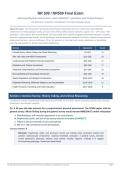
NR 509 / NR509 Final Exam
Advanced Physical Assessment | Latest 2026/2027 | Questions with Verified Answers
135 Questions | 9 Sections | Chamberlain University Graduate Nursing
About this exam: This 135-question NR 509 Advanced Physical Assessment final exam reflects the Latest 2026/2027
Chamberlain University graduate nursing curriculum with verified, evidence-based rationales. Cognitive mix: ~30% recall, ~50%
application, ~20% analysis. 80% scenario-based, 20% direct recall. Each rationale integrates assessment techniques, anatomic
landmarks, pathophysiologic findings, clinical significance, and documentation standards. Commonly confused concept pairs are
emphasized: arterial vs. venous insufficiency, S3 vs. S4, vesicular vs. bronchial breath sounds, decorticate vs. decerebrate
posturing, and pediatric vs. geriatric assessment modifications.
Section Questions Count
General Survey, History Taking, and Clinical Reasoning Q1–Q14 14
Skin, Hair, Nails, and HEENT Assessment Q15–Q32 18
Cardiovascular and Peripheral Vascular Assessment Q33–Q49 17
Respiratory and Thoracic Assessment Q50–Q66 17
Abdominal, Gastrointestinal, and Genitourinary Assessment Q67–Q81 15
Musculoskeletal and Neurological Assessment Q82–Q99 18
Special Populations and Lifespan Considerations Q100–Q115 16
Diagnostic Reasoning, Differential Diagnosis, and Documentation Q116–Q126 11
Health Promotion, Counseling, and Patient Education Q127–Q135 9
Section 1: General Survey, History Taking, and Clinical Reasoning
Competencies covered: Comprehensive health history (CC, HPI, PMH, FH, SH, ROS), cultural competence, general survey, vital signs
interpretation, documentation standards
Q1: A 62-year-old male presents for a comprehensive physical assessment. The APRN begins with the
general survey. Which finding during the general survey would warrant IMMEDIATE further evaluation?
A. Well-developed, well-nourished appearance in no acute distress
B. Diaphoresis, pallor, and use of accessory muscles to breathe [CORRECT]
C. Patient is alert and oriented x3 and conversational
D. BMI of 27 with symmetrical muscle development
Correct Answer: B
Rationale: Diaphoresis, pallor, and accessory muscle use indicate acute respiratory distress and
possible cardiovascular compromise, requiring immediate evaluation. A general survey assesses
overall appearance (alertness, distress, body habitus, mobility, hygiene). Findings in B suggest
life-threatening pathology. Verified per Bates/Seidel.
NR 509 Advanced Physical Assessment Final Exam 2026/2027 | Chamberlain University Page 1
, Q2: When obtaining a comprehensive health history, which sequence is MOST appropriate for the
History of Present Illness (HPI)?
A. Family history, social history, then chief complaint
B. OPQRST (Onset, Palliating/Provoking, Quality, Radiation, Severity, Timing) or OLDCARTS
[CORRECT]
C. Medications, allergies, then chief complaint
D. Review of systems first
Correct Answer: B
Rationale: HPI follows a structured mnemonic like OLDCARTS (Onset, Location, Duration,
Characteristics, Aggravating/Relieving, Radiation, Timing, Severity) or OPQRST to comprehensively
characterize the chief complaint. Verified per Bates' Guide.
Q3: A patient states: “My stomach has been hurting off and on for 3 weeks.” Which documentation is
the MOST appropriate to record as the chief complaint?
A. “Abdominal pain x3 weeks per patient report”
B. Use the patient’s own words in quotation marks: “Stomach has been hurting off and on for 3 weeks”
[CORRECT]
C. “Abdominal pain, possibly gastric ulcer”
D. “Patient reports gastrointestinal distress”
Correct Answer: B
Rationale: The chief complaint should be recorded verbatim in the patient's own words (in quotation
marks) to preserve accuracy and avoid interpretation bias. Diagnosing in the CC (C) is inappropriate at
this stage. Verified per SOAP/documentation standards.
Q4: Which statement BEST reflects culturally competent assessment?
A. Treat all patients the same regardless of background
B. Use an interpreter when needed, ask about health beliefs and practices, and integrate cultural
context into the assessment and plan [CORRECT]
C. Assume all patients from one culture have the same beliefs
D. Avoid discussing culture to prevent offense
Correct Answer: B
Rationale: Culturally competent assessment uses interpreter services, explores the patient's
explanatory model (Kleinman), beliefs/practices, and integrates these into shared decision-making.
Cultural humility is a lifelong learning process. Verified per Chamberlain NR 509 cultural competence
content.
NR 509 Advanced Physical Assessment Final Exam 2026/2027 | Chamberlain University Page 2
, Q5: When measuring blood pressure, the bladder of the cuff should encircle approximately what
percentage of the upper arm circumference?
A. 20%
B. 80% (bladder length covering 80-100% of circumference; width ~40% of arm) [CORRECT]
C. 50%
D. 100% exactly only
Correct Answer: B
Rationale: AHTP/AHA guidance: cuff bladder length should cover 80-100% of arm circumference and
width ~40% of arm. Too small = falsely elevated BP. Verified per AHA BP measurement guidelines.
Q6: A 55-year-old male has a BP of 148/96 mmHg in the left arm and 132/84 mmHg in the right arm.
Which interpretation is MOST appropriate?
A. Normal variation; document only the lower reading
B. Subclavian artery stenosis or coarctation until proven otherwise; repeat and consider vascular
studies; inter-arm difference >10 mmHg is significant [CORRECT]
C. Record only the left arm reading
D. Patient has hypertension based on the average
Correct Answer: B
Rationale: Inter-arm BP difference >10 mmHg (systolic) is abnormal and warrants evaluation for
subclavian stenosis, aortic dissection, or coarctation. Repeat and document the higher reading and
refer. Verified per AHA/ACC.
Q7: Which vital sign finding meets criteria for fever in an adult?
A. 98.6°F (37°C) oral
B. 100.4°F (38°C) oral or higher [CORRECT]
C. 97.5°F oral
D. 99.0°F oral
Correct Answer: B
Rationale: Adult fever = oral temperature ≥ 100.4°F (38°C). Rectal temperatures are typically 0.5-1°F
higher than oral. A temporal artery reading correlates closely with core. Verified per AHA/CDC fever
definition.
Q8: When documenting a patient’s pain using the OLDCARTS framework, which element addresses
the patient’s description of the pain quality?
A. Onset
B. Character (e.g., sharp, dull, burning, throbbing) [CORRECT]
C. Timing
D. Severity
Correct Answer: B
Rationale: C = Character (quality of pain, e.g., sharp, dull, burning, throbbing, stabbing). O = Onset; L
= Location; D = Duration; A = Aggravating/Alleviating; R = Radiation; T = Timing; S = Severity. Verified
per NR 509.
NR 509 Advanced Physical Assessment Final Exam 2026/2027 | Chamberlain University Page 3
, Q9: A 70-year-old female presents with confusion and a caregiver reports decreased oral intake. Which
vital sign/clinical finding would be the MOST concerning for serious infection in an older adult?
A. Temperature 99.1°F
B. Confusion, subnormal temperature (e.g., 96.8°F) with tachycardia, or hypotension [CORRECT]
C. Mild fatigue only
D. Weight loss of 1 lb in 1 week
Correct Answer: B
Rationale: Older adults may not mount a fever with infection; subnormal temperature with altered
mental status, tachycardia, or hypotension are red flags for sepsis. Verified per ACEP/SCCM sepsis
criteria.
Q10: Which statement BEST reflects the difference between a sign and a symptom?
A. They are identical terms
B. A symptom is subjective (patient-reported); a sign is objective (observed/measured) [CORRECT]
C. Signs are subjective; symptoms are objective
D. Signs are always more important than symptoms
Correct Answer: B
Rationale: Symptom = subjective patient report (pain, nausea). Sign = objective finding
observed/measured by examiner (BP, temperature, rash). Verified per NR 509 fundamentals.
Q11: A PMH of a patient includes hypertension, type 2 diabetes, and GERD. The patient takes lisinopril,
metformin, and omeprazole. Which statement is part of the Past Medical History (PMH)?
A. Father died of MI at 65
B. Hypertension, type 2 diabetes, GERD; include childhood illnesses, hospitalizations, surgeries, and
immunizations [CORRECT]
C. Smokes 1 ppd
D. Works as a teacher
Correct Answer: B
Rationale: PMH includes adult illnesses, childhood illnesses, hospitalizations, surgeries, injuries,
immunizations, and OB history (when applicable). FH (A) is family history; SH (C/D) is social history.
Verified per Bates.
Q12: Which element is a component of the Social History?
A. Surgical history
B. Alcohol, tobacco, illicit drug use; employment; home situation; education; sexual history; exercise;
nutrition [CORRECT]
C. Childhood immunizations
D. Family medical history
Correct Answer: B
Rationale: Social history includes substance use (alcohol, tobacco, illicit drugs), employment,
education, home environment, sexual history, exercise, nutrition, and safety. Verified per
Bates/Chamberlain.
NR 509 Advanced Physical Assessment Final Exam 2026/2027 | Chamberlain University Page 4


